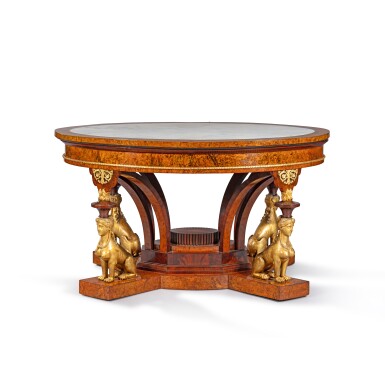
A North Italian gilt-bronze mounted parcel-gilt, mahogany, burr-elm, stained birch and ebonized veneered center table, circa 1820
Lot Closed
September 23, 02:21 PM GMT
Estimate
20,000 - 30,000 EUR
We may charge or debit your saved payment method subject to the terms set out in our Conditions of Business for Buyers.
Read more.Lot Details
Description
with an oval top inset with a Carrara marble plate, resting on eight shaped tapering legs and sphinx-mounts headed by flaming finials on a plain plinth, with castors
Haut. 81,5 cm, larg. 146 cm, prof. 101,5 cm; Height 32 in, width 54 1/2 in, depth 40 in
Property from an Iberian Privation Collection, Christie’s, Amsterdam, 13 December 2002, lot 339
Made around the turn of the 1810s–1820s, this table reflects the stylistic transition that took place in Tuscany between the French Empire style and a more local, refined and refined aesthetic. Under the direct influence of Grand Duke Ferdinand III's return in 1814 after his exile in Würzburg, the rigid Empire style was gradually replaced by a softer Tuscan version, characterized by the use of colored veneers, sober but carefully crafted bronzes, and carved gilded wood ornaments.
Cabinetmakers such as Jean-Baptiste Youf and Giuseppe Colza, who were active under both the Habsburgs and during the Napoleonic period, contributed to this evolution, combining mahogany, stained burls, and highly refined decorative elements (see: E. Colle, Italian Empire Furniture, New York, 2001, pp. 128-131 and 146-150). This table is a perfect illustration of this, with its green-stained elm veneer, high-quality bronze fittings and finely carved and gilded sphinx-shaped supports, reflecting an elegant dialogue between French influence, Austrian inspiration and Tuscan craftsmanship.
This rare model, with its original design, possibly inspired by early 19th-century Viennese furniture, reflects a pivotal period between Empire style and regional identities.
You May Also Like