
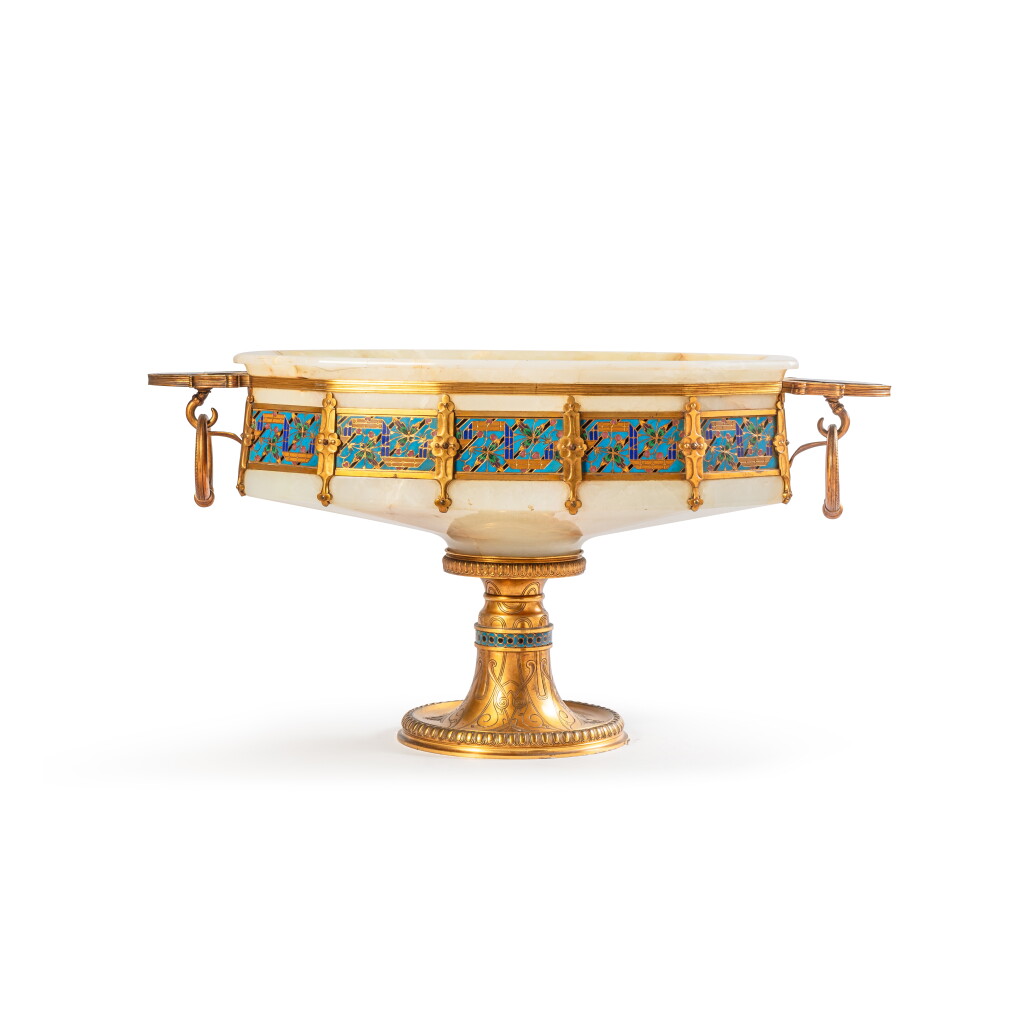
A Napoléon III gilt-bronze and enamel mounted onyx centerpiece, circa 1860, signed by Ferdinand Barbedienne, after a design by Louis-Constant Sévin
Lot Closed
September 23, 02:37 PM GMT
Estimate
15,000 - 25,000 EUR
We may charge or debit your saved payment method subject to the terms set out in our Conditions of Business for Buyers.
Read more.Lot Details
Description
in the orientalist taste, the dodecagonal onyx basin decorated with rectangular cloisonné enamel panels, flanked by two handles fitted with movable rings, resting on a footring incised with geometric patterns and ovolos, above a circular base adorned with gadroons, the frieze signed F. BARBEDIENNE
Haut. 37 cm, larg. 71 cm; Height 14 1/2 in, width 28 in
Présented at the London International Exhibtion in 1862 in the Barbedienne stand;
The Opulent Eye, Christie’s, London, 11 March 2015, lot 176.
Le Monde Illustré, Paris, N° 278. – 9 August 1862, pp. 92-94
Presented at the 1862 International Exhibition in London, this piece can be used both as a jardinière and as a centrepiece. This model is one of the works that earned Maison Barbedienne three medals (furniture, bronze, goldsmithing). The piece was described as follows during the exhibition:
« Dodécagone, style oriental, en marbre onyx d'Algérie, que décore une ceinture en bronze doré avec émaux cloisonnés par un procédé spécial : elle peut servir à volonté de jardinière ou de pièce de milieu. ». The design is attributed to Louis-Constant Sévin, master designer of the company, renowned for his rare talent: « Un homme rare, pouvant, comme les Florentins, de ses mains propres exécuter tout ce qu'il conçoit, merveilleux d'art, de sentiment, de délicatesse et d'esprit. »
At the height of its fame, Maison Barbedienne employed nearly four hundred craftsmen and twenty artists in its Parisian workshops. A veritable centre of artistic production, it brought together sculpture, cabinetmaking, marblework, mechanical model reduction, and above all a bronze, silver and gold foundry.
This piece is typical of the eclectic luxury of the Second Empire, combining oriental influences, rare materials and technical excellence. Algerian onyx, rediscovered at that time, evokes the taste for exoticism then in vogue, as do the Moorish forms of the basin and the orientalist enamel decoration.
A similar model appears in the engraving of Barbedienne's stands in London. No. 4, a Byzantine vase in blue enamel, was acquired by the South Kensington Museum (now the Victoria & Albert Museum). Two other examples are kept at the musée d'Orsay, and another was sold at Christie's Paris in 2014 ($121,500).
You May Also Like


