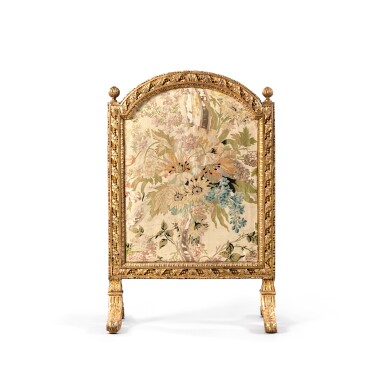
A Louis XVI giltwood screen, circa 1780, the sculpture attributed Jean-Baptiste-Simon Rode
Lot Closed
September 23, 12:01 PM GMT
Estimate
5,000 - 7,000 EUR
We may charge or debit your saved payment method subject to the terms set out in our Conditions of Business for Buyers.
Read more.Lot Details
Description
decorated with oak leaves, pearls and acanthus leaves, the mounts with a pulley mecanism, on two scrolling feet, topped with fluted balls, with an 18th century beige brocade lampas, possibly made in Lyon, depicting a large bouquet of flowers with lilies, sunflowers and wisteria
Haut. panel 68 cm, larg. 51 cm ; Height 26 3/4 in, width 20 in
Haut. total 100 cm ; Total Height 39 3/8 in
Rothschild family at Château de Ferrières
This screen is finely carved with oak leaf, pearl and acanthus leaf motifs characteristic of the neoclassical style , very fashionable during the reign of Louis XVI. The great quality of the carving is reminiscent of the work of Jean-Baptiste-Simon Rode (1735-1799), a famous woodcarver who worked for the greatest woodmakers, including the most important, Georges Jacob (1739-1814). Rode is regularly mentioned in the inventories of the Garde-Meuble de la Couronne, for which he often collaborated with Jacob. In particular, he contributed to the creation of Queen Marie-Antoinette's bedroom at the Petit Trianon in 1787.
Our screen, unfortunately without a stamp but with its original gilding, is nevertheless similar to Jacob's work in terms of its structure and beautifully executed carving. The mechanism installed in the uprights is very sophisticated for a piece of furniture in common use at that time. A gallery is carved into the upright so that weights attached to the movable panel by two strings can be raised and lowered using pulleys. The pulleys are no longer present on our fireplace screen, but the mounting is still visible.
The brocade lampas was probably made in the silk workshops of Lyon, which were the most famous in France in the 18th century. When decorating a room, fabrics were the most expensive item due to the value of the materials used (silk, gold and silver thread) and the time required to produce colorful and complex pieces. This fabric is obviously associated with our screen, probably by one of the members of the Rothschild family, who very often used precious antique fabrics with furniture made by the greatest cabinetmakers and carpenters in order to restore them to their former glory, displayed in the family's various residences, including the Château de Ferrières.
You May Also Like