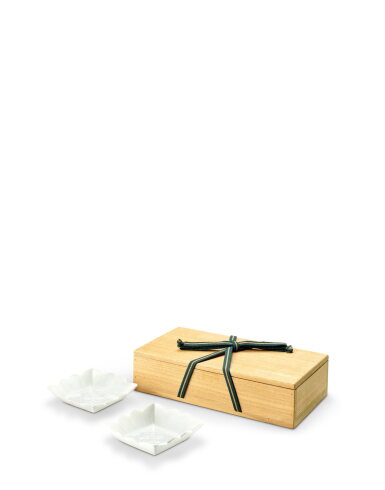
An exceptional and very rare pair of 'guan'-inscribed Dingyao square dishes, Five dynasties - early Northern Song dynasty | 五代至北宋初 定窰瀝粉堆花「官」字款方盤一對
Auction Closed
May 7, 10:26 AM GMT
Estimate
2,500,000 - 8,000,000 HKD
Lot Details
Description
Japanese wood box
9.6 cm
The Shibata family collection (Mr Shibata Akihiko (1940-2004) and Mrs Yuko Shibata (1944-)).
Tokyo Bijutsu Club, Tokyo, 1980s.
Chang Wei-Hwa & Co., Taipei, 12th November 1992.
Christie's Hong Kong, 30th May 2018, lot 2925.
Collectors, Curators, Connoisseurs: A Century of the Oriental Ceramic Society 1921-2021, London, 2021, cat. no. 52.
Ding Guan Ware, for Secular and Underground Palaces
Regina Krahl
Court interest in fine ceramics developed only in the second half of the Tang dynasty (618 – 907), when white and green stonewares began to be cherished among tea connoisseurs and were discovered as treasures worthy of the underground palaces devoted to the Buddha. On some exceptional wares from a few outstanding kilns this royal attention found lasting tangible expression in inscriptions, incised on the vessels before firing, in particular in form of the character guan (‘official’). The custom of marking ceramics in this way started in the late Tang dynasty, continued over the Five Dynasties period (907 – 960), and ended around the early Northern Song dynasty (960 – 1127), with the guan character being found overwhelmingly on white Ding wares of the tenth century from Quyang county, Hebei province.
The exact meaning of this inscription and the destination of the wares thus distinguished has been much discussed. The study is made complicated because of the many different courts ruling parts of China during that time, which besides Tang and Song included five consecutive dynasties in the Central Plain, ten kingdoms mainly in the south, as well as the Qidan Liao (907 – 1125) in the northeast. The production of guan-marked ceramics does not seem to have been concentrated on one particular reign period and their usage does not seem to have been limited to the territory of any one of these dynasties. Vessels thus inscribed – although rare altogether – have been found all over China, with a concentration in the central regions, but equally in the southeast, the southwest, and the far north, and they have appeared in pagoda foundations as well as in royal and other high-ranking tombs. It therefore seems futile to search for one particular court that may have ordered or received such wares. Although the guan mark, which is also, more rarely, found on Xing, Yaozhou and other wares, may originally have been applied at the instigation of one particular ruler, it seems to have become a prized marker of excellence in general, coveted in palaces far and wide.
In the tenth century, when these dishes were made, the Ding kilns produced the finest wares in the Chinese realm, and many appear to have been chosen specially as donations for Buddhist temples. In the ninth century, when the Tang court donated treasures to the underground palaces of the Famensi pagoda in Fufeng county, Shaanxi province, it still picked mainly Yue wares from a far-away southern kiln in Zhejiang to add to its presents of gold, silver and rare glass vessels; in the early Song period, when the pagodas of the Jingzhisi and Jingzhongyuansi in Dingzhou received their valuable donations, it was predominantly Ding wares that were chosen, several bearing the guan inscription; see Chika kyūden no ihō/Treasures from the Underground Palaces: Excavated Treasures from Northern Song Pagodas, Dingzhou, Hebei Province, China, Idemitsu Museum of Arts, Tokyo, 1997, passim, with guan-marked pieces cat. nos 58, 60, 69, 71-4, 91. A pair of white dishes of the present shape has also been excavated from a pagoda base located at the border between Song and Liao territory, at Daliang in Wuqing, Tianjin, illustrated in Zhang Bai, ed., Zhongguo chutu ciqi quanji/Complete Collection of Ceramic Art Unearthed in China, Beijing, 2008, vol. 2, pl. 11.
No other example of a Ding dish of this form inscribed with the guan character appears to have been published. The square shape of the present dishes is extremely rare among Ding wares but appears to have been developed by the Ding kilns, perhaps following wooden or metal models. A fragment of a very similar dish but with a butterfly design in slip relief in the centre, has been excavated at the Ding kiln site in Quyang county in a late Tang/Five Dynasties context, and is illustrated – the outline wrongly reconstructed – in Ding ci ya ji. Gugong Bowuyuan zhencang ji chutu Dingyao ciqi huicui/Selection of Ding Ware. The Palace Museum’s Collection and Archaeological Excavation, Palace Museum, Beijing, 2012, pl. 20; and one complete square Ding dish, again with butterfly design, excavated at Yanjialing, Changsha, Hunan, and attributed to the Five Dynasties period, is published in Zhang Bai, op.cit., vol. 13, pl. 196 top.
This angular dish shape is better known from later sancai versions, for which these Ding dishes seem to have provided the model. Sancai dishes of similar form have been discovered at the Longquanwu kiln site in Beijing, at the time in Liao territory, which also copied white Ding wares, but at lesser quality. As the Ding kilns were located close to the border with Liao territory, they experienced turbulent times after the fall of the Tang. Although not permanently falling under Liao control, the Liao army occupied Quyang county briefly in 922 and captured enemy soldiers. This may have led also to the emigration of some Ding potters to the Longquanwu kilns, but with the fabled Ding kilns being located so close by, they would have exerted stylistic influence in any case. Sancai wares were made at Longquanwu from the mid-Liao period onwards, and square dishes with sancai glazes have been discovered in the second phase of the kilns’ operation, considered to fall into the period between 1032 and 1056, that is, about a century after the appearance of this shape at the Ding kilns; for a fragment of a sancai square dish discovered at the kiln site, moulds for such dishes and a dish reproduced after these finds, see Beijing Longquanwu yao fajue baogao/Excavations of the Longquanwu Kiln-site in Beijing, Beijing, 2002, col. pl. 3: 2-4, p. 139, fig. 43: 1; and pp. 182-4., fig. 59, pl. 57: 1, and fig. 60: 1, and cover.
Compare also a pair of white dishes with more complex moulded design discovered in a Liao tomb at Sangshu, Shuangliao county, Jilin, in Zhang Bai, op.cit., vol. 2, pl. 168. Like the pair from the Daliang pagoda mentioned above, these densely decorated dishes seem much less elegant than the present pair, closer in style to the sancai versions, and may not have been made by the Ding kilns, but may represent Liao copies. Square white dishes of the fine quality of the present pair are exceedingly rare.
「官」定
康蕊君
直至大唐後半期,朝廷方始重視發展瓷藝,青瓷與白瓷最得茶家推崇,亦用以敬佛,可見於此時期佛教地宮出土珍例。其中少數名窰出品之器,銘有「官」字款,乃燒造前已書之,說明此或為官用,與朝廷相關。銘記陶瓷之習,自晚唐延續至五代,北宋初期方休,「官」字款多見於河北曲陽出土十世紀定窰白瓷。
學者對於「官」款的確切意義,與此批器物之用途,有諸多討論,惟因此時期政局複雜,各方勢力割據,唐宋之外,中原尚有不同政權之五代,南方有十國,東北還有契丹遼(907 – 1125年)。「官」字款瓷器,並非集中生產於上述某一政權,也非僅見於某一政權之領土,而是通國可見,數量上以中原為多,東南、西南、北方皆有,也見於佛塔地宮,還有皇室權貴陵寢。如此推論,非某一朝代專用或督製。「官」字款,雖亦偶見於邢窰、耀州窰等瓷器,應或原為一朝君主特許銘文,後逐漸廣為瓷人標註珍瓷所用,再不囿限於宮廷範疇。
此對方盤製於十世紀,正是定窰之巔,所造之瓷精美絕倫,享譽國境,特選之器常用以供佛。九世紀,唐代朝廷以珍寶供養陝西扶風縣法門寺佛塔,除了金銀器與琉璃,更不畏路遙,遠從浙江瓷窰精選越瓷來奉。宋初,朝廷施予定州靜志寺與淨眾院塔供養品,瓷器以定瓷為主,包含數例銘「官」款,參考《地下宮殿の遺寶:中國河北省定州北宋塔基出土文物展》,出光美術館,東京,1997年,編號58、60、69、71-74、91,「官」字款定瓷。宋遼邊界,天津武清區大良鎮佛塔遺址,出土一對同樣造形白釉盤,錄於張柏編《中國出土瓷器全集》,北京,2008年,卷2,圖版11。
現知著錄未見其他器形相似,且帶「官」款之定瓷。本品方盤造形極罕,應取材於木製或金屬器,於定窰逐漸發展而來。曲陽定窰遺址出土一殘片,器形相近,盤心瀝粉堆花作蝴蝶紋飾,屬晚唐至五代,刊載於《定瓷雅集:故宮博物院珍藏及出土定窰瓷器薈萃》,故宮博物院,北京,2012年,圖版20,此處重建線圖有誤。另一例完整方盤,同前例綴蝴蝶紋,出土於湖南長沙顏家嶺,斷為五代,出版於張柏,前述出處,卷13,圖版196上。
本品方盤造形,較多見於後朝三彩瓷,常以定窰器形為本。北京龍泉務窰曾出土類同造形三彩盤,時屬遼領地,亦有仿白釉定瓷,品質較低。定窰位於遼宋邊界,唐末以來,動盪不安,922年遼軍佔領曲陽,俘虜敵軍,促使部分定窰匠人遷徙至龍泉務窰。風格上,自然多被鄰近且負盛名的定窰影響。遼代中期,龍泉務窰始燒三彩瓷,三彩方盤出土於窰址第二期土層,約1032至1056年,可謂定窰方盤面世後百載。此處出土三彩方盤殘片、模,與再造一例,見《北京龍泉務窰發掘報告》,北京,2002年,彩圖版3: 2-4,頁139,圖43: 1;頁182-4,圖59,圖版57: 1,及圖60: 1與封面。
比較吉林雙遼市桑樹遼墓出土一對白釉盤,模印造形更繁複,錄於張柏,前述出處,卷2,圖版168。與上述大良佛塔對盤相似,紋飾富麗,不及本品素雅,更進類於三彩作例,非定窰燒製,或為遼代製器。本對白釉方盤,質精淨麗,通世罕得。
來源
柴田伉儷收藏(柴田明彦(1950-2004年)及柴田祐子(1994-))
美術俱樂部,東京,1980年代
雲中居,台北,1992年11月12日
香港佳士得2018年5月30日,編號2925
展覽
《Collectors, Curators, Connoisseurs: A Century of the Oriental Ceramic Society 1921-2021》,倫敦,2021年,編號52
You May Also Like