
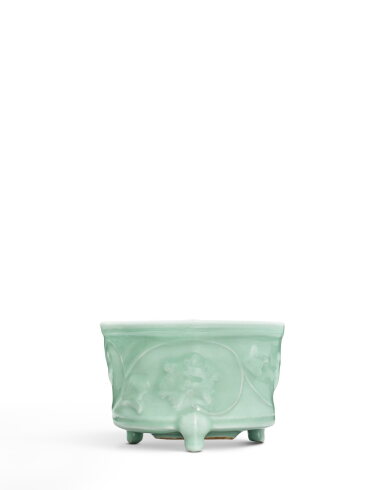
A Longquan celadon appliqué-decorated 'peony' incense burner, Southern Song dynasty | 南宋 龍泉青釉貼花牡丹紋爐
Auction Closed
May 7, 10:26 AM GMT
Estimate
400,000 - 800,000 HKD
Lot Details
Description
Japanese double box, metal and wood covers
d. 13.5 cm
Collection of Baron Fujita Denzaburo (1841-1912), Osaka.
An old Japanese family collection, acquired from above in 1929.
Fujita danshaku ke zohin nyusatsu mokuroku [Collection catalogue of the Baron Fujita], Osaka Bijutsu Club, Osaka, 10th May 1929, lot 216.
Robed in an unctuous yet vibrant sea-blue glaze, the present incense burner is an extraordinary example of a much beloved Longquan design. Produced at the height of celadon production in the 13th century, the incense burner possesses all the features most desirable for a piece of this type, sturdily potted yet gracefully poised atop three feet, adorned with crisp floral moulding coated in a dazzling thick glaze.
Known to Japanese connoisseurs as kinuta (‘mallet’), after its more common appearance on vases of a ‘mallet’ shape, this thick and luminous blue-green glaze effect has long been coveted by collectors and appears only on the highest quality of Longquan ceramics, likely produced with the support of imperial patronage; see Suzanne G. Valenstein, A Handbook of Chinese Ceramics, New York, 1989, pp 100-101.
It is rare to find an incense burner of this lian form moulded with peony scrolls, let alone one so thickly glazed in the kinuta style. For related incense burners of this type but more thinly glazed, compare an example excavated from a tomb in Quanzhou, Fujian province, dated in accordance with AD 1286, illustrated in Longquan qingci [Longquan celadon ceramics], Beijing, 1966, pl. 23 bottom, together with a censer, in the Shanghai Museum, attributed to the Yuan dynasty, pl. 50; and another sold in our New York rooms, 18th and 19th March 2014, lot 218. Compare also a closely related censer in the Asian Art Museum of San Francisco (no. B62P151), published in He Li, Chinese Ceramics, London, 1996, no. 271; and one in the Palace Museum, Beijing, illustrated in Celadons from Longquan Kilns, Taipei, 1998, pl. 183-1, together with a later, Ming period, censer with moulded decoration, in the Ningbo City Museum, pl. 258. A further example can be found in the Meiyintang collection, illustrated in Regina Krahl, Chinese Ceramics from the Meiyintang Collection, London, 1994, vol. 1, p. 303, pl. 568.
來源
藤田傳三郎(1841-1912年)收藏,大阪
日本私人舊藏,自1921年由以上獲得
出版
《藤田男爵家蔵品入札目録》,大阪美術倶樂部,大阪,1929年5月10日,編號216
此爐通體施青釉,釉色瑩潤厚實,光華奪目,造型優雅,乃龍泉窰中難得一見之佳作。燒製於十三世紀龍泉青瓷鼎盛之際,其器形端莊敦厚,三足鼎立尤見嫻雅,爐身飾貼塑牡丹紋,紋飾清麗生動,釉層濃厚瑩澈,殊為珍貴。
此類釉色為日本鑑賞家所稱之「砧青」(kinuta),以常見於砧式瓶(形如木槌之瓶式)而得名。此種濃厚瑩亮之藍綠釉彩歷來為藏家所珍愛,僅見於最上乘之龍泉青瓷,多認為與當時南宋宮廷之支持密切相關;詳見 Suzanne G. Valenstein 著《A Handbook of Chinese Ceramics》,紐約,1989年,頁100-101。
如此以牡丹紋裝飾之「奩式」爐本屬難得,且施以砧青厚釉者更屬罕見。可比較數例相似之爐式,但釉層較薄,如福建泉州一座紀年為公元1286年之墓葬出土之例,著錄於《龍泉青瓷》,北京,1966年,圖版23下,及一件上海博物館藏元代例,見同書圖版50;另見紐約蘇富比曾售出一例2014年3月18-19日,拍品編號218。再參考舊金山亞洲藝術博物館藏一例(博物館編號B62P151),著錄於何麗,《中國陶瓷》,倫敦,1996年,編號271;以及北京故宮博物院藏例,著錄於《龍泉窰青瓷》,台北,1998年,圖版183-1,並參考一件寧波市博物館藏明代貼塑紋飾香爐,見同書圖版258。另可參閱玫茵堂珍藏一例,著錄於康蕊君著《玫茵堂中國陶瓷》,倫敦,1994年,卷一,頁303,圖版568。
You May Also Like


