
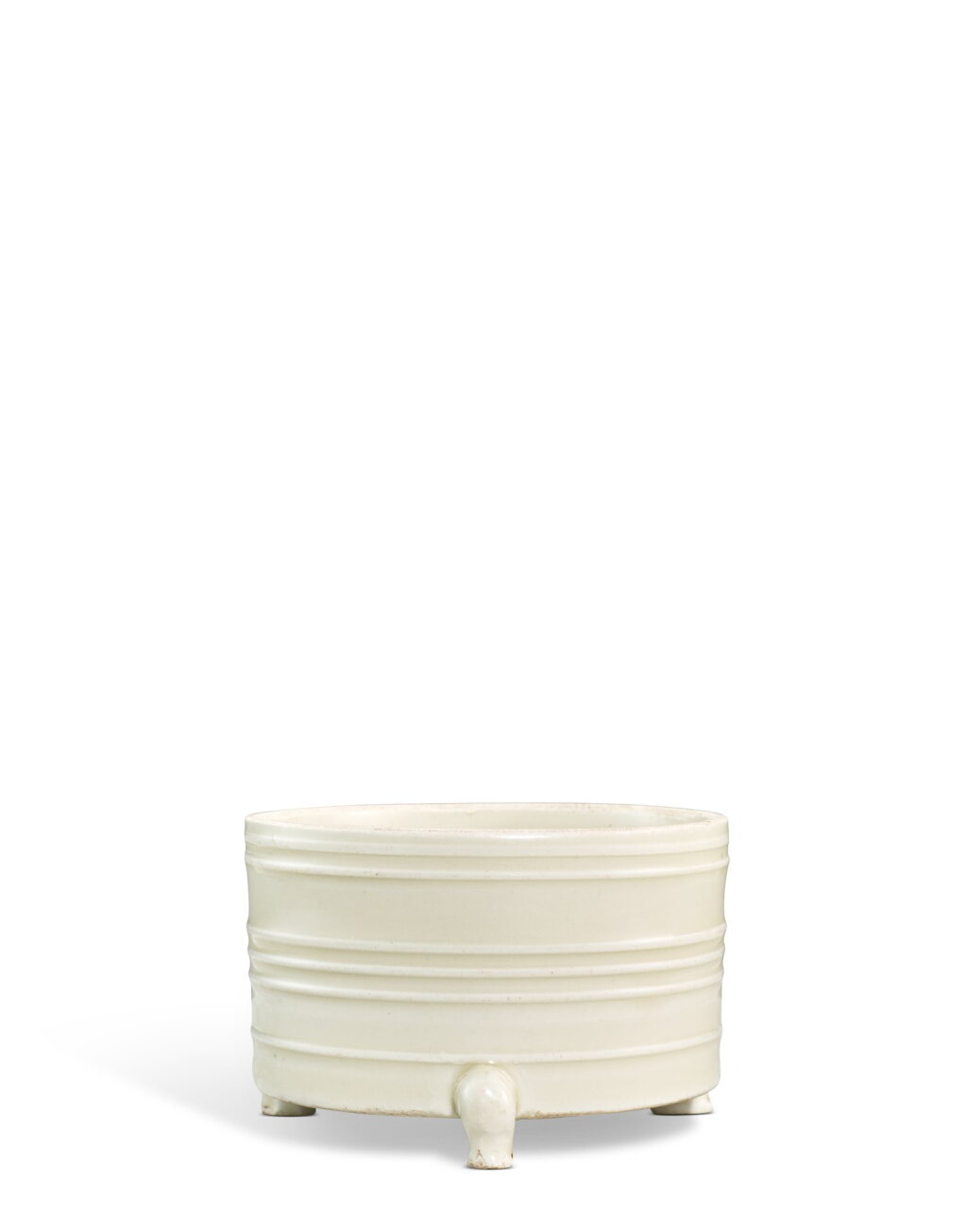
A Dingyao ribbed cylindrical tripod incense burner, Northern Song dynasty | 北宋 定窰白釉弦紋三足奩式爐
Auction Closed
May 7, 10:26 AM GMT
Estimate
1,800,000 - 4,000,000 HKD
Lot Details
Description
wood stand and Japanese wood box
w. 13 cm
John Sparks Ltd., London, by repute.
A European private collection, assembled mostly during the 1930s to 1960s, and thence by descent.
Bonhams London, 10th November 2016, lot 6.
Adapted from an archaic bronze form, this elegant censer reflects the major impact on the arts that resulted from a drastic political shift during the early Song dynasty, from a society ruled by a hereditary aristocracy to one governed by a central bureaucracy of scholar-officials selected through civil service examinations. The resulting rise of Neo-Confucian ideals emphasised the importance of history in the pursuit of virtue. The increased interest in antiquities led to a revival of archaic jade and bronze forms that Song potters adapted into their repertoire. The present censer finds its roots in gilt bronze tripod wine vessels (zun) of the Han dynasty (206 BC – AD 220), generally supported on bear-shaped feet, fitted with ring handles and supplied with a cover, such as an example decorated with animals, that is engraved with an inscription identifying it as a wine vessel (jiu zun) and dating it in accordance with the year 26 BC, illustrated in Li Xueqin, ed., Zhongguo meishu quanji: Gongyi meishu bian [Complete series on Chinese art: Arts and crafts section], 5: Qingtong qi [Bronzes], vol. 2, Beijing, 1986, pl. 217, together with another gilt-bronze wine zun with matching tripod stand in the Palace Museum, Beijing, pl. 236, which is decorated with a triple raised band in the centre and single bands at rim and base, not unlike the present piece, and attributed to the reign of Guangwudi, AD 25-57.
For ceramic incense burners, this shape was popular from the Song dynasty right through to modern times, and this Ding version with simple raised ribs, became a classic. Five similar Ding examples, in various shapes and proportions and with different arrangements of raised ribs, were included in the exhibition Gugong lidai xiangju tulu/A Special Exhibition of Incense Burners and Perfumers Throughout the Dynasties, National Palace Museum, Taipei, 1994, cat. nos 35-39, together with a roughly contemporary Jingdezhen copy, cat. no. 44, a later Dehua copy, cat. no. 67, and a ‘Guang ware’ copy, probably from Guangzhou, cat. no. 71, all from the collection of the National Palace Museum. Three of the five Ding censers in Taipei were also included in the exhibition Dingzhou hua ci. Yuan zang Dingyaoxi baici tezhan/Decorated Porcelains of Dingzhou. White Ding wares from the collection of the National Palace Museum, National Palace Museum, Taipei, 2014, cat. no. II-5.6.7, all with fitted wooden covers with Yuan (1279-1368) or Ming (1368-1644) jade carvings as knobs, a type known to have been commissioned by the Yongzheng Emperor (r. 1723-1735) from the palace workshops.
Another censer of this size, also with two ribs near the mouth but with a metal rim mount, from the Carl Kempe collection and illustrated in Bo Gyllensvärd, Chinese Ceramics in the Carl Kempe Collection, Stockholm, 1964, pl. 447, was sold in our London rooms, 14th May 2008, lot 238; another is illustrated in Hsien-ch’i Tseng & Robert Paul Dart, The Charles B. Hoyt Collection in the Museum of Fine Arts: Boston, vol. II, Boston, 1972, pl. 29; a larger example, in the Palace Museum, Beijing, is published in Selection of Ding Ware. The Palace Museum Collection and Archaeological Excavation, Beijing, 2012, pl. 41, together with a slightly smaller version excavated from Tomb 1 in Yangjiawan, Changsha, Hunan province, and now in the Hunan Provincial Museum, pl. 40; another in the Tianjin City Art Museum, Tianjin, is published in Tianjin Shi Yishu Bowuguan cang ci/Porcelains from the Tianjin Municipal Museum, Hong Kong, 1993, pl. 26; and a further example formerly in the Chang Foundation, Taipei, included in James Spencer (comp.), Selected Chinese Ceramics from Han to Qing Dynasties, Taipei, 1990, cat. no. 24, was sold twice, first in our London rooms, 11th December 1984, lot 169 and again in these rooms, 3rd October 2017, lot 10, from the Le Cong Tang collection. Compare also a much smaller fragmentary example recovered from the Ding kiln site in Quyang, Hebei province, illustrated in Zhongguo gu ciyao daxi. Zhongguo Dingyao/Series of China’s Ancient Porcelain Kiln Sites: Ding Kiln of China, Beijing, 2012, pl. 108.
來源
傳 John Sparks Ltd.,倫敦
歐洲私人收藏,主要於1930至1960年代集成,此後家族傳承
倫敦邦瀚斯2016年11月10日,編號6
宋初,士大夫經科舉遴拔為官,取代世襲權貴執政治國,理學大興,崇尚鑒史以修德。此爐形制古雅,仿高古銅奩,正與當時流行之理學相乎。尚古之風盛及瓷業,宋匠常依古玉及青銅器形製瓷,遞衍遞嬗。本例式樣可溯至漢;漢有鎏金銅樽,熊形足,配獸首銜環耳,附蓋,可見一熊足獸紋樽例,鑄有「溫酒樽」銘,知其為酒器,並有西漢成帝「河平三年造」字,即製於公元前26年,圖見李學勤編,《中國美術全集工藝美術編5:青銅器》,卷2,北京,1986年,圖版217,另錄鎏金銅酒樽一例,下配承盤,北京故宮博物院藏,圖版236,應為東漢光武年製(公元25-57年),腰間環飾三道弦紋,口及底沿又各添飾弦紋,與此爐別無二致。
此類三足奩式爐自宋風靡,今猶不衰,定窰弦紋奩式爐更乃經典。有相類宋代定窰五例,形制比例不一,弦紋排布各異,刊於《故宮歷代香具圖錄》,台北故宮博物院,1994年,編號35-39,另錄約同時期之景德鎮窰仿定爐例(編號44),亦見一年代略晚之德化窰仿例(編號67),及一「廣窰」類例(編號71),或出廣州,以上各例皆為台北故宮博物院寶蓄。前述定窰五例,其中三例同錄於《定州花瓷—院藏定窰系白瓷特展》,台北,2014年,編號II-5.6.7,皆附木蓋,蓋循雍正年間宮廷技法,以元、明玉雕作鈕。
比較一相類瓷爐,尺寸相若,金屬釦口下方飾兩道弦紋,卡爾肯普舊藏,載於 Bo Gyllensvärd,《Chinese Ceramics in the Carl Kempe Collection》,斯德哥爾摩,1964年,圖版447,售於倫敦蘇富比2008年5月14日,編號238。又一例,刊於曾憲七及 Robert Paul Dart,《The Charles B. Hoyt Collection in the Museum of Fine Arts: Boston》,卷2,波士頓,1972年,圖版29。另可參考一尺寸較大之例,藏北京故宮博物院,刊於《定瓷雅集:故宮博物院珍藏及出土定窰瓷器薈萃》,北京,2012年,圖版41,旁附一較小例,湖南長沙楊家灣1號墓出土,現藏湖南省博物館,圖版40。天津市藝術博物館且蓄一爐,錄於《天津市藝術博物館藏瓷》,香港,1993年,圖版26。台北鴻禧美術館舊藏一例,收入史彬士編纂的《中國歷代陶瓷選集》,台北,1990年,編號24,曾為樂從堂寶蓄,兩度售於蘇富比,1984年12月11日在倫敦拍出,編號169,後於2017年10月3日在香港易手,編號10。還可比較一殘例,尺寸甚小,河北曲陽定窰窰址出土,載於《中國古瓷窰大系:中國定窰》,北京,2012年,圖版108。
You May Also Like


