
Property from an Important Hong Kong Private Collection
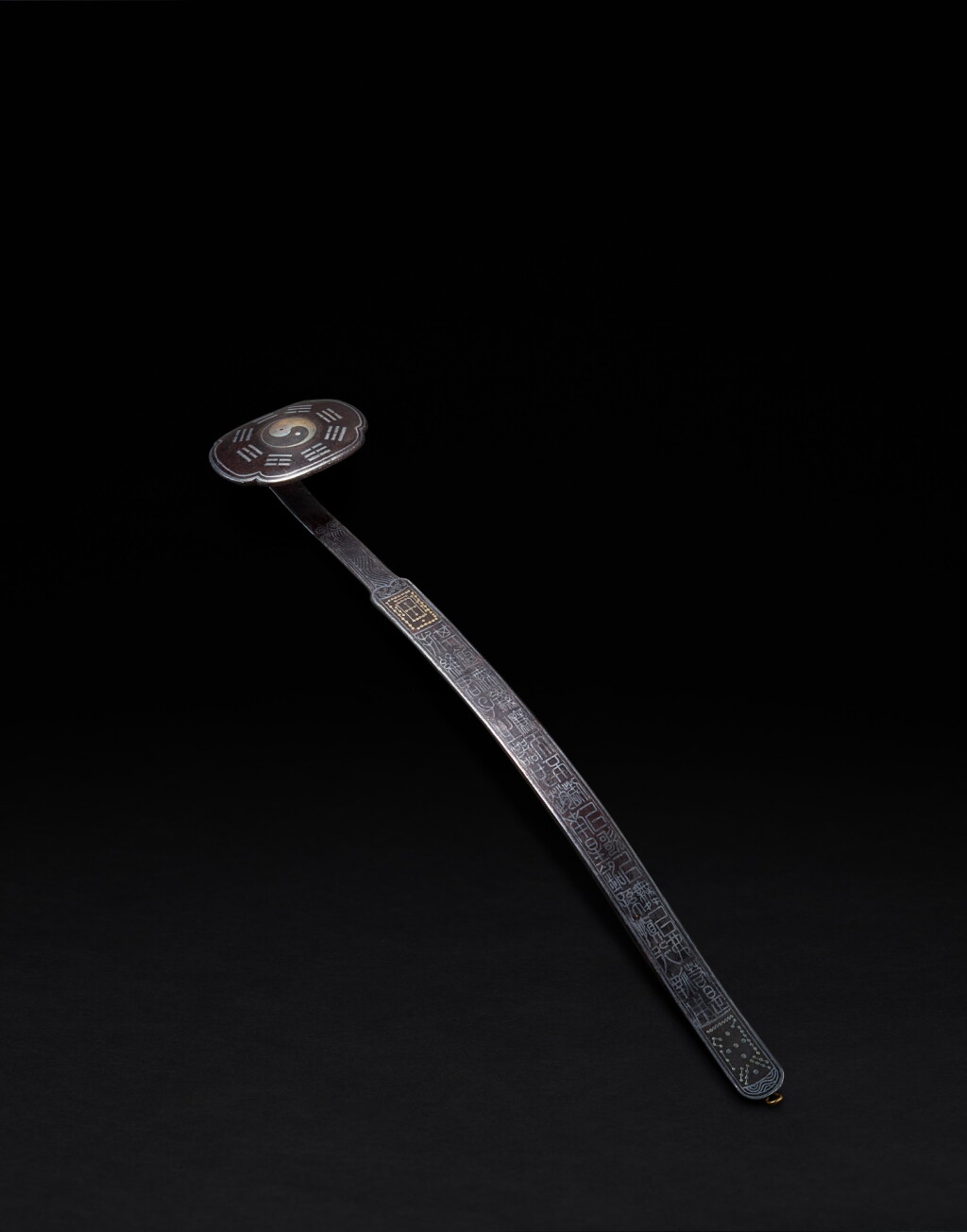
An inscribed gold and silver-inlaid iron ruyi sceptre, By Zhang Aochun, dated to the renxu year of the Tianqi reign (in accordance with 1622)
Auction Closed
November 5, 05:06 PM GMT
Estimate
30,000 - 60,000 GBP
Lot Details
Description
the front of the lower shaft with Daoist diagrams, flanking a zhuanshu inscription followed by Sun Shenxing zhiyong (‘Made use of by Sun Shenxing’), the reverse of the shaft inscribed in zhuanshu Tianqi renxu Zhang Aochun zhi (‘Made by Zhang Aochun in the renxu year of the Tianqi reign.’)
Length 49 cm, 19¼ in.
Collection of Mrs. Walter Sedgwick (1883-1967).
The Water, Pine and Stone Retreat Collection.
Sotheby's Hong Kong, 7th April 2014, lot 215.
Soame Jenyns and William Watson, Chinese Art. The Minor Arts, vol. 2, London, 1965, no. 70.
The National Palace Museum Monthly of Chinese Art, Taipei, April, 1984, no. 13, p. 86.
While in many areas of Chinese art the identity of the maker is often overlooked, in certain media, the identity of well-known master becomes fundamental to an entire collecting category. In the case of iron ruyi sceptres, Zhang Aochun is one such master.
Finely inlaid with an auspicious bagua ('eight trigrams') design and lengthy dedication, the present ruyi represents a rare and exceptional example directly attributable to Zhang himself. The current ruyi, dated to 1622, is closely related to another example in the Royal Ontario Museum of Archaeology, Toronto, illustrated in Sheila Riddell, Dated Chinese Antiquities 600 - 1650, London, 1979, p. 148, fig. 137, where the author notes that Zhang Aochun is 'on record as having specialized in the making of iron ruyi sceptres, inlaid with gold and silver. One of his principal customers was the grand censor, Zhao Nanxing...'
Zhao Nanxing (1550-1627) was a high official minister of state, who rose to become Grand Censor and is celebrated for his integrity and outspokenness. From surviving examples of this rare group, it seems a poem written by Zhao about a certain ruyi sceptre in 1610 inspired Zhang Aochun's original 1610 creation and, in turn, led to a further series of similar sceptres produced in 1622. The poem can be translated as follows:
'Its hook has no barb;
It is upright without giving injury.
With it, sing and dance;
If it disapproves it will break.
This is [truly] the implement of a gentleman'.
Interestingly, like the current sceptre, the Royal Ontario Museum example is also inscribed for the use of Sun Shenxing, no doubt inspired by the model made for Zhao Nanxing, who appears to have been the original patron. Compare one such ruyi dated to 1610 and dedicated to Zhao, originally sold alongside the present lot from the Collection of the Water, Pine and Stone Retreat in our Hong Kong rooms, 7th April 2014, lot 222; and a Qianlong mark and period reinterpretation of the design, lot 227, which demonstrates Zhang's enduring legacy as an artist.
You May Also Like


