Sold to Benefit George Watson's College, Edinburgh
An important collection of ink rubbings, Early 20th century and earlier
Auction Closed
November 5, 05:06 PM GMT
Estimate
20,000 - 30,000 GBP
Lot Details
Description
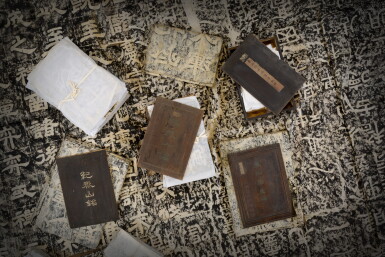
Coloured inks on various papers, many composed of multiple sheets, most calligraphic, taken from monuments, tiles, statues, lacquer, wood and cast-metal objects, some with fragments of wood boxes with colophon labels, some mounted as hanging scrolls, others featuring notes and calligraphy in Stewart Lockhart’s hand, approximately 1000, various sizes
Acquired by Sir James Stewart Lockhart (1858-1937), and thence by descent to his daughter, Mary Stewart Lockhart (1894-1985).
Gifted by the above to George Watson's College, Edinburgh, 1967.
National Museums of Scotland, Edinburgh, 2004-2025 (on loan).
Assembled from approximately one thousand individual sheets, each recording in ink and paper monumental inscriptions and images from across China, the present collection represents one of the most academically significant and comprehensive examples of its type to survive in the West and presents a unique opportunity for further research – into the landscapes of China, the tradition of stone inscriptions and the legacy of the Scotsman who sought to preserve and study them.
The process of disseminating text and images by inking inscriptions and carvings, cut from stone or other hard materials, and transferring the image onto thin sheets of wet paper is at least 1,500 years old in China. Embraced by advocates of Confucianism, Buddhism, and Daoism not long after the invention of paper itself (ca. 100 CE), the dissemination of text and doctrine through ink rubbings was fundamental to the intellectual landscape of premodern China. While the earliest recognisable Chinese inscriptions survive carved into oracle bones and cast into the bronze vessels of the Shang and Zhou dynasties, the impermanence of paper and bamboo have left much of early Chinese thought lost to the sands of time. As a remedy for this impermanence, the practice of carving notable inscriptions, eulogies, dedications, religious texts and poetry into rock faces allowed the emperors, scholars and believers of early China to pass on their messages in near perpetuity.
The practice of taking, collecting and discussing the ensuing rubbings appears to be nearly as old as the form of the stele itself, with the earliest extant examples of rubbings typically dated to the early seventh century. With the arrival of the Song dynasty (960–1279), its Neo-Confucian revival and the growing interest in antiquarianism that followed, the practice of jinshi xue ('study of metal and stone') became celebrated as a fitting vocation for the learned scholar-official. The earliest extant catalogue of rubbings, attributed to this period, is said to have been collected by Ouyang Xiu (1007–1072), a prominent Song Dynasty scholar and poet, who collected some 1,000 rolls of ink rubbings, while an even larger group of 1,900 inscriptions is recorded in the Jinshi lu (Record of Bronze and Stone), attributed to Zhao Mingcheng (1081–1129).
While in many ways a far cry from the scholars of antiquity, James Stewart Lockhart was conscious of the grand tradition he was inheriting and devoted countless hours to the collection and study of the present group, soliciting new rubbings from officials and neighbours alike. As Shiona Airlie notes in her brief biography of Stewart Lockhart, “rubbings from archaeological monuments throughout the country were acquired in quantity from a variety of sources ranging from consular offices to railway engineers.” (see Thistle and Bamboo, Hong Kong, 2010, p. 162). These rubbings also provided source material for collaborative research, particularly with his friend and colleague Sir Reginald Johnston (1874-1938); see a letter from Johnston to Stewart Lockhart, 23 January 1913 (National Library of Scotland, Stewart Lockhart Papers; vol. 9).
While a full inventory of the preserved materials has yet to be completed, given the early dating and illustrious provenance of the collection, it appears highly likely that some of those included record monuments now lost in the turmoil of the 20th century, presenting an invaluable opportunity for further study. During the collection’s time on loan to the National Museums of Scotland, some effort was made to formalise the cataloguing of this extensive collection though, in many ways, the most valuable resource in this regard remains a small leather-bound notebook prepared by Stewart Lockhart himself, detailing his most important acquisitions (still preserved in the library of George Watson’s College).
From these listings, three particular highlights of the collection emerge: those taken from the temples of Qufu, Shandong province; those from Mount Tai, Shandong; and those sent to him from friends, dealers and scholars across the country. Stewart Lockhart was a close associate of Duke Kong, the direct descendant of Confucius, and made frequent visits to the Duke and the Temple of Confucius in Qufu, from whence he gathered an almost encyclopedic collection of rubbings. Similarly enamoured with the extensive inscriptions carved on the rock faces and temples of Mount Tai, Stewart Lockhart assembled an extraordinary collection of material from the site, including the dedicatory inscription by Tang Emperor (r. 712–756) himself. While Stewart Lockhart and his associates braved the elements and even pandemic to achieve his aim (see Airlie, op. cit., p. 12), as an erudite scholar of the broader Chinese classics, Stewart Lockhart also had a desire for inscriptions more out of reach of his home in Weihaiwei. This final group of inscriptions, including a particular abundance of calligraphy attributed to Su Shi (1037–1101), presents the perfect remedy to this hunger.
You May Also Like