Property from an English Family Collection
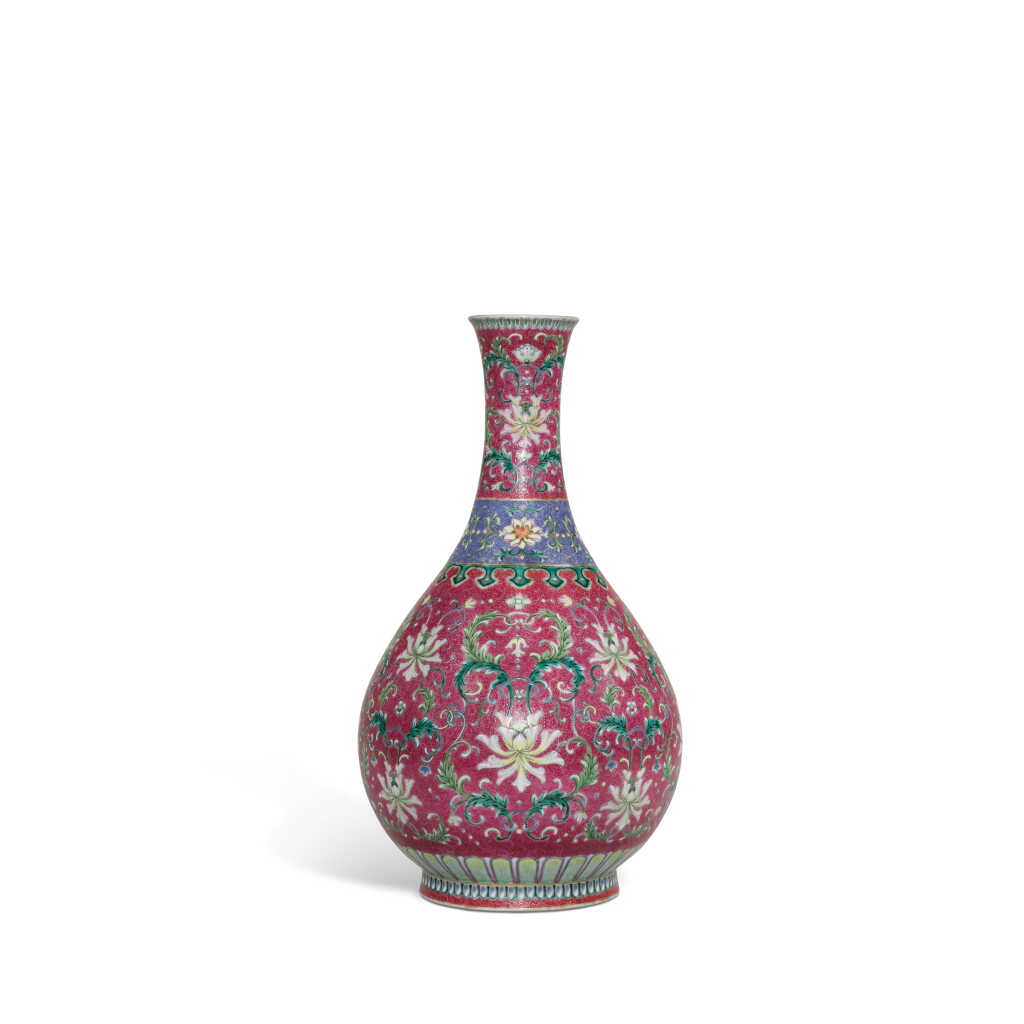
A rare large ruby-ground sgraffiato yangcai 'lotus' bottle vase, Seal mark and period of Qianlong
Auction Closed
November 5, 05:06 PM GMT
Estimate
100,000 - 200,000 GBP
Lot Details
Description
the base with a six-character seal mark in underglaze blue
Height 37 cm, 14⅝ in.
Collection of Dame Agnes Lowndes Jekyll (1861-1937), and thence by descent.
With its grand proportions, sensuous curved form, and vibrant design, the present vase is a rare and extraordinary example of ‘Qianlong taste’ at its most exuberant. Combining the classical yuhuchunping shape, in vogue since the Song dynasty, with the brilliance of contemporary ruby enamelling, baroque-inspired scrollwork and intricate sgraffiato, the present vase serves as a majestic example of the vibrancy and sumptuous tastes of the Qianlong Emperor (r. 1735-1795); taking the very best of traditional Chinese and Buddhist motifs and injecting an energy of splendour and technical mastery unprecedented in earlier reigns which incorporates master craftsmanship from around the world.
Sgraffiato, or sgraffito – the carving through a surface layer to reveal a contrasting layer below – is a versatile technique that has been long been used in ceramics around the world, and came to prominence in China as early as the Song dynasty (960-1279), coming to the fore again with the development of enameling on porcelain and the development of the yangcai (‘foreign colours’) palette in the eighteenth century. Carving through a layer of ruby enamel, down to the glazed porcelain underneath and revealing the design in white, this painstaking technique appears to have developed around the same time in both the imperial enameling workshops of the Forbidden City and the imperial kilns at Jingdezhen though the latter tended to produce more delicate elevated designs than the former's more formal diaper grounds. Liao Pao Show attributes the introduction of this technique to Jingdezhen to an increased effort from 1741 onwards by Tang Ying (1682-1756), the long-time supervisor of the imperial kilns, to please the Qianlong Emperor, after the latter had criticized the porcelain production of the previous years, see Huali cai ci: Qianlong yangcai / Stunning Decorative Porcelains from the Ch'ien-lung Reign, National Palace Museum, Taipei, 2008, pp 10-41.
To date no other vase of this extraordinary design appears to survive, though most related vases appear to have been produced in pairs for the Qianlong court. Compare, for example, a separated pair of sgraffiato ruby-ground vases of closely related lotus scroll design and archaistic hu form, respectively preserved in the Hakone Museum of Art in Kanagawa, Japan and sold in in our New York rooms, 18th September 2024, lot 151; a separated pair of ruby-ground meiping of similarly generous proportions (37.5 cm): the first from the collections of Alfred Morrison and Lord Margadale of Islay, part of the Fonthill Heirlooms, and later the collection of Roger Lam, sold in these rooms, 8th and 9th July 1974, lot 416, and three times in our Hong Kong rooms, 1980, 1988, and finally 31st October 2004, lot 131; and its pair found in the Palace Museum, Beijing, illustrated in Kangxi, Yongzheng, Qianlong. Qing Porcelain from the Palace Museum Collection, Hong Kong, 1989, p. 361, pl. 42; a pair of ruby-ground sgraffiato vases in the Yale University Art Gallery, one of the two illustrated in George J. Lee, Selected Far Eastern Art in the Yale University Art Gallery, New Haven & London, 1970, pl. 53; and another grand vase of danping ('gall bladder vase') shape, sold in our Hong Kong rooms, 3rd April 2018, lot 3622.
The vase was acquired in the early 20th century by Dame Agnes Lowndes Jekyll (1861-1937), the Scottish-born British artist, writer and philanthropist. She was born into a prominent art-collecting family - her father William Graham (1817-1885), the politician and wine merchant, was a patron of Pre-Raphaelite artists including Edward Burne-Jones and Dante Gabriel Rossetti. Via her descendants, Dame Agnes Jekyll's painting The Charity of St Nicholas of Bari, by Girolamo Macchietti, was acquired by the National Gallery in 2007 and The Triumph of Love by Titian was bequeathed to the Ashmolean museum, when the present vase was inherited with other paintings and antiques.