
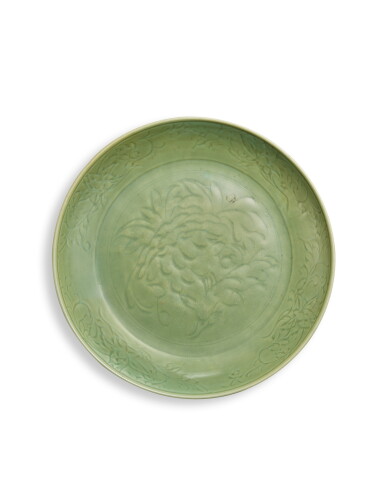
Property from an Important Hong Kong Private Collection
A large carved 'Longquan' celadon-glazed 'chrysanthemum' charger, Ming dynasty
Auction Closed
November 5, 05:06 PM GMT
Estimate
20,000 - 40,000 GBP
Lot Details
Description
Diameter 49.5 cm, 19½ in.
Christie's London, 5th November 2013, lot 401.
The present dish belongs to a group of high-quality Longquan celadon wares produced in the Ming dynasty, characterised by their bold carved designs comparable with the blue and white porcelain contemporary to their time. During the early Ming dynasty, the Longquan kilns appear to have worked closely with the imperial porcelain kilns at Jingdezhen, thus making wares of similar form, decoration and quality.
Large-sized vessels, such as the present dish, commissioned by the court, were predominantly made to meet foreign taste. They played an important role in the emperor’s control of foreign trade and tributary relations. Upon his ascension to the throne in 1368, the Hongwu Emperor ordered that foreign diplomatic and trade contacts should be conducted through official government channels only, in the form of a tributary system. Further into his reign, these initial regulations became considerably less strict, as evidenced by the many Longquan pieces found outside China. The Longquan kilns, spreading over a large part of Zhejiang province and even further into the neighboring province of Fujian, were indeed conveniently located to reach the trade ports of Wenzhou and Quanzhou from where the merchandise could be shipped to foreign markets in the Far East, Southeast Asia and India, the Middle East and even as far as Africa. The Ottoman court in Istanbul was particularly keen on the rich, lustrous green glaze of celadon and the large size of the vessels suited Middle Eastern eating habits perfectly. Highly treasured, the best pieces were strictly reserved for the sultan and for special occasions. Valued and prized, they were offered as part of their princesses’ dowries or as rewards for outstanding services.
You May Also Like


