Property from an Important Private Collection
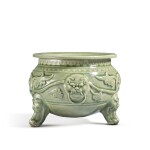
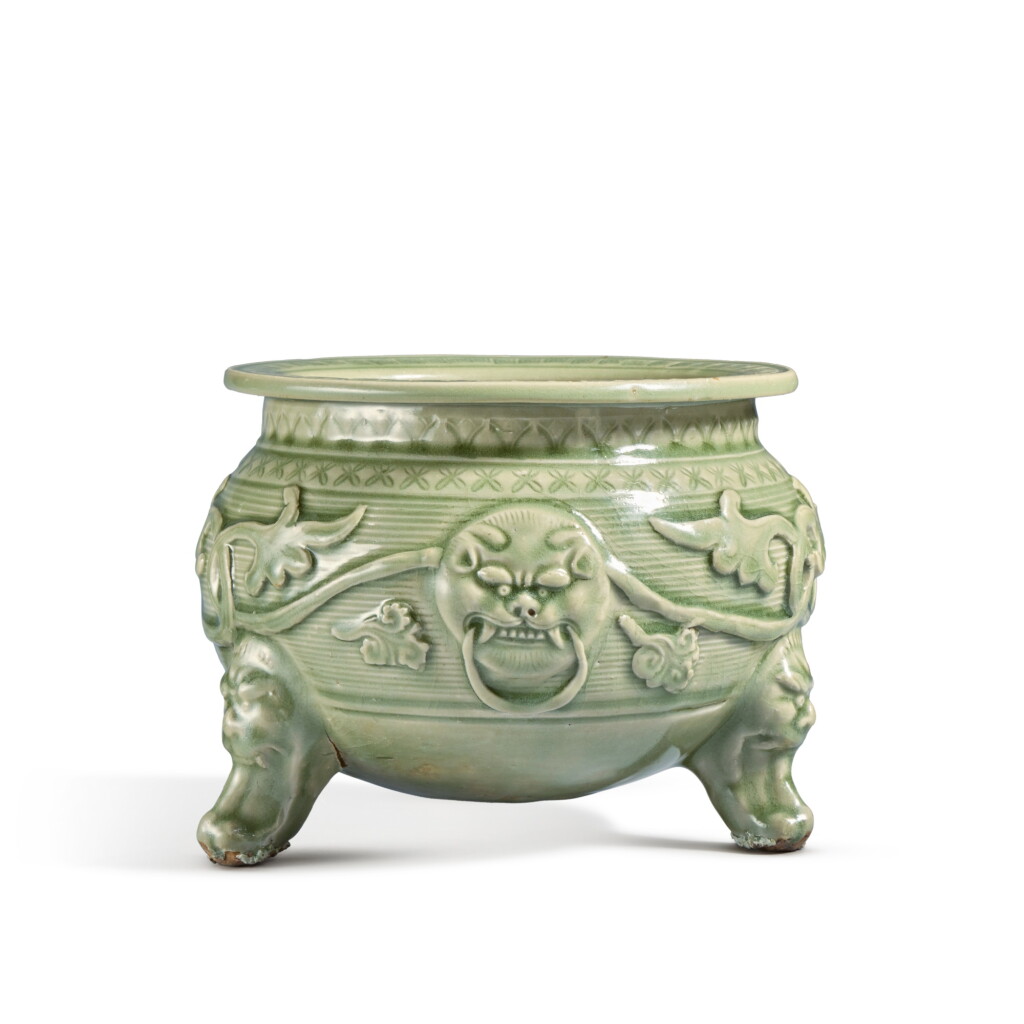
北宋 / 金 耀州窰青釉獸面紋三足爐
拍賣已結束
September 17, 05:00 PM GMT
估價
200,000 - 300,000 USD
拍品資料
描述
Diameter 8⅛ in., 20.5 cm
鴻禧美術館收藏
《鴻禧美術館開館紀念選集》,鴻禧美術館,臺北,1990年,頁26
史彬士,《中國歷代陶瓷選集》,鴻禧美術館,臺北,1990年,編號38
Standing proudly atop three fearsome lion mask legs, the present censer is exceptionally rare in its impressive size, imposing shape and fine craftsmanship. Robed in a soft lustrous green glaze, pooling in the recesses of the carving, this grand piece represents the very zenith of twelfth century production at the celadon kilns of Yaozhou.
Pieces of this scale and sculptural sophistication were likely produced for elite use, perhaps in a scholarly or ritual context, and represent an artistic freedom rarely seen in more minor functional wares produced in the same period. Modeled after archaic bronze ding tripods in a conspicuous homage to China’s ancient past, the censer embodies the wave of archaism that swept elite circles during the Song dynasty, as scholars turned to early history for inspiration and philosophical grounding. Combining finely incised diaper designs to the neck, boldly moulded masks and leafy scrolls to the belly, and deftly sculpted elements around the feet, the present censer is a triumph of ceramic craftsmanship and displays deftness in techniques rarely combined at Yaozhou.
To date, no other censers of this striking design appear to survive with most closely related examples now preserved in prominent museum collections. Compare a closely related censer with a moulded design of confronting phoenixes divided by notched archaistic flanges atop a striped ground from the Winkworth Collection included in Mostra d’Arte Cinese / Exhibition of Chinese Art, Palazzo Ducale, Venice, 1954, cat. no. 416; another of the latter design in the Museum of Oriental Ceramics, Osaka, included in the Museum’s exhibition The Masterpieces of Yaozhou Ware, 1998, cat. no. 105, together with a related handled variation of the design from the Shanxi History Museum, cat. no. 104; another handled example sold at Christie’s New York, 23rd March 2023, lot 860, now preserved in the Metropolitan Museum of Art, New York (accession no. 2024.281); and a related censer of the present form but with scrolling lotuses carved, rather than molded, across the body illustrated in Julian Thompson, ‘Chinese Celadons’, Arts of Asia, November-December 1993, p. 66, fig. 6.
相關推薦