
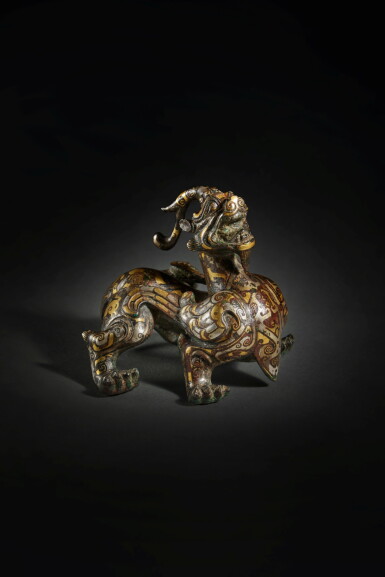
A superb and rare gold and silver-inlaid mythical beast (Bixie), Han dynasty
Auction Closed
September 17, 05:00 PM GMT
Estimate
80,000 - 120,000 USD
Lot Details
Description
Width 3⅛ in., 8 cm
Christian Deydier, Oriental Bronze Ltd., London, 21st March 1994.
New York Private Collection.
This extraordinary sculpture, with its rich aged patina and intricate flowing inlays, is a remarkable example of Han craftsmanship and among the finer works to appear on the market in recent years.
Unfolding at the very end of China’s Bronze Age, the Han dynasty (206 BCE – 220 CE) saw a turn away from the use of bronze in everyday life and an increased focus on the medium as means of artistic expression. Dramatically cast – its legs poised to pounce, its head proudly raised and back arched – the present figure is a far cry from the more austere piece-molded images of the Shang dynasty (c. 1600 – 1045 BCE) and represents the apogee of archaic bronze-working technique.
The present form of a winged mythical beast – generally termed a bixie, tianlu or ‘chimera’ in the literature – rose to prominence in the Han dynasty as a protector against evil. Though perhaps initially inspired by rumors of real animals found abroad, the bixie soon became an established part of the ritual artistic canon as an auspicious mythical beast and is frequently found rendered in stone among the animals guarding the Spirit Roads to elite tombs. Compare, for example, a related pair of winged creatures (without horns) uncovered from an Eastern Han tomb near Luoyang, now in the Luoyang Museum of Ancient Arts at Guanlin Temple, illustrated in Ann Paludan, The Chinese Spirit Road. The Classical Tradition of Stone Tomb Statuary, New Haven and London, 1991, pl. 36. These stone figures, while admittedly monumental (often three meters long), generally lack the vitality of the present figure and are rendered more statically, standing guard beside the Spirit Road. In contrast, in its smaller size, dynamic casting and vibrant inlay, the present figure appears full of vitality; as if ready to move at any moment.
Complex gold and silver inlay designs of this type – demonstrating the opulence of their erstwhile owner and accentuating the vitality of the figure’s sculpting – are rarely attested on figural work of this type and more regularly found on smaller functional pieces, including weapons, chariot fittings and belthooks. For recent auction examples of inlaid works from this period compare a crossbow fitting from the collection of Stephen Junkunc, III, sold in these rooms, 19 March 2019, lot 124; a sword hilt, sold in our Hong Kong rooms, 9th October 2022, lot 3612; and an important widely published disc from the Woods Bliss, Junkunc and Swergold Collections, sold in these rooms, 19th March 2025, lot 142.
While Han dynasty depictions of mythical beasts are frequently attested in two dimensions – in friezes, lacquer decoration and on tomb bricks – bronze sculptures worked in the round rarely survive; let alone those with such rich inlaid decoration. Perhaps the closest surviving comparison to the present piece can be found in a larger bronze fitting in the form of a two-horned bixie formerly in the renowned collection of Baron Adolphe Stoclet (1871-1949). This widely published fitting of similar stance, presence and expression to the present but lacking inlay was sold more recently from the collection of Sir Joseph Hotung in our Hong Kong rooms, 8th October 2022, lot 1.
Also compare a closely related but more crudely rendered Western Han mythical beast of comparable size, similarly inlaid with gold and silver, in the collection of the Miho Museum, Koka, included in Miho Museum. South Wing, Koka, 1997, pl. 106; a related gilt-bronze bixie dated to the Six Dynasties period from the collection of Frederick M. Mayer, included in Mostra d’Arte Cinese / Exhibition of Chinese Art, Palazzo Ducale, Venice, 1954, cat. no. 160; and a bixie of very similar overall form and pose but rendered in jade with a circular socket to the back, excavated from a Han tomb in a northern suburb of Baoji in Shaanxi, included in the exhibition Tan Shengguang, ed., Yu tian jiu chang. Zhou Qin Han Tang wenhua yu yishu / Everlasting like the Heavens. The Cultures and Arts of the Zhou, Qin, Han, and Tang, Shanghai, 2019, pp 372-3.
You May Also Like


