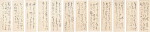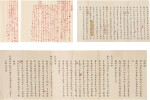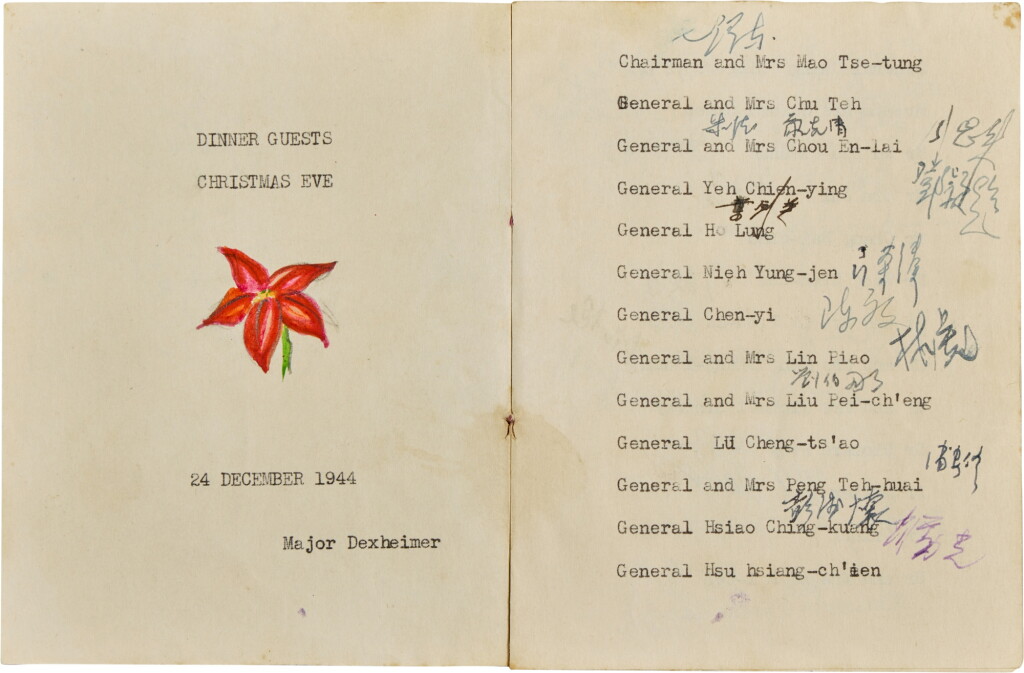
A Christmas eve dinner guest book with autographs of major members of the Chinese Communist Party, 24th December 1944
Auction Closed
September 17, 05:00 PM GMT
Estimate
80,000 - 120,000 USD
Lot Details
Description
including autographs of Mao Zedong, Zhou Enlai, Zhu De, Peng Dehuai, Lin Biao, Liu Bocheng, Chen Yi, Nie Rongzhen, and Ye Jianying, etc.
Height 5⅛ in., 13 cm; Width 4in., 10 cm
Collection of Major Wilbur A. Dexheimer (1901-1974), and thence by descent.
Sotheby's New York, 18th December 2019, lot 155.
This handmade Christmas Eve dinner guest book, compiled on 24th December 1944, bears the signatures of nearly every principal figure of the Chinese Communist Party at the time—including Mao Zedong, Zhu De, Zhou Enlai, Ye Jianying and Peng Dehuai—as well as members of the United States Army Observation Group, known informally as the Dixie Mission. Only two other such guest books are known to exist, one held by The International Museum of World War II in Natick, Massachusetts, and the other in private hands.
The dinner, likely hosted by Major Wilbur Dexheimer of the United States Army Observation Group, marked the first Christmas the Americans spent in Communist-held territory. Though officially an intelligence operation, the Dixie Mission rapidly developed into a series of unprecedented social, political, and cultural exchanges between the American delegation and the Communist leadership. This event—celebrated with warmth, shared meals, and mutual curiosity—embodied that brief window in which the possibility of U.S.-Communist cooperation still existed.
The guest book's arrangement—listing Mao and his associates first, in semi-hierarchical order—suggests careful intention, either out of deference or diplomatic courtesy. Notably, Mao’s wife, Jiang Qing, is included, as are other top leaders: Zhu De, Mao’s longtime comrade-in-arms; Zhou Enlai, the Party’s future premier; and Ye Jianying, who would later serve as Defence Minister. Several signatures, such as Zhou’s and Ye’s, are written in traditional Chinese characters, reflecting the orthographic practices prior to the post-revolution character reforms of the 1950s.
In addition to the CCP leadership, the book includes the names of a fascinating constellation of Communist sympathizers and international allies. Among them: Michael Lindsay, the British academic-turned-radio-technician for the CCP; Ma Haide (George Hatem), the Lebanese-American physician who became the first foreign national granted citizenship in the People’s Republic of China; and Sanzō Nosaka, listed here under his alias Susumu Okano, who organized the Japanese People’s Emancipation League from within China.
More than a guest list, this document is a powerful testament to a fleeting moment in which American boots stood on revolutionary Chinese soil—not in opposition, but in camaraderie.
You May Also Like