
A Collecting Journey: The Jane and Leopold Swergold Collection
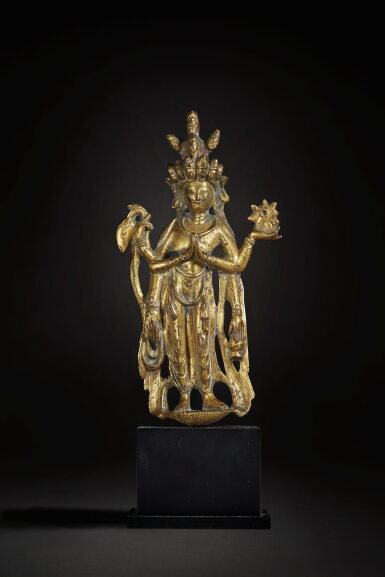
An extremely rare gilt-bronze figure of eleven-headed Avalokiteshvara, Tang dynasty
Auction Closed
March 19, 05:41 PM GMT
Estimate
120,000 - 180,000 USD
Lot Details
Description
stand (2)
Height 8½in., 21.6 cm
Yamanaka & Co., New York.
Parke-Bernet Galleries, Inc., New York, 27th May 1944, lot 724.
Collection of Rafi Y. Mottahedeh (1901-1978).
Sotheby Parke-Bernet, New York, 4th November 1978, lot 211.
Connecticut Private Collection.
Sotheby's New York, 23rd March 2011, lot 691.
Reflection and Enlightenment: Chinese Buddhist Gilt Bronzes from the Jane and Leopold Swergold Collection, Museum of Fine Arts, Houston, 2017-2018.
Leopold Swergold, Thoughts on Chinese Buddhist Gilt Bronzes, Aventura, 2014, pl. 26.
This extremely rare figure depicts Avalokiteshvara standing in tribhanga on a lotus platform. Of the six arms, one pair holds the hands in anjali mudra in front of the chest, while the others respectively hold a pierced star-shaped symbol of the sun and the moon, a kundika, a rosary, and a lotus stem with an attendant bud. This dynamic eleven-headed form is derived from the Indian tradition, in which deities were able to manifest themselves in as many as thirty-three different forms to adapt to an ever changing world and help those in need. The present eleven-headed manifestation reflects the bodhisattva’s ability to detect need in every direction, reminding devotees of the mercy and compassion of Avalokiteshvara in their time of distress.
As is typical of the finest Tang dynasty examples, this figure sways sensuously at the waist combining qualities of a prince and an ascetic, grandly adorned with a crown and jewels yet humbly dressed in a yogi's antelope skin with prayer beads in his hand. Representing the range of Avalokiteshvara's forms and aspects, each of the present eleven heads are finely articulated and surmounted by a head of the Buddha Amitabha, with whom he is closely associated in the Buddhist tradition.
This grand and complex representation of Avalokiteshvara is extremely rare. Compare a related example of this type from Western Tibet, rendered with eleven heads and six arms in copper alloy, now preserved in the Cleveland Museum of Art (accession no. 1975.101), included in Marylin Rhie, Robert Thurman, and John Bigelow Taylor, Wisdom and Compassion: The Sacred Art of Tibet, New York, 1996, cat. no. 127; as well as a related eleven-headed Avalokiteshvara from the Tang dynasty from the collection of Sakamoto Gorō, sold in our Hong Kong rooms, 5th October 2016, lot 3218; and another in a private collection, illustrated in Saburō Matsubara, Chūgoku Bukkyō chōkoku shiron [History of Chinese Buddhist sculpture], Tokyo, 1995, vol. III, pl. 701c.