
A Collecting Journey: The Jane and Leopold Swergold Collection
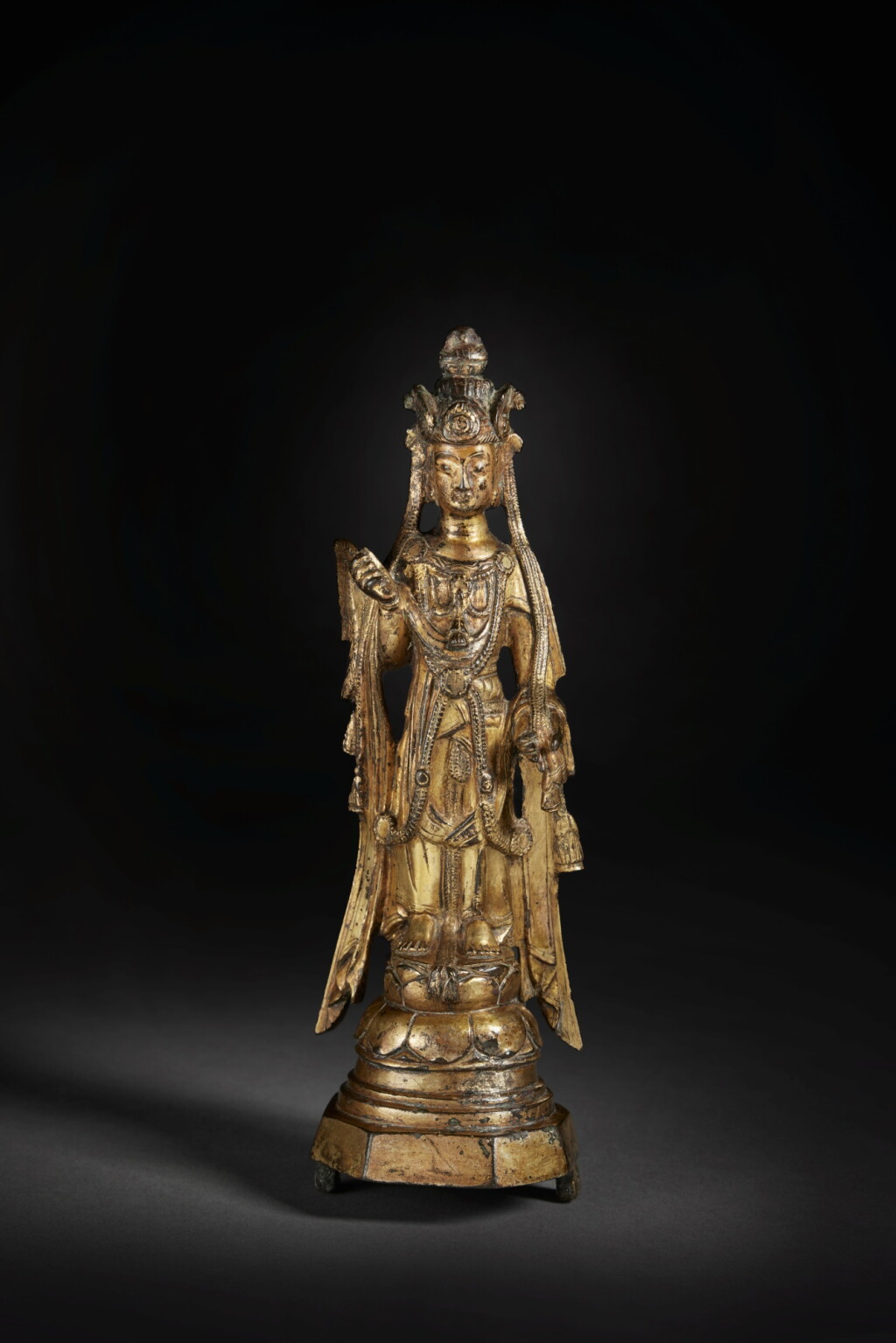
A magnificent and finely cast gilt-bronze figure of Avalokiteshvara, Sui dynasty
Auction Closed
March 19, 05:41 PM GMT
Estimate
250,000 - 350,000 USD
Lot Details
Description
wood stand (2)
Height 6⅝ in., 16.8 cm
Collection of Fong Chow (1923-2012), acquired prior to 1990.
Christie's New York, 20th March 2014, lot 2048.
Reflection and Enlightenment: Chinese Buddhist Gilt Bronzes from the Jane and Leopold Swergold Collection, Museum of Fine Arts, Houston, 2017-2018.
Leopold Swergold, Thoughts on Chinese Buddhist Gilt Bronzes, Aventura, 2014, pl. 13.
Beatrice Chan, 'Reflection and Enlightenment: Chinese Buddhist Gilt Bronzes from the Jane and Leopold Swergold Collection at the Museum of Fine Arts, Houston', Arts of Asia, January/February 2018, pp 58-65.
This grand figure depicts the bodhisattva Avalokiteshvara (also known as Guanyin) standing atop a lotus blossom and octagonal plinth. With a gentle lean in the waist, the slender figure stands with an almost sensuous serenity, akin to the more fluid forms of the ensuing Tang dynasty. However, still richly adorned with elaborate shawls and sashes, standing tall in an erect yet graceful pose, the figure remains the very embodiment of the Sui sculptural style.
Compare a similar Sui dynasty figure of Guanyin preserved with an octagonal base in the Metropolitan Museum of Art, New York, included in Denise Patry Leidy and Donna Strahan, Wisdom Embodied: Chinese Buddhist and Daoist Sculpture in the Metropolitan Museum of Art, New York, 2010, pl. 12, in which the authors identify the willow branch as an attribute of Avalokiteshvara that first emerged in the late 6th century, perhaps associated with the Samadhi Rite and traditional water offerings brought to the bodhisattva.
Compare also a closely related sculpture illustrated in Rene-Yvon Lefevre d'Argencé, ed., Chinese, Korean and Japanese Sculpture in the Avery Brundage Collection, Asian Art Museum of San Francisco, 1974, cat. no. 67; another Sui example, standing as part of a triad, in Saburō Matsubara, Chūgoku Bukkyō chōkoku shiron [History of Chinese Buddhist sculpture], vol. II, Tokyo, 1995, pl. 526; and another now preserved in the Nelson-Atkins Museum of Art, Kansas City, ibid., pl. 589.