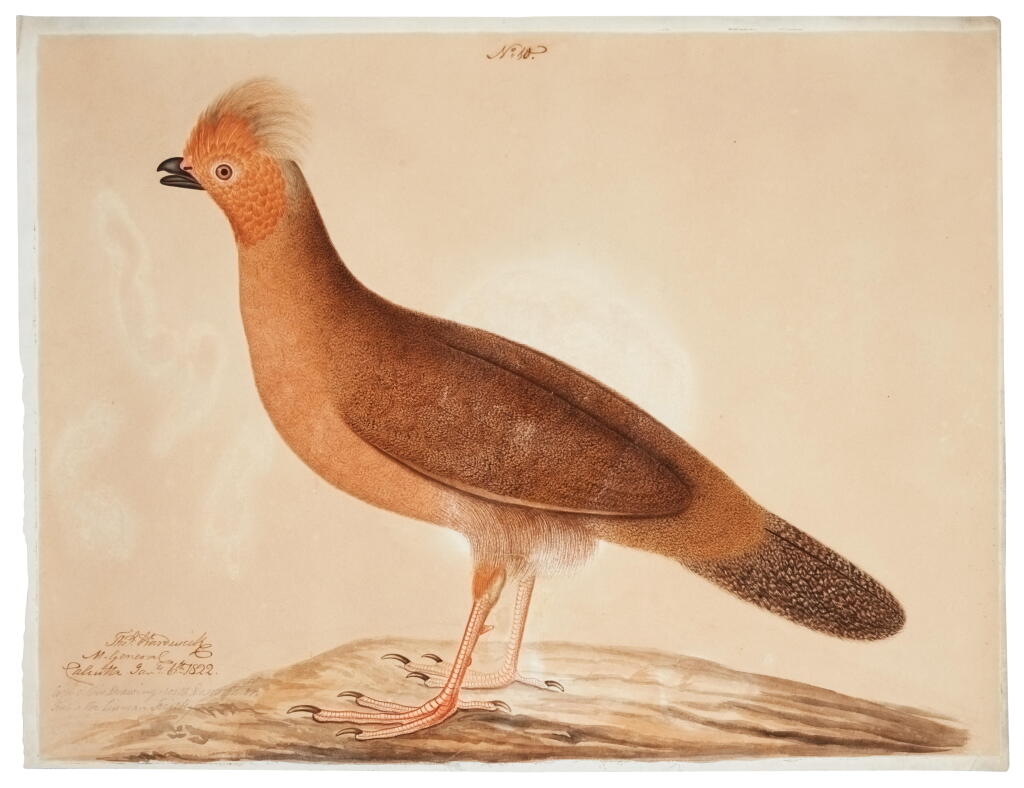
Two studies of pheasants (Phasianus Cornutus - Meleagris Satyra), signed and dated by Major-General Thomas Hardwicke, India, Calcutta, Company School, 1822
Auction Closed
April 30, 03:48 PM GMT
Estimate
6,000 - 8,000 GBP
Lot Details
Description
pencil, watercolour and ink on paper, Ruse & Turner 1813 watermark, inscribed in brown ink lower left 'ThoS. Hardwicke / M.General / Calcultta 6th. Jan. 1822.', further inscribed in pencil and black ink along lower edge 'Phasianus Cornutus - hen bird/ Meleagris Satyra - fem.'; inscribed in brown ink and pencil lower left 'ThoS. Hardwicke / M.General / Calcultta 6th. Jan. 1822/ Copy of this Drawing with Description / Sent to the Linnean Society', numbered at the top 'No.10.',
painting: 36 by 47cm; 32 by 42cm.
leaf: 38.4 by 50cm; 33 by 43cm.
Major-General Thomas Hardwicke (1755-1835)
Major-General Hardwicke of the Bengal Artillery (1755-1835) was one of the greatest collectors of natural history drawings in India. Hardwicke combined his interest in natural history with his military career, collecting specimens and drawings wherever he was stationed. Hardwicke entered the service in 1778, and fought in the Second and Third Mysore Wars and took part in the Rohilla War in 1794. During his career he was based in Cawnpore, Bengal and Dumdum. He became a member of the Asiatic Society of Bengal and was Vice-President from 1820-22. Back in London he was elected Fellow of the Royal Asiatic Society and fellow of the Linnean Society. Hardwicke sent back many papers to be read at meetings of the Linnean Society, accompanied by the paintings. His famous painting of a red panda (by an unknown artist) is said to be the first one ever to reach Europe. The inscription on the second bird indicates that a copy of this painting was sent to the Linnean Society.
Hardwicke employed artists both Indian and British to draw the specimens of flowers, birds, mammals and insects. Hardwicke is known to have been continually giving drawings to his friends and fellow natural history enthusiasts. By the time he retired in 1823 he had acquired a vast amount of drawings, with fifteen hundred of his studies now in the Natural History Museum and a further ninety-six in the India Office Library (British Library).
J.E.Gray who used many of Hardwicke’s drawing in his Illustrations of Indian Zoology 1830-1835, noted how the drawings "were made upon the spot and chiefly from living specimens of Animals, executed by English and Native Artists, constantly employed for this purpose under his own immediate superintendence." (Gray & Hardwicke 1830-35, preface).
The drawings of Indian birds in the India Office library may well have been given to a friend by Hardwicke. The paper has 1794 and 1801 watermarks and Urdu inscriptions that record the specimens being collected in Kumaon, Srinagar and Betul, where Hardwicke visited following his involvement in the Rohilla War of 1794. A further two folios of bird drawings in the Natural History Museum from Wellesley’s collection were also probably acquired from Hardwicke (see NHD 29, f.80 NHD 39, f.43, NHD 29, ff.47 and 48).
You May Also Like