Property from the collection of Eva and Konrad Seitz
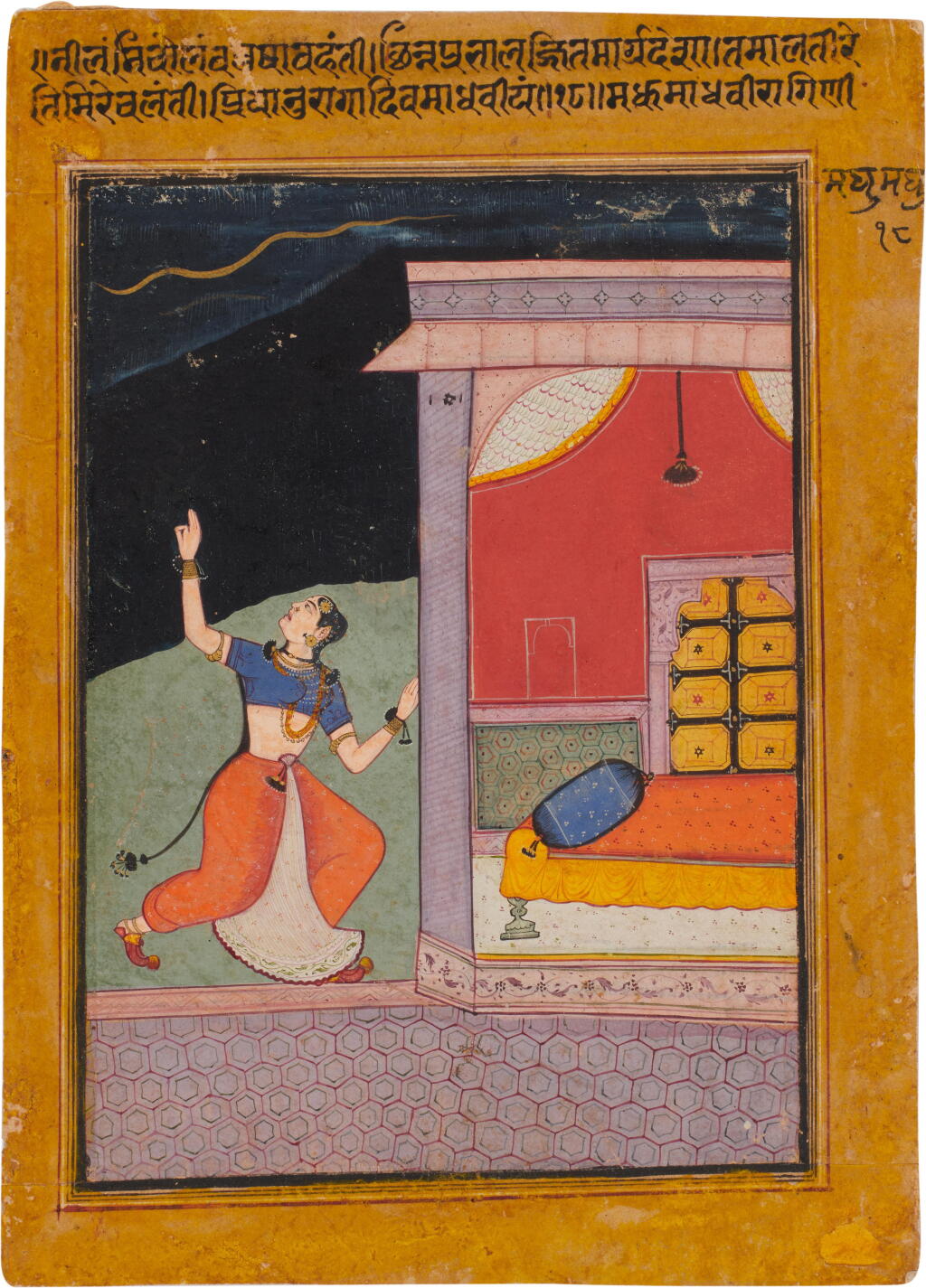
An illustration to a ragamala series: Madhumadhavi Ragini, India, Mughal, 1605-06
No reserve
Auction Closed
April 30, 03:48 PM GMT
Estimate
6,000 - 8,000 GBP
Lot Details
Description
gouache heightened with gold on paper, narrow black border, yellow margins with white and red rules, two lines of black devanagari to the upper margin, further devanagari inscription upper right margin
painting: 19.7 by 12.2cm.
leaf: 20.7 by 14.1cm.
Dazzling Visions, Mughal and Deccani Paintings from the Collection of Konrad and Eva Seitz, Museum Rietberg, Zurich, 30 November 2010 - 10 April 2011
J. Seyller & K. Seitz, Eva and Konrad Seitz Collection of Indian miniatures, Mughal & Deccani paintings, Zurich, 2010, p.51, no.9
The sanskrit inscription identifies this ragamala as Madhumadhavi Ragini, number 18 in the series and describes the woman wearing a blue bodice and hurrying through a night as dark as the tamala tree. (The black barked tamala tree is regarded as auspicious due to its association with the dark complexion of Krishna).
This painting is from the 'Berlin' ragamala, four folios of which are in the collection of the Museum für Asiatische Kunst, Berlin, one of which bears the date V.S. 1662 (1605 AD) (see Waldschmidt, Miniatures of Musical Inspiration, fig.109, p.287). Four other pages from the series are in the Kronos Collection (McInerney, Kossak & Haidar, Divine Pleasures, pp.64-70, nos.7-10.) Another folio from the Moscatelli Collection was sold in these rooms, 8 June 2000, lot 6, (Glynn et al., Ragamala Paintings, 2012, p.64 ).
The exact origin of these 'popular Mughal' paintings is undecided. Some believe they were painted in Agra for Rajput patrons of the Mughal court by artists from Akbar's atelier such as Ustad Salivahana who used a distinctive palette of blue, green and yellow as seen in the present painting and some of the other 'Berlin' ragamala illustrations (see Chandra, 'Ustad Salivahana and the Development of Popular Mughal Art', in Lalit Kala no.8, 1960, pp.25-41). Others place their production in the Rajput courts of either Amber, Jodhpur or Bikaner (see Glynn et al. 2012 p.64).
You May Also Like