Property from the Family of the Artist I Provenant de la Famille de l'Artiste
Rafael Zabaleta
Perdices y reclamo
Lot Closed
April 11, 01:17 PM GMT
Estimate
40,000 - 60,000 EUR
We may charge or debit your saved payment method subject to the terms set out in our Conditions of Business for Buyers.
Read more.Lot Details
Description
Property from the Family of the Artist
Rafael Zabaleta
1907 - 1960
Perdices y reclamo
signed RZabaleta (lower left)
oil on canvas
80,3 x 99,7 cm; 31⅝ x 39¼ in.
Executed in 1957.
____________________________________________________________________
Provenant de la Famille de l'Artiste
Rafael Zabaleta
1907 - 1960
Perdices y reclamo
signé RZabaleta (en bas à gauche)
huile sur toile
80,3 x 99,7 cm; 31⅝ x 39¼ in.
Exécuté en 1957.
Estate of the artist
Thence by descent to the present owners
Barcelona, Galería Adriá, Zabaleta, Exposición Homenaje, 1971, no. 64
Madrid, Galería Biosca, Homenaje a Rafael Zabaleta 1907-1960, 1975
Madrid, Caja de Madrid, Exposición homenaje XXV aniversario de su fallecimiento, 1986, no. 20, p. 52, illustrated
Madrid, Museo Nacional Centro de Arte Reina Sofia, Naturalezas españolas, 1940-1987, 1987, p. 46, illustrated
Granada, Funadcion Caja Granada-Junta de Andalucia, Rafael Zabaleta (1907-1960). Pinturas y dibujos, no. 37, p. 143, illustrated
Vitoria-Gasteiz, Museo Artium, Rafael Zabaleta, 2002-2003, pp. 44-45, illustrated
AA.VV., Maestros de la pintura española, vol. IV, Barcelona, 1973, illustrated
L. Azancot, Rafael Zabaleta, illustrated
Maria Guzmán Pérez, Catalogación de la producción zabaletiana, Granada, 1983, no. 387, pp. 642-643
Maria Guzmán Pérez, R. Zabaleta. Vida y obra, Córdoba, 1985, no. 34, pp. 134-135, illustrated
Maria Guzmán Pérez, La pintura de R. Zabaleta, Granada, 1985, no. 390, pp. 270-271, illustrated in colour
Miguel Viribay, Zabaleta en el museo Vasco, illustrated
Maria Guzmán Pérez, Rafael Zabaleta, Estudio Catalografico oleos y acuarelas, Jaen, 2010, no. 394, pp. 314-315, illustrated in colour
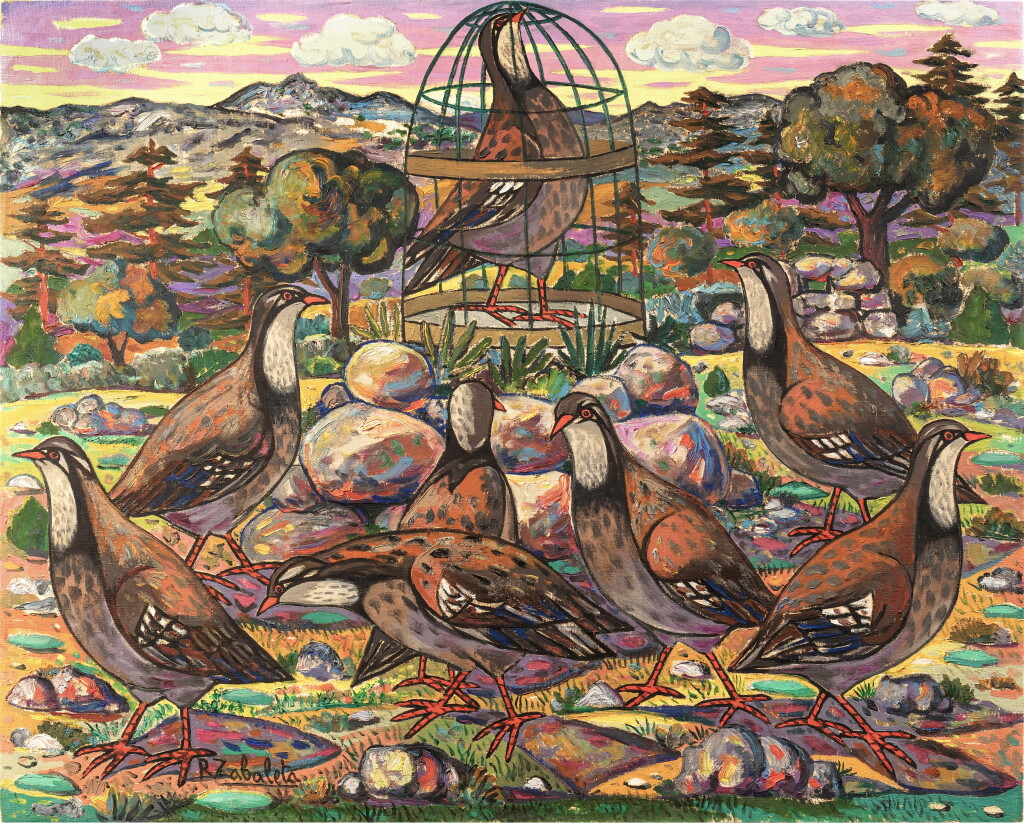
Produced in 1957, Perdices y reclamo perfectly embodies Rafael Zabaleta's pictorial language: shimmering colours framed by black outlines, a synthetic drawing and a gentle, dreamlike atmosphere.
Touches of the same bright shades of green, violet and orange create correspondences and echoes between the partridges and the mountain landscape, with the birds almost seeming to merge with their surroundings. Seven partridges gambol in different directions around a caged partridge on top of a pile of stones. This pyramidal, symmetrical composition, together with the schematisation of the birds and the meticulous blades of grass, laid one by one on a ground of unreal tones, give the scene a fairytale dimension.
This landscape was probably inspired by the countryside of south-eastern Spain, which Zabaleta knew well. He was born in Quesada and returned there regularly, even when he went to Madrid to study at the Ecole Supérieure des Beaux-Arts in 1927. In 1935, he travelled to Paris where he met Picasso, with whom he maintained a close friendship and great artistic complicity. This work thus seems to bear witness to the influences of his Parisian stay: the schematisation of the birds and rocks evokes Picasso's cubism, the warm colours applied in flat tints, almost without modelling, recall those of Gauguin, while the trees and mountains seem to echo Cézanne's directional brushstrokes.
There is another work with the same title, dated 1950. Unlike the first version, the soft pink sky of this painting, punctuated by almost childlike clouds, its bright complementary colours and the symmetry of its composition give it an even more decorative and luminous dimension.
__________________________
Réalisé en 1957, Perdices y reclamo incarne parfaitement le langage pictural de Rafael Zabaleta : des couleurs chatoyantes cernées de contours noirs, un dessin synthétique ainsi qu’une douce atmosphère teintée d’onirisme.
Les touches des mêmes teintes vives de vert, violet et orange créent des correspondances et échos entre les perdrix et le paysage montagneux, les oiseaux paraissant presque se confondre à leur environnement. Sept perdrix gambadent dans des directions différentes autour d’une perdrix en cage, surmontant un amoncellement de pierres. Cette composition pyramidale et symétrique, ainsi que la schématisation des oiseaux et des minutieux brins d’herbe, posés un à un sur un sol aux tonalités irréelles, confèrent à la scène une dimension féerique.
Ce paysage est probablement inspiré de la campagne du sud est de l’Espagne, que connaît bien Zabaleta qui est né à Quesada et y retourne régulièrement, même lorsqu’il se rend à Madrid à l’Ecole supérieure des Beaux-Arts en 1927. En 1935, il voyage à Paris et y rencontre Picasso, avec qui il entretient une profonde amitié et une grande complicité artistique. Cette œuvre semble ainsi témoigner des influences de son séjour parisien : la schématisation des oiseaux et des rochers évoque le cubisme de Picasso, les couleurs chaudes appliquées en aplats, presque sans modelé, rappellent celles de Gauguin, tandis que les arbres et les montagnes semblent reprendre les touches directionnelles de Cézanne.
Il existe une œuvre portant le même titre, datée de 1950. A la différence de la première version, le doux ciel rose de ce tableau, ponctué de nuages presque enfantins, ses correspondances de teintes vives et complémentaires et la symétrie de sa composition lui confèrent une dimension encore plus décorative et lumineuse.