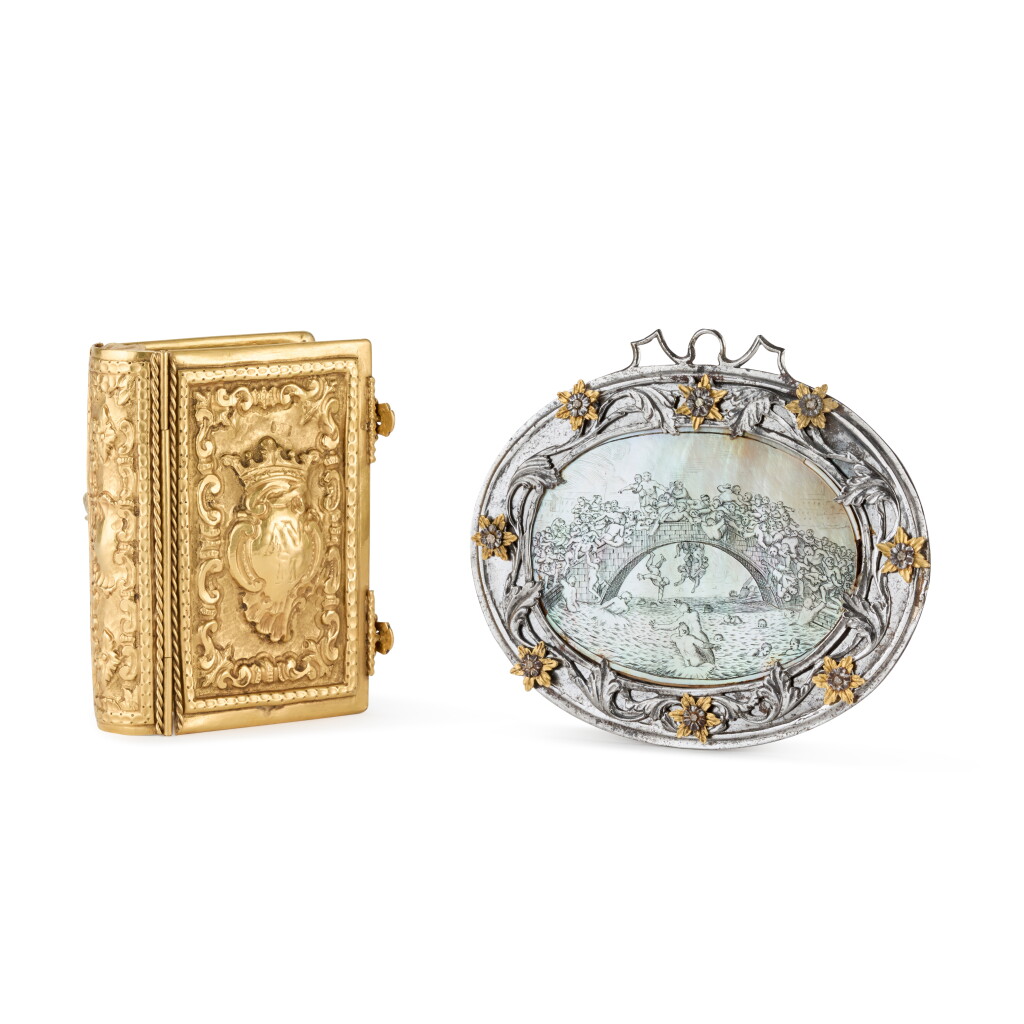
An oval engraved mother-of-pearl plaque, 17th century, probably Venice and a possibly Italian gold binding, Venice, circa 1760, maker’s mark PM
Lot Closed
September 26, 10:46 AM GMT
Estimate
7,000 - 10,000 EUR
Lot Details
Description
The plaque depicting 'La Battaglia del Ponte dei Pugni' (The fighting bridge) in Venice, within a polished and wrought-iron oval frame applied with flowers and foliages, an open crown on the reverse
Width. 12 cm (4 .3/4 in.)
The binding engraved with a rococò medallion engraved with initials “ANM” above a crown on the reverse with initials “IV” with a scrolling foliage frame, mark on one side: maker's mark
Width. 18 cm. (7 1/8 in.), gross weight. 150 gr. (4.82 oz.)
Please note that this lot includes endangered species, which will require a CITES permit for export. Please refer to the Guide for Buyers at Auction and Conditions of Business for Buyers for additional information.
The plaque:
The Princely House of Liechtenstein, Vienna and Liechtenstein
Christie’s Amsterdam, Liechtenstein Property from the Collection of the Princely House of Liechtenstein, 1 April 2008, lot 164.
The binding: Sotheby’s Paris, 1 December 2011, lot 214
The Ponte dei Pugni in Venice, represented on the plaque, is the bridge where rival gangs from the Serenissima (the Castellani and the Nicolotti) were allowed to fight, with the loser being thrown overboard into the Grand Canal. These fights were banned in 1705, but you can still see the marks on the ground indicating the position of the opponents.
Gold bindings are extremely rare. This one is engraved only with the goldsmith's mark, but this mark is typical of Venetian goldsmiths; the decoration of the binding is also reminiscent of Italian bindings, very often Venetian, sometimes Roman. These bindings are almost exclusively intended for use with Hebrew books.
You May Also Like