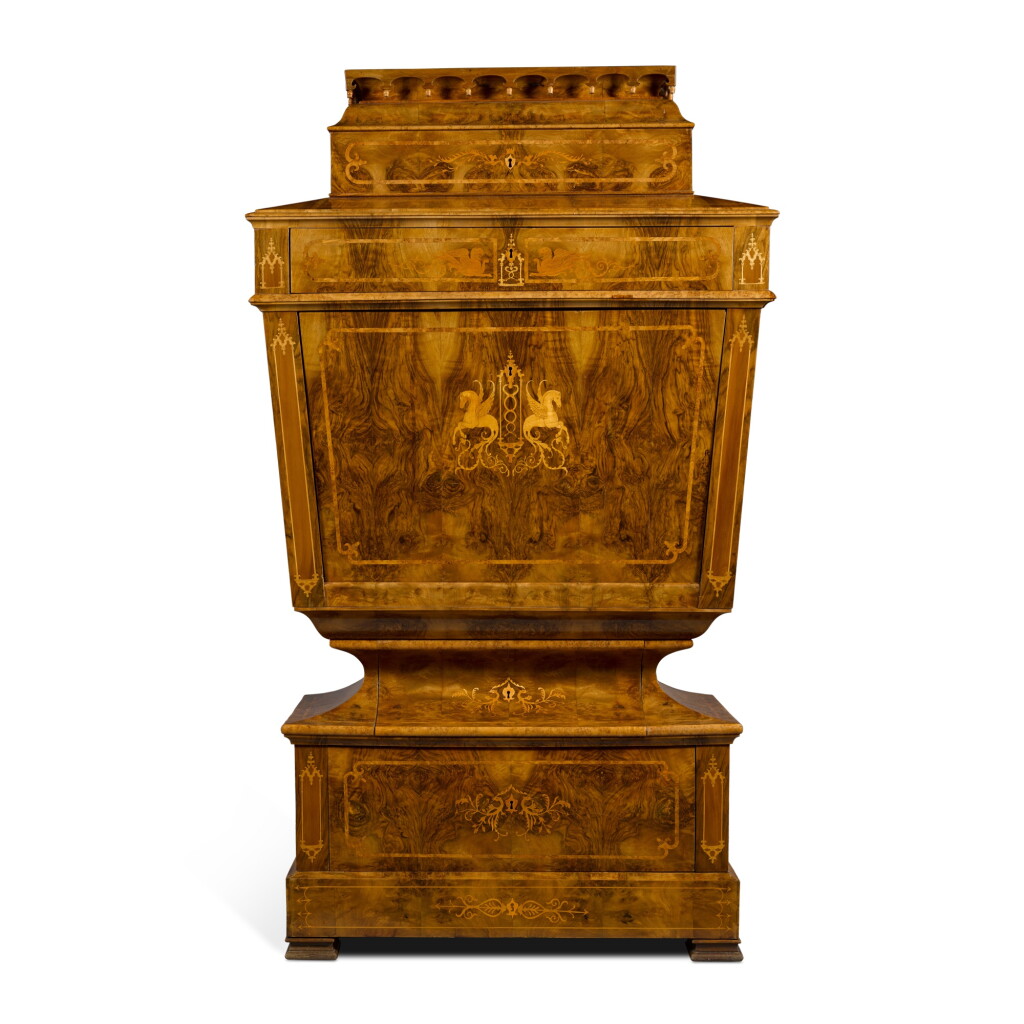
An Austrian Biedermeier walnut and marquetry secretaire cabinet, circa 1830
Auction Closed
December 2, 01:01 PM GMT
Estimate
10,000 - 15,000 GBP
Lot Details
Description
the hinged top opening to a storage compartment, above a sliding drawer with a drop-down front, enclosing a drawer on either side flanking a niche set with a mirror, the middle section with a drop-down door decorated with two pegasi on either side of intertwined snakes opening to reveal an fitted a interior with pigeon holes above four drawers flanking on either side a wooden tempietto raised on a small drawer and placed in front of a mirror backing, some drawers with bone handles, one with the Austrian Empire coat-of-arms, another with the coat-of-arms of the Kingdom of Hungary, the reverse of the door with geometrical marquetry, the lower section with one drawer, and a further drawer
171cm high, 98cm wide, 48cm deep; 67 1/4in., 38 5/8in., 18 7/8in.
The Biedermeier period was highly innovative in the field of furniture design, with inventive new forms springing up and creating the signature eclectic look for the era. This example, with its narrow ‘belted’ section between the plinth and the main desk section, is a variation on the characteristic Lyrasekretär of the period. These case pieces mimicked the Ancient Greek instrument in their overall form, and some even incorporated ‘strings’ into the design, as an example in the Bayrisches Nationalmuseum does (66/22). This consciously classicising attitude is even reflected in the name, since the Latin term lyra is used instead of the German term Leier. Most Lyrasekretäre have curved outlines, making this trapezoidal example highly unusual. A piece of similar form, though with far less ornament, is in the Dresden Kunstgewerbemuseum (39451).
In the secretaire’s interior, the two marquetry arms represent the Kingdom of Hungary (L) and the Austrian Empire (R); the two would not officially unite politically into the Austro-Hungarian Empire until 1867. On the Hungarian arms, the alternating stripes to the left are known as the Árpád stripes, while the round hills on which the double cross rests represent more speifcially the Tátra, Mátra, and Fátra mountain ranges. On the Austrian side, the enclosed coat-of-arms is for the House of Habsburg Lorraine: the rampant lion of the Habsburg branch is to the left, and the diagonal line of three ‘alerions’ (eagles) of the Lorraine branch are to the right.