
Suzanne Belperron
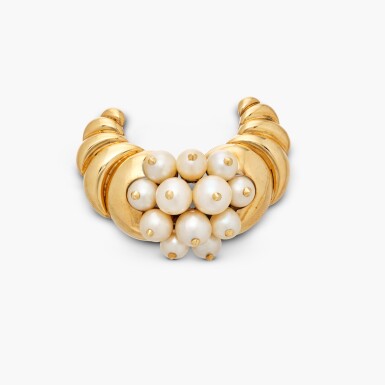
Gold and Cultured Pearl Clip-Brooch, France K金 配 養殖珍珠 胸針,法國
Live auction begins on:
December 8, 11:00 PM GMT
Estimate
10,000 - 15,000 USD
Bid
7,000 USD
Lot Details
Description
Designed as a pair of cornucopiae centering drill-set cultured pearls, with French assay marks and workshop mark for Groëné et Darde; 1937-1942.
Accompanied by Certificate of Authenticity no. 251007d by Olivier Baroin dated October 7, 2025 stating that Groëné et Darde manufactured the piece between 1937 and 1942.
One of the most consistent and striking features of Belperron jewels is their scale and volume. There was a general trend of geometric jewelry becoming less delicate and more substantial as the 1920s turned into the 1930s, but Belperron was very much in the vanguard of this, designing her rotund “Bibendum” ring by 1919 before she began working for René Boivin. Her work helped to popularize the large, bulky jewelry that the contemporary fashion press sometimes described as “barbaric” style. Her carved rock crystal and chalcedony creations exemplify this fashion, but even gold wirework takes on a solid volumetric aspect. Lot 6, a pair of gold and diamond cuffs designed to resemble the frilled paper sometimes used to decorate meat bones, uses thin gold wires to form a volumetric shape. Lot 7, a crescent-shaped gold and cultured pearl brooch looks almost as though it has been inflated with air.
Forever Modern
Suzanne Belperron
Suzanne Belperron (1900-1983), née Vuillerme, was born in the village of Saint-Claude in the French Jura region to a family with ties to the area’s lapidary and watchmaking industries. Shortly after her birth, Suzanne’s father took a position in Bésançon and it was here, at the age of 16, she began her training in watchmaking and jewelry decoration at the Écoles Municipales de Musique et des Beaux-Arts. By this time her father had passed away, and it was therefore highly fortuitous that the school was not only free but open to female students. She showed a natural facility for design and draftsmanship, and her surviving designs from this period exhibit hints of the sculptural and geometric qualities of her later work. In 1919 she moved to Paris where she was hired as a designer by the jewelry firm René Boivin. Founded in 1893, the company was a prominent and successful house known for its innovative designs and cultured clientele. Upon René Boivin’s death in 1917, his widow Jeanne, the sister of famed fashion designer Paul Poiret, took over as director and went on to lead the house through some of its most influential and prosperous years.
Belperron’s experience at the company was to have a profound impact upon her career. Madame Boivin served as the young designer’s mentor as her style and position advanced within the firm, elevating her to the role of co-director in 1924. The house’s tendency to eschew advertising and its avoidance of adding signatures—instead relying upon word-of-mouth and loyalty to attract customers—are practices Belperron continued throughout her life. The Legacy of Elegance collection includes two jewels created during Suzanne Belperron’s years at René Boivin. Lots 15 and 16, two carved rock crystal and diamond brooches made as early as 1928, are masterful examples of Belperron’s work that incorporate the volume, geometry and translucency she would revisit throughout her career.
In 1932 Suzanne left René Boivin and began a collaboration with noted gemstone and pearl dealer Bernard Herz. Belperron became the sole designer and director for the newly formed Maison Herz. The two opened a private salon on Rue de Châteaudun that quickly began to attract discerning and prominent clients. Groëné & Darde, a jewelry workshop owned by Maurice Groëné and Émile Darde with whom she had worked while at René Boivin, became her dedicated manufacturers. Belperron’s jewels became constant fixtures in the fashion press during the 1930s, appearing frequently in publications such as Vogue and Harper’s Bazaar. Sometimes the jewels were attributed to Maison Herz, but she was often credited as their designer, an unprecedented degree of recognition for a woman in the industry at that time. Always extremely stylish and traveling in sophisticated circles, she sometimes appeared in the contemporary fashion press alongside her creations. Her high-profile clients included some of the most celebrated figures of the era, including Daisy Fellowes, Mona Bismarck, the Duke and Duchess of Windsor, Ganna Walska, Princess Agha Khan, Adele Astaire and Diana Vreeland. Despite her prominence, she continued to decline to sign her jewelry, explaining, “My style is my signature.”
The year 1941 brought tragedy to the firm when it was confiscated by the occupying Nazi government due to Bernard Herz’s Jewish origins. Belperron purchased the company herself, with Herz’s assistance, renaming it Suzanne Belperron. In 1943, to her horror, Bernard Herz was deported to Auschwitz and killed. When Jean, Bernard’s son, was released from captivity in 1946, she offered to return the company to the Herz family. In appreciation of her stewardship throughout the war and her indispensable talent, Jean offered her a partnership, and the firm was renamed Herz-Belperron. It continued to attract a loyal clientele in the post-war years, adapting to changing styles. In 1963 Belperron was made a knight of the Legion of Honor for her contributions to French jewelry design and manufacturing. She decided to retire in 1975, though she continued to work on occasional projects until her death in 1983.
In the late 1980s, the heirs to the Maison Herz-Belperron sought a custodian who would preserve Belperron’s legacy with the same integrity that characterized her career. They approached Ward Landrigan—then owner of Verdura and formerly head of Sotheby’s Jewelry Department in New York—who had gained international recognition for his careful stewardship of the Verdura archives. In 1999, Landrigan acquired the rights to the Belperron brand as well as an extensive archive of over 9,300 gouache designs and tracings, wax models, molds and inventory books. These materials not only document her remarkable career and act as a critical resource in authenticating her original creations, but also serve as the creative foundation for each jewel produced today. As the steward of the House of Belperron, Nico Landrigan works with collectors and museums authenticating the original work of Suzanne Belperron. The company lives on in a beautiful salon located at 745 Fifth Avenue in New York City, modeled on Suzanne Belperron’s own Paris apartment.
While other jewelry houses have produced jewels that fall in-and-out of fashion, the designs of Suzanne Belperron never look dated. For more than one hundred years, her signature style has never lost its edge.
You May Also Like


