
Property from a branch of the Breguet family
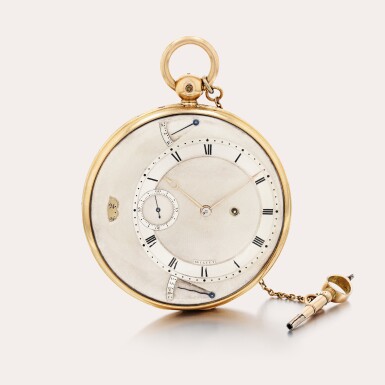
An important and exceptionally fine 20ct gold slim self-winding open-faced Perpetuelle Montre à Tact of Royal Provenance with lever escapement, date and state-of-wind indication
Breguet, No. 4548 | Sold to His Majesty King George IV of Great Britain on 3 July 1827 for the sum of £350, Fr. 7,500
Auction Closed
November 9, 08:49 PM GMT
Estimate
300,000 - 800,000 CHF
Lot Details
Description
gilded movement, lever escapement, jewelled pallets to lever, jewelled wheel train, two-armed compensation balance, parachute suspension to both pivots, steel spring with terminal curve and regulator, platinum perpétuelle weight recessed into the main plate, buffer springs for weight mounted to edge of movement with ruby banking rollers, numbered to bottom plate 4548
silver engine-turned dial, guilloché damier patterned centre and clou de Paris surround, eccentric satin finished twin chapter rings with Roman numerals and pearled minute track, off-set subsidiary seconds at 9 o’clock, aperture for winding beside 3 o’clock, gold moon hands, the minute hand with steel centre and eccentric square aperture for setting to base, two damier fan-form sectors for regulation above 12 and state-of-wind indication below 6 with blued steel serpentine hand, aperture for date outside chapter ring at 9 o’clock, angled cartouche signed Breguet
20ct gold Tavernier case, engine-turned à grains d’orge, with plain gold tapered tact hand mounted to back, touch pins of platinum to band, case back interior with Paris assay and discharge marks comprising baby’s head 2 in fitted frame (second standard gold 840/1000), Pegasus 2 in irregular hexagonal frame (840/1000, 1819-1838), pendant with Paris ox head assay mark (1822-1838), maker’s mark MAB beneath a triangle for Tavernier workshop and numbered B 4548, T 4114
Measurements
diameter 63mm
depth of case 15mm (excluding tact hand)
depth excluding glass and tact hand 11.5mm
weight 217.1g (excluding key and chain)
Accompaniments
with a later short gold chain and double ended key, later Desoutter morocco leather fitted presentation case numbered to the lid 4548 and a Breguet 250th anniversary certificate
Sold on 4 July 1827 to King George IV.
Le Roy et Fils, 57 New Bond Street, sold in 1908 for £400.
Sir John Prestige.
Sotheby & Co., Catalogue of Ten Important Watches and a Timekeeper, The Property of Lady Prestige, 22 April 1963, lot 11 sold for £3,100 ($8,680) to Chollet.
Current Private Collection, purchased from the above.
Musée International d’Horlogerie, La Chaux-de-Fonds, 1976, Vitrine 5, No. 3.
- Breguet, C., A. L. Breguet Horloger, Ramsgate: Thanet Printing Works, 1961, p. 19.
- Clutton, Cecil & Daniels, George, Watches, Third Ed., London: Philip Wilson for Sotheby Parke Bernet, 1979, figs. 265a-265c.
- Breguet, Emmanuel, Breguet Watchmakers since 1775, Revised and Expanded Edition, Swan Éditeur, 2016, pp. 322-323, pls. 378-379.
- Daniels, George, The Art of Breguet, London & New York: Sotheby Parke, Bernet, 1975, p. 281, pls. 348a-b.
- Jagger, Cedric, Royal Clocks, London: Robert Hale, 1983, p. 183.
- L’Oeuvre d’Abraham-Louis Breguet 1747-1823, Musée International d’Horlogerie Suisse, 1976, p. 25, no. 3.
- Connaissance des Arts, March 1962.
- Horological Journal, Vol. 105, No. 3, March 1963, p. 63 (Sotheby’s Advertisement).
Given its historical importance and outstanding quality, this Royal watch has been featured in numerous publications and was included in the landmark exhibition L’Oeuvre d’Abraham-Louis Breguet, held at the Musée International d’Horlogerie in La Chaux-de-Fonds in 1976. That retrospective brought together more than 120 Breguet watches and clocks, among them the legendary no. 160, the so-called Marie Antoinette, and no. 92, made for the Duc de Praslin — a watch almost as technically ambitious as the Marie Antoinette itself. The present watch, no. 4548, was among the highlights and was displayed in Vitrine 5, which contained a select group of ten Breguet perpétuelle watches.
King George IV was one of Breguet’s most loyal patrons. As Prince of Wales, he began purchasing pieces by Breguet in the 1790s,1 continued during his tenure as Prince Regent during his father’s illness, and carried this patronage into his reign as King. Among his collection were some of the most significant clocks and watches ever made by Breguet, reflecting both his appreciation of science and his desire for the finest objects to adorn his residences and accompany him in daily life. This exceptional and slim self-winding perpétuelle montre à tact was one of the last watches he acquired, and it embodies many of the key refinements and complications that Breguet perfected. Although made after the death of Abraham-Louis, this watch, no. 4548, encapsulates Breguet’s genius for uniting fashionable elegance with technical refinement and practical utility, a creation ideally suited to a monarch who prized distinction as much as display. With its automatic winding, calendar display, and ingenious tact mechanism for telling the time silently or in darkness, it was conceived for the practical demands of daily life.
Breguet’s perpétuelle design, developed between 1775 and 1779, was his first major horological triumph and laid the foundation of his future reputation. It transformed the unreliable early self-winding watch into a practical and efficient system, employing a dense platinum weight, twin mainspring barrels for a stable 60-hour reserve, and discreet regulation hidden beneath the bezel. It was in the perpétuelle that Breguet developed his own version of the detached lever escapement and first introduced his ingenious parachute shock-protection device. From the outset, the perpétuelle was highly prized for its combination of innovation, reliability, and refinement; early owners included Marie Antoinette and the Duc d’Orléans, helping to establish Breguet as the foremost watchmaker of his age.
The perpétuelle was always among Breguet’s most expensive productions, often enhanced with additional complications such as repeating work. From about 1812 it entered a final stage of development with a markedly slimmer movement in which the oscillating weight was recessed into the main plate – as seen in the present watch. Although Breguet continued to produce some examples with the earlier large platinum weight mounted above the back plate until at least 1817, the recessed construction offered clear advantages: it reduced the overall depth and produced a sleeker profile, better aligned with the refined aesthetic that Breguet had honed since his return from exile in Switzerland.
This watch incorporates many of Breguet’s signature design elements: an engine-turned dial, fan-shaped sectors displaying regulation and state of wind, the latter fitted with a distinctive serpentine hand to differentiate it from the regulator. The eccentric dial is further characterised by its laterally shifted, off-centre chapter ring, a feature introduced by Breguet’s son in the mid-1820s.2 In the space this creates to its left, the date is shown through a small window. Unlike many perpétuelles, this example also includes a provision for manual winding through the dial and a further opening in the dial allows regulation of the movement. With hand-setting, winding (when required) and regulation all performed entirely from the front, the movement was thereby protected from unnecessary intervention. To the reverse, Breguet’s ingenious tact system enabled the time to be read silently by touch, a refinement that allowed the King to consult the hour discreetly, whether in company or in darkness.
Though often vilified and caricatured during his lifetime for self-indulgence and extravagance, later assessments have recognised King George IV as one of the most discerning royal patrons of the arts since Charles I. His collections embraced Old Masters such as Rembrandt and Rubens; he supported contemporary painters including Reynolds, Gainsborough, and Constable; and he welcomed the sculptor Canova to London. He also valued science, bestowing honours on Humphry Davy, William Herschel, and William Congreve. His passion for horology, inherited from his father, found its most refined expression in his loyalty to Breguet, from whom he acquired a succession of remarkable timepieces—including the present watch.
Within the Georgian Papers is a Mémoire des Ouvrages de la Maison Breguet—an account of works supplied to the Royal Household through Breguet’s London agent, Recordon, but still unpaid. Dated 20 January 1812 and addressed to His Majesty the Prince Regent, the memorandum (GEO/25792) lists three Breguet watches and a clock for which payment was outstanding. The first entry is no. 1297, an important tourbillon watch delivered to King George III in 1808 for £280 (see Sotheby’s London, 14 July 2020, lot 28). The others are: no. 2122, a répétition de première classe delivered 30 October 1808 for £156; no. 2187, “une très petite répétition chronomètre” delivered 1 November 1810 for £186; and no. 2661, a small travelling clock with calendar, moon phases, alarm, and repetition, delivered 2 November 1811 for £375. The total outstanding came to £997.
Annotations to the invoice record part-payments beginning in March 1812 (£297). A letter from Breguet’s agent Moreau to Colonel McMahon, dated 29 March 1813 (RA/25862), pleaded for his assistance in obtaining the remaining £700. Moreau wrote: “I hope, Sir, considering the time elapsed, and when you reflect that my departure from this country cannot possibly take place unless this affair is settled, all these reasons…will induce you to procure me the settlement of my account.” His appeal appears to have been successful: further annotations show a payment of £300 in May 1813 and the final £400 in October the same year.
As Prince Regent and later King, George IV continued to acquire remarkable works from Breguet, securing during the 1810s and 1820s some of the firm’s most ambitious and technically advanced creations — of which the present watch is one of the rare examples now in private hands. Other notable pieces from George IV’s collection include:
- Breguet nos. 666 & 507, Sympathique clock with constant force escapement and watch with enamel dial set to time and regulated by the clock. Made for the Prince Regent in 1814 and sold for Fr. 11,500 (Royal Collection).
- Breguet no. 1252, eight-day table clock with constant-force escapement and two-minute tourbillon carriage. Sold to the Prince Regent in August 1814 for Fr. 6,900 (The Art of Breguet, p. 193, figs 167a–c; Sotheby & Co., London, 1 June 1964, lot 63) (Private collection).
- Breguet no. 2788, a large experimental gold precision watch constructed on the principles of resonance, with two dials and twin movements, each with lever escapements and seconds indication. Sold to the Prince Regent on 2 October 1818 for £350 (L.A. Mayer Museum, Jerusalem).
- Breguet no. 3671, double-pendulum monumental astronomical regulator constructed on the principles of resonance with two independent movements and two dials displaying mean time, solar time and equation indication. Originally intended for George III but later offered to George IV by Antoine-Louis Breguet (Royal Collection, Buckingham Palace).
- Breguet no. 4308, gold, pair-cased, half-quarter repeating montre à tact with calendar and equation of time, the repeating work operable only when removed from its outer case. Sold to the King through Rundell, Bridge & Rundell on 27 May 1827 for £380 (L.A. Mayer Museum, Jerusalem).
- Breguet no. 4420, a slim gold and silver hunting-cased watch with ruby cylinder escapement and regulator-type dial. Sold 3 October 1825 for Fr. 2,900 (Collection Montres Breguet S.A.).
George IV (1762–1830) was the eldest son of George III and Queen Charlotte, born at St James’s Palace on 12 August 1762. From childhood he received a demanding education at Kew, where he showed talent for languages, music, and drawing, as well as a gift for mimicry. His charm was often offset by a taste for extravagance, which quickly became a defining feature of his life. As Prince of Wales he immersed himself in fashionable society, accumulating huge debts that were largely channelled into the remodelling of Carlton House with the architect Henry Holland. The project became a showcase of his collecting passions: agents in London, Paris, and further afield secured him paintings, bronzes, furniture, and clocks, which played a central role in furnishing the residence.
In 1785 he secretly and illegally married Maria Fitzherbert, a Roman Catholic widow, and in 1795 was pressured into marrying his cousin, Princess Caroline of Brunswick. The union collapsed within months, though it produced his only child, Princess Charlotte. His treatment of her was often harsh: he dismissed her servants, restricted her movements, and sought to arrange a politically advantageous marriage to the Prince of Orange, which she resisted. Charlotte’s sudden death in childbirth in 1817 was nonetheless a devastating personal blow and a national tragedy, leaving George without a direct heir and throwing the succession into uncertainty. Charlotte’s great friend and confidante, with whom she regularly corresponded, was Margaret Mercer Elphinstone (later the Countess of Flahault), whose Breguet watch is included in this auction – see lot 64.
From the late 1780s the repeated bouts of illness suffered by his father, George III, brought the question of a regency to the fore. A major crisis erupted in 1788–89 when the king’s incapacity seemed permanent, but parliament avoided handing full powers to the prince. It was only after George III’s final mental collapse in 1811 that George was formally installed as Prince Regent, ruling in his father’s name until the king’s death in 1820, when he succeeded as King in his own right. His reign was politically turbulent. The scandal of Queen Caroline’s attempted exclusion in 1820 aroused widespread public sympathy for her and hostility toward the king. Later, he abandoned his old Whig allies, leaned on Tory governments, and, despite his misgivings, was forced to accept Catholic Emancipation in 1829.
George IV’s name is indelibly linked with some of Britain’s most iconic architectural projects. At Brighton he transformed a seaside villa into the fantastical Royal Pavilion; in London he pressed ahead with John Nash’s grand design for Regent Street and Regent’s Park; and as king he commissioned the enlargement of Buckingham Palace and the remodelling of Windsor Castle. These ventures embodied his taste for drama, scale, and splendour.
In his final years he became increasingly reclusive, plagued by ill health and excessive drinking, and died at Windsor on 26 June 1830.3
1 Breguet, Emmanuel, Breguet Watchmakers since 1775, Revised and Expanded Edition, Swan Éditeur, 2016, p. 204.
2 Ibid, p. 234-5.
3 For a full biography of George IV see: Hibbert, Christopher, George IV (1762-1830), Oxford Dictionary of National Biography, 2004.