
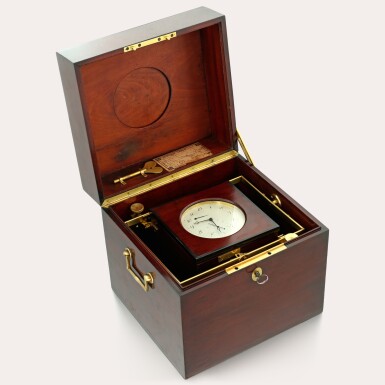
An extremely rare and historical early gilt-brass and mahogany two-day double-boxed marine chronometer with twin barrels
Breguet No. 104 | Sold to Captain Charles Baudin on 9 April 1818 for Fr. 2,000
Auction Closed
November 9, 08:49 PM GMT
Estimate
100,000 - 200,000 CHF
Lot Details
Description
brass Samuel Roy ébauche, two large tandem-wound going barrels turning a single double helix chain fusee, Earnshaw-type spring detent escapement, roller with ruby impulse pallet, large free-sprung bi-metallic compensation balance with moveable timing weights each with additional timing screw, large undersprung grey-finished steel helical spring, diamond endstone, long sleeve for winding square, wound through back
matt silvered dial, black Breguet numerals, sector for 40-hour up-and-down indication, large subsidiary seconds, outer minute ring, signed and numbered Breguet et Fils, No. 104
inner mahogany box with spring arms, outer box with rectangular brass gimbal, sliding viewing aperture to lid with inset brass plaque signed and numbered Breguet 104
Measurements
dial diameter 115mm
inner box 169mm x 169mm x 120mm
outer box 300mm x 280mm x 285mm
Accompaniments
with numbered key, Breguet certificate no. 4529, detailed illustrated book of restoration and a Breguet 250th anniversary certificate
Sotheby's Geneva, 12 May 2019, Lot 70
Since the rediscovery and sale of this historical marine chronometer at Sotheby’s in 2019, it has undergone an extensive and highly skilled programme of conservation and restoration by the specialist conservator Anthony Gray. A book containing detailed photography documenting this process accompanies the lot.
The Breguet certificate notes that work on this marine chronometer was begun in 1795 using an ébauche supplied by Samuel Roy in the early 1790s. Work on the chronometer was interrupted in 1804, re-started in 1812 and finished in 1818 when it was sold to Captain Charles Baudin. It is recorded in the Breguet Archives that this chronometer was returned to Breguet for service five times between 1821 and 1853, each time by Baudin from Le Havre. When returned in 1853, it was noted that the chronometer required full refurbishment having suffered an immersion. Baudin died in 1854 and in later years, the chronometer was returned to Breguet for servicing by Allix, a ship owner also from Le Havre.
Breguet’s earliest known marine chronometers are numbered 104 (the present example), 105, and 106. Until the rediscovery of the present piece, no. 106 - sold at Sotheby’s New York in May 2018 - was believed to be the sole survivor. Chronometers nos. 104 and 105 were originally sold in 1818 and 1817 respectively, each for 2,000 francs, whereas no. 106 was sold earlier, in 1816, despite its higher number in the sequence. Work on these instruments is thought to have begun before Breguet’s exile to Switzerland in 1793.
The box of no. 104 differs in construction from that of no. 106, the latter being more closely aligned with the work of the English watchmaker John Arnold. By contrast, the present example, is contained within a large double mahogany box with rectangular gimbals, a form more consistent with Breguet’s later production.
Despite their differences in casing, the movements of both chronometers display many similarities and reveal a clear debt to Arnold’s influence. The balance design of no. 104, however, also recalls that of Ferdinand Berthoud, featuring four arms with semicircular weights secured by what appear to be gold and platinum screws. It is often said that no two Breguets are truly alike, and here we see the experimental spirit expressed in two almost sequentially numbered marine chronometers that share many characteristics yet also possess distinct differences—a clear illustration of Breguet’s constant pursuit to challenge, refine, and perfect his horological creations. In no. 104, we observe the evolution of the marine chronometer away from the earlier octagonal English style as Breguet established his own distinctive aesthetic and technical identity.
An exceptional piece of horological history, now painstakingly restored and conserved, this represents an extremely rare opportunity to acquire Breguet’s lowest-numbered marine chronometer.
Captain Charles Baudin 1784-1854
Charles Baudin was born in Paris on 21 July 1784, the son of a Convention deputy known as Baudin des Ardennes. Under Bonaparte’s patronage, he entered the French Navy in 1799 and soon joined Captain Nicolas Baudin’s scientific expedition to the South Pacific (1800–1803). He later served in the Indian Ocean aboard the frigates Piémontaise and Sémillante, losing an arm during an action with the British frigate HMS Terpsichore in 1808. Promoted to lieutenant in 1809, Baudin took command of the 16-gun brig Le Renard, escorting convoys between Genoa and Toulon. He was wounded again in 1812 during combat with the British brig The Swallow, though his convoy reached safety in the bay of Saint-Tropez. As captain of La Dryade, he fought the final action of the Imperial Navy off Toulon in February 1814.
While commanding La Bayadère at the Île d’Aix in 1815, Baudin was involved in Napoleon’s abortive plan to flee to the United States after Waterloo. With the Bourbon Restoration he retired from active service, settling in Le Havre as a shipowner. Returning to the Navy after the 1830 Revolution, Baudin was promoted capitaine de vaisseau in 1834 and contre-amiral in 1838. That same year he led the French squadron to Mexico to demand compensation for injuries to French merchants. His bombardment of San Juan de Ulúa marked the first use of explosive shells in naval warfare; he subsequently captured Vera Cruz and concluded a treaty with the Mexican government.
Advanced to vice-amiral in 1839, Baudin served as Commander-in-Chief at Toulon (1840–47), sat on the Bureau des longitudes, and became President of the Admiralty Council in 1847. Following the 1848 Revolution, he commanded the Mediterranean Squadron, using his authority to restrain revolutionary violence at Naples, Messina, and Palermo. Baudin spent his final years in Paris, remaining on the active list until his death on 7 June 1854.1 According to contemporary accounts, Emperor Napoleon III placed an admiral’s baton beside him in recognition of his distinguished service.
1 Wilson, A & Callo, J. Who's Who in Naval History, Routledge, 2004, p.17.