
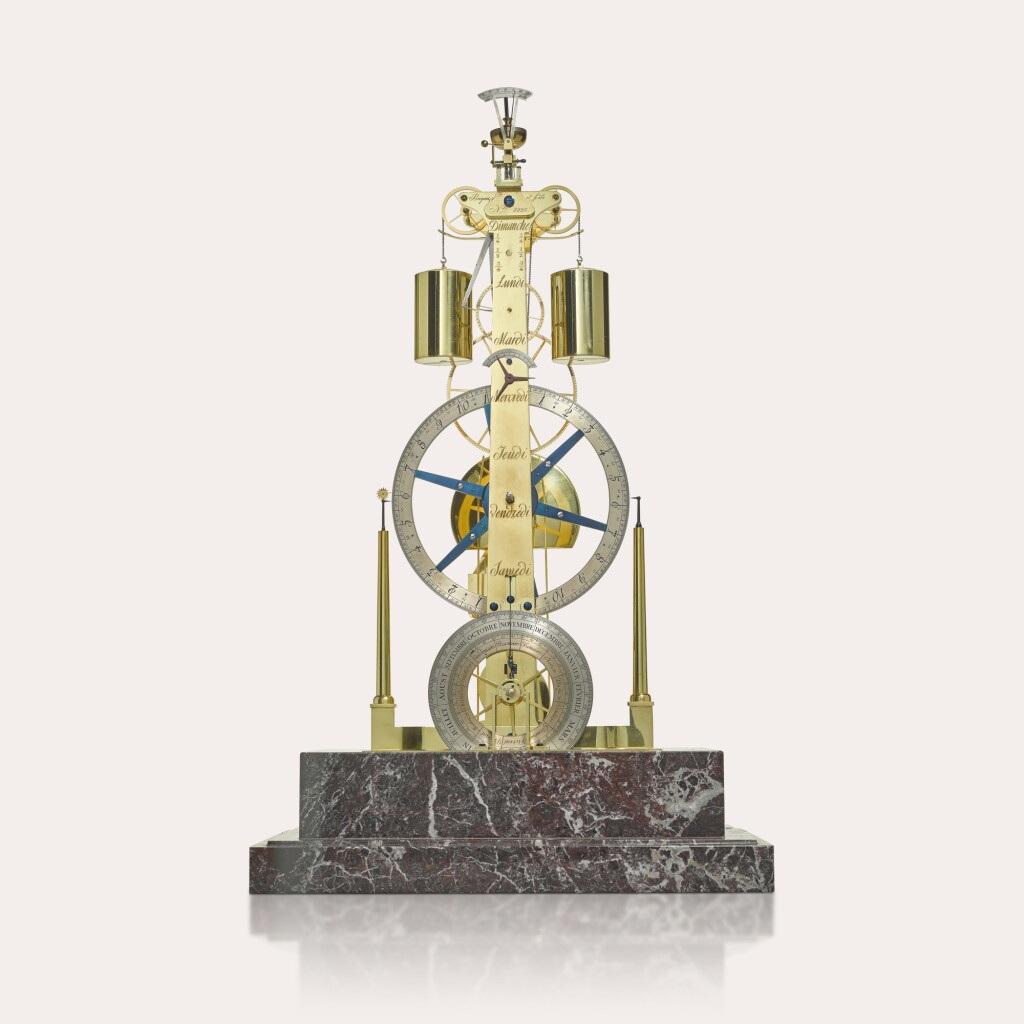
A weight-driven pendule à trois roues skeleton timepiece with equation, Gregorian & French Revolutionary annual calendar and days of the week
Breguet et Fils / George Daniels No. 3225 | Made in 1968
Auction Closed
November 9, 08:49 PM GMT
Estimate
200,000 - 400,000 CHF
Lot Details
Description
7-inch annular 2 x twelve hour silvered principal dial calibrated in two-minute intervals and applied to the great wheel, flanked by two fixed mean time pointers, the equation indicated by a variable sun pointer, its position controlled by a kidney cam mounted behind a revolving annual Gregorian and French Revolutionary calendar dial, the individual days indicated by a plumb line, the minutes indicated on a ten minute sector with triple pointer, the high count train with maintaining power and driven by two brass-cased weights pendant from chains passing over pulleys at the top of the frame, indicating the days of the week engraved on the front frame as their top edges pass by, pin wheel escapement and compound pendulum with knife edge suspension at the rear and cup and pin to the front, the rod with grid-iron compensation below the bob, the upper section mounted with a bi-metallic strip, fine regulation and temperature indication, the whole on a veined red marble plinth with glazed cover
Measurements
660mm height overall
Accompaniments
With Breguet Certificate No. 3200, dated 20th December 1968 and a Breguet 250th anniversary certificate
George Daniels’ personal collection.
Sotheby’s London, The George Daniels Horological Collection, 6th November 2012, Lot 3.
Private Collection.
Sotheby’s London, George Daniels Masterpieces Including the Space Travellers’ Watch, 19 September 2017, lot 120.
Private Collection.
George Daniels Retrospective Exhibition Catalogue, London: Sotheby's, 2006, pp. 10-11.
George Daniels, The Art of Breguet, London: Sotheby Parke Bernet, 1975, pp. 81-82 & col. pl. VIII p. 100.
Daniels, George., All in Good Time, Reflections of a Watchmaker, London: Philip Wilson, 2013, p. 83, plate 18.
Clerizo, Michael, George Daniels, A Master Watchmaker and His Art, London: Thames and Hudson, 2013, p. 110 & col. ills. p. 6.
George Daniels was appointed London agent to Breguet in 1967. It was on a visit to the workshops in Paris that Daniels first saw an original three-wheel Breguet timepiece. “Before that trip to Paris I had never seen one of these clocks. As far as can be determined Breguet made four: But when I saw it I was very struck by it. You could see how it worked in an instant.”1 His admiration was such that he asked George Brown (the then proprietor of Breguet) for permission to measure the original with a view to making a copy. Permission was granted and when George Brown visited Dr Daniels' London workshop, he was so impressed with the copy that he suggested granting it a Breguet certificate so that it would be a genuine Breguet. This was agreed upon in exchange for the profit that Breguet would have achieved had they sold the timepiece, a practice that Breguet himself had engaged in. Daniels made just two examples of the 3-wheel clock and each were entered into the Breguet records under numbers 3224 and 3225. Dr Daniels retained the present timepiece, no. 3225, and it took pride of place on the mantelpiece in the drawing room of his Riversdale home until his death.
The original Breguet three-wheel clocks, known as pendule à trois roues, were made by Breguet between 1795 and 1818, two are illustrated in Daniels’ book, The Art of Breguet, 1975, plates 104 & 99 – the former is unnumbered and the latter, which Daniels dates to c. 1795 is numbered 111.
The clock has a three-wheel train and is geared for an 8-day running duration. The largest wheel makes one revolution every twenty-four hours. A silvered chapter ring is mounted to the wheel and displays the hours divided into ten-minute segments, each of which is subdivided with five graduations representing two minutes of time. A second wheel which completes one revolution every thirty minutes engages a three-armed pointer to mark the minutes more clearly against a silvered sector mounted on the central gilt-brass frame. A subsidiary dial at the base makes one complete rotation each year. With its 365 teeth, advanced daily by the main wheel, it shows both the date and month according to the Gregorian and Revolutionary calendars. This dial also carries the equation cam for solar time. A cord stretched across its surface indicates the date on the display behind it and terminates in a plumb bob used for levelling the clock. On the case are two vertical columns with indicators: the left column has two pointers, one fixed and another which rises and falls to indicate the daily equation of time. The right-hand column has a pointer to indicate mean time on the chapter ring.
George Daniels’ fascination and admiration for the genius of Breguet is well known. As the world’s leading expert on Breguet, Daniels examined, restored and photographed a vast array of Breguet clocks and watches. His study and expertise was shared in his important book, The Art of Breguet, which was published in 1975. It was during the early 1960s that Daniels first met George Brown, the then proprietor of Breguet in Paris. The pair soon became friends and Brown allowed Daniels access to the famous Breguet archives which recorded the date of manufacture of every Breguet clock and watch. This of course was an invaluable resource for Daniels, as he noted in his autobiography, All in Good Time, ‘this information was important to my personal Breguet records in that it helped to give perspective to Breguet’s system of manufacture’.2 It was during Brown’s visit to Daniels’ workshop to examine the present three-wheel timepiece, that Daniels mentioned he was starting the manufacture of his first watch. Clearly impressed, Brown asked Daniels if he would consider making new Breguet watches. For Daniels this was of no interest for, as he later explained “this would have meant burying my own name under the Breguet mantle” and he later recounted telling Brown how “much as I admired Breguet, who was a direct inspiration for my determination to make my own watches, I was, in the modern context, inclined to prefer ‘Daniels of London’ to ‘Breguet of Paris’ “3
1 Clerizo, Michael, George Daniels, London: Thames and Hudson, 2013, p. 110.
2 Daniels, George, All in Good Time, Reflections of a Watchmaker, London: Philip Wilson, Revised 2013 edition, pp. 83-84.
3 Ibid.