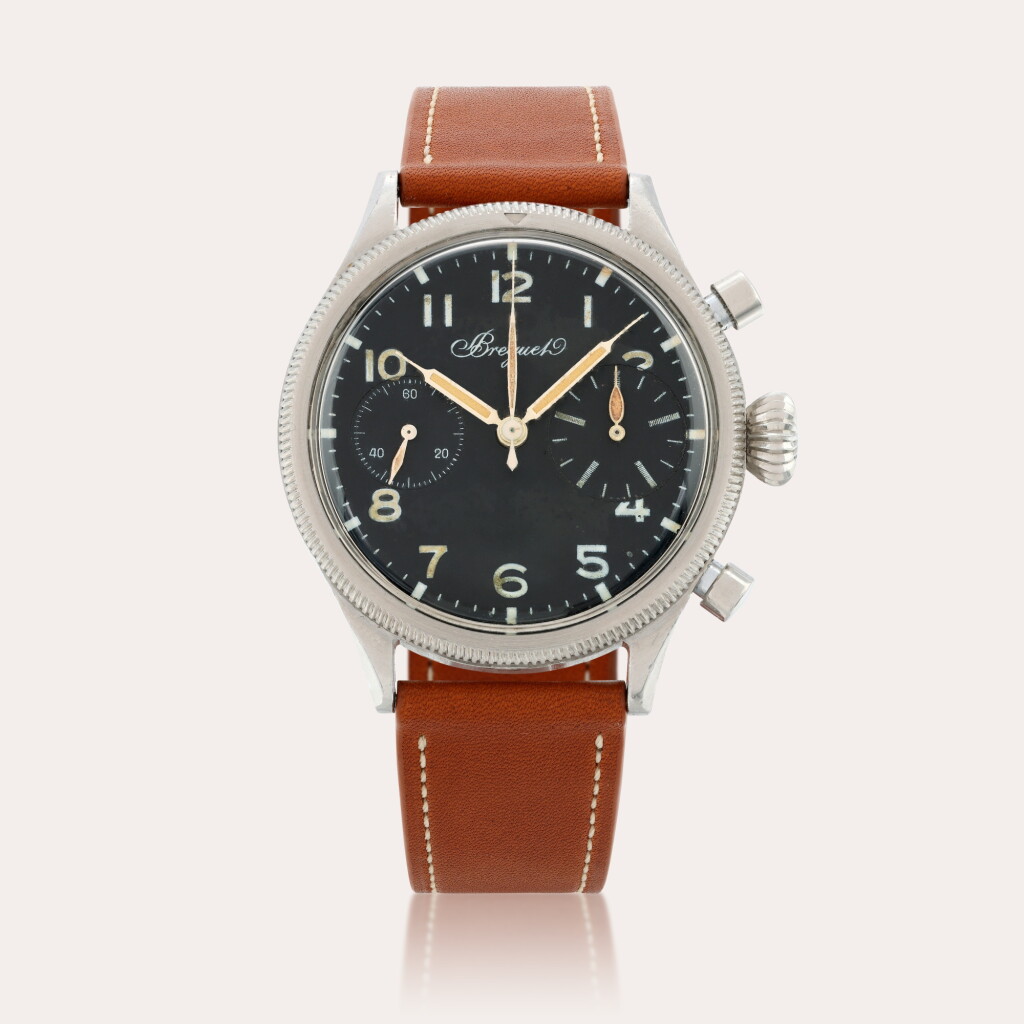
A stainless steel flyback military chronograph wristwatch with register
Breguet No. 343/500 B 4290, Type XX Aéronavale | Supplied to the Aéronautique Navale on 13 January 1960
Auction Closed
November 9, 08:49 PM GMT
Estimate
22,000 - 45,000 CHF
Lot Details
Description
14’’’ Valjoux manual winding calibre 222, lever escapement, 17 jewels, mono-metallic compensation balance, chronograph bridge work visible to the backplate
matt black dial, luminescent Arabic numerals and syringe hands, luminescenet feuille chronograph seconds hand, outer white track calibrated for minutes/chronograph seconds with luminescent 5-minute markers, subsidiary seconds and oversized 15-minute register each with luminescent hand, the minute register with luminescent batons at each 3-minute interval, cursive Breguet signature
stainless steel case, rotating bezel with milled edge and triangular indicator, two chronograph pushers to the band, down-turned lugs with chamfered edges, screw-down case back engraved BREGUET MARINE NATIONALE AERONAUTIQUE NAVALE 'FG 29 10 66', 'FG 10 3 70', 'FG 26 3 72' and 'FG 4 1 68', further signed and numbered 4290, 343/500
Measurements
diameter 38.5mm
depth including crystal 14 mm
Accompaniments
with a Breguet 250th anniversary certificate
The Breguet Archives confirm that this military chronograph was part of a special series of 500 pieces supplied to the Aéronautique navale on 13 January 1960.
A defining feature of many early Type XX chronographs was the clear demarcation of each three-minute segment on the minute register. On this example, each three-minute interval is highlighted by a luminescent baton within the 15-minute totalizer, positioned at 3 o’clock on the dial. This detail reflected the practical needs of aerial navigation. Pilots often relied on the so-called “three-minute rule”, which takes 60 knots as a baseline: at that speed an aircraft covers one nautical mile per minute, making distance straightforward to calculate in three-minute blocks. Although no combat aircraft of the 1950s would cruise at 60 knots, this simple benchmark allowed instant proportional calculations at higher speeds. At 180 knots, for example, three minutes equates to 9 nautical miles; at 240 knots, 12 nautical miles; at 300 knots, 15 nautical miles; and at 360 knots, 18 nautical miles.
Since many Air Force aircraft of the period typically cruised between 180 and 420 knots, the rule remained entirely practical in day-to-day flying. The 15-minute counter enabled navigators to work in convenient three-minute multiples, while the Type XX’s flyback function allowed immediate reset and restart at each turning point or checkpoint. Together, these features demonstrate how the Type XX was conceived as a genuine pilot’s instrument, tailored to the operational realities of mid-20th-century military aviation.
The Aéronautique navale, commonly known as the Aéronavale, is the aviation branch of the French Navy. It traces its origins to 1910, when the French Ministry of Marine established an experimental naval air service — one of the earliest of its kind worldwide. Initially focused on seaplanes and reconnaissance, it developed rapidly during the First World War and evolved into a permanent component of the Navy, operating from both shore bases and aircraft carriers. Its missions have included fleet protection, anti-submarine warfare, maritime patrol, reconnaissance, transport, and search and rescue. From the 1950s, the Aéronavale was among the principal recipients of Breguet’s Type XX chronographs, alongside the French Air Force and the Centre d’Essais en Vol.