
Property from a branch of the Breguet family
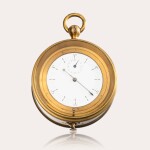
A gilt-brass Compteur à Coincidences inking chronograph with 60-minute register
Breguet, No. 959 | Circa 1845
Auction Closed
November 9, 08:49 PM GMT
Estimate
10,000 - 20,000 CHF
Lot Details
Description
23’’’ gilt-brass movement, cylinder escapement with steel shell, plain flat three-arm balance, blued steel regulator with extended pivoted arm and arc for regulating through case back aperture, large nib to band slides a lever with plain steel whip to start and stop movement, movement and dial backplates each numbered 959
white enamel dial, twin outer chapter for seconds with Arabic 10-second markers, central plain ring between seconds rings to accommodate ink spot, 60-minute register to top of dial with secret ‘6’
gilt-brass drum-form case, milled bezels, start/stop nib to band below ’30’ engraved M/A for Marche/Arret, adjacent pusher for activating inking pin, plain ring pendant, apertures for winding and regulation to back, case back with locator pin and secured by two screws, case back exterior signed and numbered Breguet No. 959
accompanied by a presentation box with fitted velvet lined interior including glass ink vial, handwritten label inside lid marked Comteur à Coincidences, Breguet no. 959, S.G.A. no., Temps: Moyen, Huiles: __ further handwritten number 2/1878 2[?]3, label to base of box marked No. Money, Epoque des Huiles, October 1913, Ancienne Maison Thomas, J. Auricoste, Succr, 10, Rue la Boëtie, Paris (8e) Paris 1900 - Médaille d’Or.
Measurements
diameter 79mm
case depth 40mm
weight 481.2g
Accompaniments
with a Breguet 250th anniversary certificate
The Breguet Archives record that this inking chronograph was never sold. It has remained with a branch of the Breguet family by descent from Abraham-Louis Breguet’s grandson, Louis-Clément Breguet (1804-1883). A late example of the Fatton/Breguet device, this form of inking chronograph was perfected by Louis-Clément himself.
The inking chronograph hand is designed to place its spot of ink on the dial in the space between the twin outer seconds tracks. This ensures that the ink spot cannot be concealed by the black tracking and remains clearly visible. A reservoir at the tip of the hand is first filled with ink and, when activated via the pusher to the band, the hand is driven by the barrel ratchet. The action of the inking ‘pen’ is instantaneous and does not slow the chronograph’s going train. As Daniels noted, the relatively short periods of time for which these chronographs were designed meant that a cylinder escapement and plain, uncompensated balance were perfectly adequate for reliable performance.1 In The Art of Breguet, George Daniels further observes that while there are variations in the ‘linkage’ mechanisms that operate Breguet’s inking ‘pen’, they are all conceived along the same principles.2
The inking chronograph was invented by one of Breguet’s most talented workmen, Frédéric Louis Fatton, who was granted British Patent no. 4707 on 9 February 1822. At the time, Fatton was working independently in London, while also acting as Breguet’s agent. Exactly a month later, on 9 March 1822, Nicolas Mathieu Rieussec (1781–1852) was granted a French patent for his own inking chronograph. It was Rieussec who introduced the term chronograph, using it within his patent application.3
The label to the base of the fitted box bears the name Ancienne Maison Thomas, J. Auricoste. J. Auricoste succeeded Émile Thomas at 10, rue La Boétie, Paris, in 1889. Into the early 20th century, pieces often carried the wording “Thomas / J. Auricoste Succr,” and by c.1913 the firm was trading under the name J. Auricoste, Horloger de la Marine, at the same address.
A similar inking chronograph, numbered 525, can be found in the collection of the Breguet Museum and is illustrated in Breguet in the Hermitage, 2004, p. 133.
1 Daniels, George, The Art of Breguet, London & New York: Sotheby Parke, Bernet, 1975, p. 72.
2 Ibid.
3 Turner, Anthony; Nye, James & Betts, Jonathan – Editors, A General History of Horology, Oxford: OUP, 2022, p. 578.