
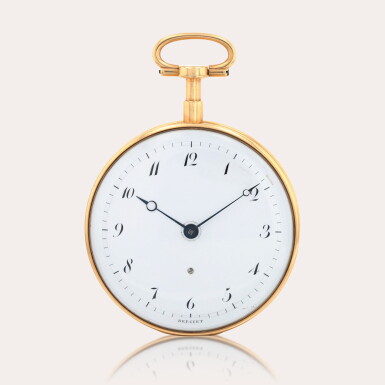
Property from a branch of the Breguet family
A 20ct gold open-faced ruby cylinder watch quarter-repeating à toc
Breguet No. 952 | Sold to Davin Leleu on 25 Germinal An 10 [15 April 1802] for Fr. 1,200 Breguet
Auction Closed
November 9, 08:49 PM GMT
Estimate
7,000 - 14,000 CHF
Lot Details
Description
20’’’ gilded movement, hanging barrel, ruby cylinder escapement, plain three-arm balance with parachute suspension, blued steel flat spiral balance spring and regulator index, bi-metallic compensation curb, quarter repeating train with exposed blued steel spring, racks beneath dial, two asymmetrically shaped polished hammers repeating à toc on blocks mounted to interior of band, bottom plate numbered 952
white enamel dial, Breguet numerals, secret signature ‘Breguet No. 952’ beneath 12, outer minute ring, blued steel Breguet hands, dial securing screw above 6 o’clock, further signed Breguet beneath 6 o’clock, reverse of dial counter enamelled and signed [X]orel 37 possibly Borel
20 ctgold Tavernier case engine-turned à grains d’orge, case back centred by vacant circular cartouche surrounded by translucent blue enamel filet sauté ring, fluted band, plunge pendant repeat, gilded hinged cuvette with aperture for winding signed Breguet No. 952, case back interior with rubbed Paris assay and discharge marks comprising baby’s head (2) in irregular cartouche (2nd standard gold 840/1000), cockerel to left in oval frame (2) (840/1000, 1798-1809) man’s head facing forwards (85) in circular frame (excise mark 1798-1809), maker’s mark P. B T beneath a triangle in irregular pentagonal cartouche for Pierre-Benjamin Tavernier, numbered B 952, Tavernier number rubbed (possibly 1741)
Measurements
diameter 52.5mm
depth 17.2mm
weight 128.8g
Accompaniments
with a later associated steel and gilt key and a Breguet 250th anniversary certificate
Purchased from George Brown at Breguet on 24 October 1959.
Breguet produced a wide range of repeating watches in both gong and à toc forms, and occasionally in combinations of the two. He is often credited with inventing the gong-type repeating mechanism, which enabled a slimmer case profile by mounting a length of sonorous steel wire around the perimeter of the movement, rather than placing a bell above the backplate as was traditional. With repeating watches in great demand, this innovation allowed Breguet to pursue his characteristically slim and elegant designs without compromising aesthetic refinement in order to accommodate the complex mechanism.
Breguet’s repeating watches evolved through a number of developmental stages, and the movement in the present watch belongs to a new form of Lépine-style calibre introduced in 1799.1 In this open-form construction, the train wheels are supported beneath individual cocks rather than a full backplate. A hanging mainspring barrel is positioned adjacent to the pendant, while the exposed blued-steel spring for the repeating train is held within an asymmetrical cock between the mainspring barrel and the balance.
The enamel dial is signed and numbered on the reverse and, although the signature is partially worn, it is most likely attributable to Borel. Daniels records Borel as a supplier to Breguet, and an example of another under-dial image bearing the Borel signature and numbered 88 is illustrated in The Art of Breguet (1975), p. 134, fig. 60b.
1 Daniels, George, The Art of Breguet, London & New York: Sotheby Parke, Bernet, 1975, p. 68.