
Property from the Collection of Seymour Stein
Sir John Everett Millais, P.R.A.
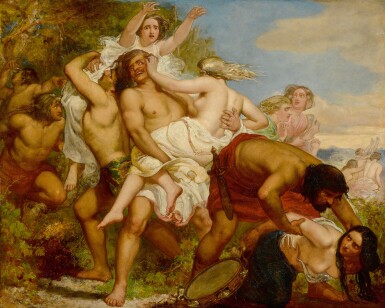
The Tribe of Benjamin Seizing the Daughters of Shiloh
Lot Closed
October 15, 07:10 PM GMT
Estimate
30,000 - 50,000 USD
We may charge or debit your saved payment method subject to the terms set out in our Conditions of Business for Buyers.
Read more.Lot Details
Description
Property from the Collection of Seymour Stein
Sir John Everett Millais, P.R.A.
British 1829 - 1896
The Tribe of Benjamin Seizing the Daughters of Shiloh
oil on canvas
canvas: 40 ¼ by 50 ½ in.; 102.2 by 128.3 cm
framed: 50 ½ by 60 ½ in.; 128.3 by 153.7 cm
We would like to thank Jason Rosenfeld, Ph.D, Distinguished Chair and Professor of Art History, Marymount Manhattan College, New York for contributing to this catalogue entry.
Sale, Christie's, London, 9 March 1867, lot 83A
Cameron Miller, Esq.
Sale, Sotheby's, Belgravia, 20 November 1973, lot 44
Sale, Sotheby's, London, 21 June 1989, lot 101
Where acquired by the present owner
London, British Institution, 1848, no. 259
London, The Old British Gallery, 1877
The Illustrated London News, London, 18 December 1847, p. 400
Appleton's Journal, vol. XII, New York, 24 October 1874, p. 513, no. 292
The Art Journal, 1877, p. 16
"In Memoriam: Sir John Everett Millais, Bart, P.R.A," vol. 19, The Magazine of Art, London 1896, p. iv
The Sketch, London, August 19, 1896, vol. XV, no. 186, p. 131
M. H. Spielmann, Millais and His Works, 1898, pp. 21, 165, 167
Alfred Lys Baldry, Sir John Everett Millais, His Art and Influence, London 1899, pp. 23, 39
John Guille Millais, The Life and Letters of Sir John Everett Millais, New York 1899, vol. I, pp. 18-19, 23; vol. II, p. 467
William Holman Hunt, Pre-Raphaelitism and the Pre-Raphaelite Brotherhood, vol. 1, London 1905, pp. 67, 75-76
Arthur Fish, John Everett Millais 1829-1896, London 1923, p. 10
Millais: An Exhibition organized by the Walker Art Gallery Liverpool & the Royal Academy of Arts London, exh. cat., Walker Art Gallery, Liverpool; Royal Academy, London, January-April 1967, p. 70
Joanna Barnes, John Christian and Benedict Read, Pre-Raphaelite Sculpture: Nature and Imagination in British Sculpture 1848-1914, London 1991, p. 110
Alison Smith, "The Pre-Raphaelite Nude," Collecting the Pre-Raphaelites: The Anglo-American Enchantment, London 1997, n.p.
Malcolm Warner, “Millais, Sir John Everett, first baronet (1829-1896),” Dictionary of National Biography, Oxford 2004, n.p.
Michaela Giebelhausen, Painting the Bible: Representation and Belief in Mid-Victorian Britain, London 2006, pp. 100-101
The Tribe of Benjamin Seizing the Daughters of Shiloh in the Vineyards is one of John Everett Millais's most important early compositions, painted when the artist was only eighteen years old. It won him the Gold Medal for history painting in the Academy Schools in 1847, and he exhibited it at the British Institution in January 1848, his second and final time showing at that venue. It represents the summit of his student work, and one of his final major pictures made before the inception of the Pre-Raphaelite Brotherhood.
The subject is from the Book of Judges in the Old Testament. The Tribe of Benjamin, at war with the other tribes of Israel, had been reduced to only 600 men and feared extinction. The Benjamites sought wives, and they planned to ambush a tabernacle feast in Shiloh where young women were dancing in the vineyards: "So they instructed the Benjamites, saying 'Go and hide in the vineyards and watch. When the young women of Shiloh come out to join the dancing, rush from the vineyards and each of you seize one of them to be your wife. Then return to the land of Benjamin'" (Judges 21: 20-21).
Fifty years after the British Institution exhibition, the critic M.H. Spielmann adeptly praised it as showing “a power of composition, a freedom of drawing, and a bigness of design—a capacity to use the human form in the 'grand manner'.... painted to prove the artist's knowledge in the rendering of flesh and the figure" (Spielmann, p. 165). As in his first major picture exhibited at the Royal Academy of Arts, Pizarro Seizing the Inca of Peru (1846, Victoria and Albert Museum, London), Millais here channeled works by both the old and modern Romantic masters to vivify a historical scene. For example, the torso and legs of the male figure in profile at left of center recalls both the striding form of the famed Hellenistic Borghese Fighting Warrior composition (Musée du Louvre), and the arcing and stressed body of Hercules in Antonio Canova’s Hercules and Lichas (1795-1815, Galleria Nazionale d’Arte Moderna e Contemporanea, Rome). At upper center, the woman’s alarmed expression and foreshortened outstretched arms echo female bodily distress familiar in historical works by Jacques-Louis David, John Singleton Copley, and Henry Fuseli, all readily available to the young Millais in reproductive engravings after oil paintings or in the original works. The central couple recalls abduction scenes in sculptures such as Giambologna’s Rape of a Sabine (1579-83) and Bernini’s Rape of Proserpina (1621-22), familiar to artists via small-scale bronze reproductions, or similar scenes in numerous Baroque paintings by artists such as Poussin and Rubens. The right foreground duo reprises a similar vignette in the same position in Antoine-Jean Gros’s Napoleon on the Battlefield of Eylau, February 9, 1807 (1808, Musée du Louvre), with the French soldier offering succor to a defeated Prussian now replaced by a more malevolent image of an attacking man and a partly nude woman, her cymbal cast aside; she bears an expression that is both stern and apprehensive. In studiously and adroitly integrating such artistic traditions of pictorial and sculptural historical representations into his work, Millais demonstrated his art historical savvy and compositional and painterly skills. And by using clearly contemporary models' faces in the same way that he would in his Cymon and Iphigenia of 1848 (Lady Lever Art Gallery, Port Sunlight), he risked censure by critics who detected too much realism in his designs. It was this latter tendency towards an adaptive yet radical approach that led Millais to join with six other artists to form the Pre-Raphaelite Brotherhood in September of 1848, the same year this picture was first exhibited, and to turn away from the old master and Romantic sources seen in such early, award-winning efforts. Through a combination of Early Italian and Early Netherlandish influences with modern techniques, Millais would thus contribute to forging a new direction for British art.


