
Property from a Private California Collection
Narcisse Virgile Diaz de la Peña
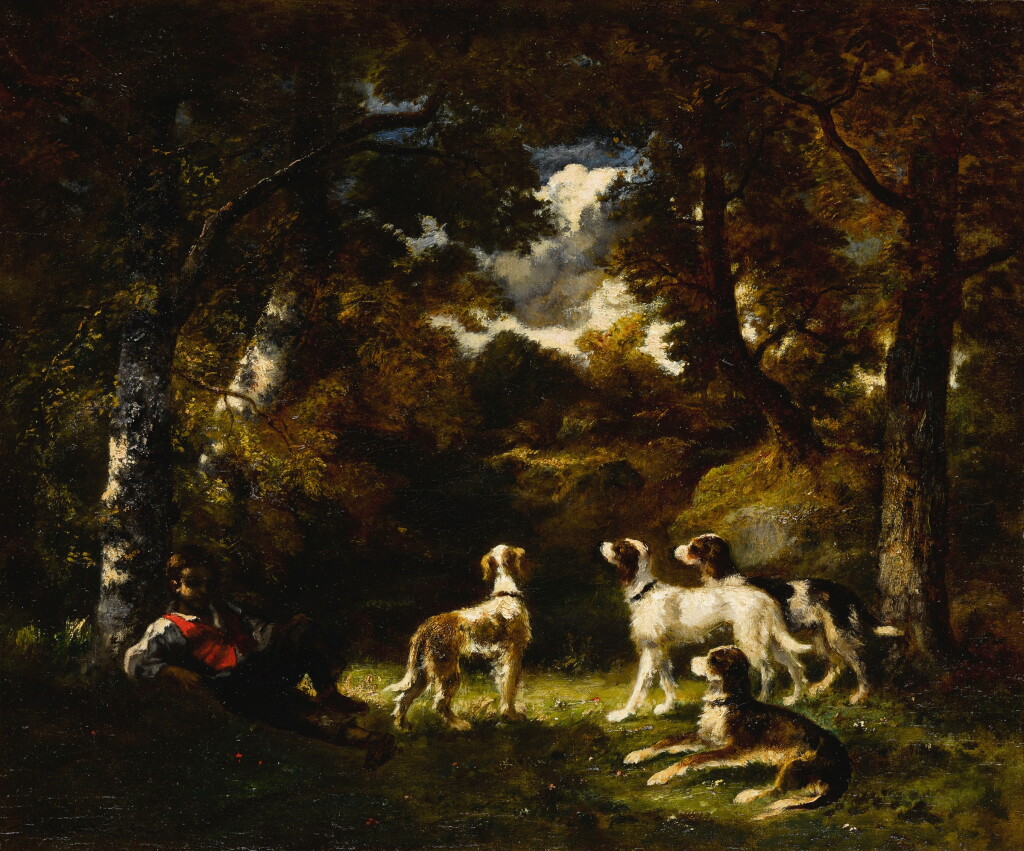
Rest from the Hunt
Lot Closed
October 15, 06:09 PM GMT
Estimate
10,000 - 15,000 USD
We may charge or debit your saved payment method subject to the terms set out in our Conditions of Business for Buyers.
Read more.Lot Details
Description
Property from a Private California Collection
Narcisse Virgile Diaz de la Peña
French 1808 - 1876
Rest from the Hunt
signed and dated lower left: N. Diaz -55-
oil on canvas
canvas: 21 ⅜ by 25 ¾ in.; 54.2 by 65.4 cm
framed: 30 ¼ by 34 ¼ in.; 76.8 by 86.9 cm
With Galerie Michael, Beverly Hills
Private Collection
Sale, Sotheby's, New York, 13 October 2020, lot 1
Where acquired by the present owner
A foundational artist of the Barbizon School, Narcisse Diaz de La Peña’s life story would be a fitting subject for a nineteenth century novel. He was born in Bordeaux to a Spanish immigrant family and, after his parents’ early deaths, was put into foster care in Paris, only to lose a leg at the age of thirteen as the result of an infection caused by an insect or snake bite. A testament to his vibrant, resilient character, Diaz’s wooden leg became a part of his artistic persona. As with many of his contemporaries, he began his career as a porcelain painter and worked with Jules Dupré, who would become a fellow Barbizon artist and lifelong friend, at the Sèvres factory. In the late 1820s he studied briefly under François Souchon (1787-1857) and copied the masters at the Louvre, while also finding inspiration from the painting of Eugène Delacroix and the poetry of Victor Hugo. His early production of the 1830s and 1840s mostly included romantic, mythological, and bohemian subjects—suggesting the influence of artists such as Correggio, Leonardo da Vinci, and Pierre-Paul Prud’hon. These paintings reflected trends in the popular art market and earned the artist a comfortable income. At the same time, Diaz was consistently compelled to paint landscapes following in the footsteps of Théodore Rousseau, whose work Diaz admired and studied carefully.
From around 1833, Diaz became a regular summer visitor to Barbizon and the forest of Fontainebleau, where he grew close to Rousseau and became part of a community of painters devoted to plein air painting to record their first-hand observations of nature. Painted in 1855, Rest from the Hunt depicts the forest interior, among Diaz’s most important motifs. Its deep, cool shadows are broken by shafts of light, which gleam against white birch bark and illuminate a clearing in the distance. Rich interplays of color and expressive brushwork enliven the scene which features the picturesque addition of a young boy resting in the shade while his hounds look off in the distance, ready to resume the hunt. Works like Rest from the Hunt brought Diaz wealth—his paintings routinely were sold for higher prices than those of Rousseau, Jean-Baptiste-Camille Corot or Jean François Millet—and international fame.
You May Also Like


