
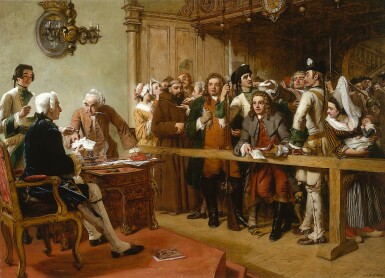
Property of a Gentleman
William Powell Frith, R.A.
Hogarth brought before the Governor of Calais as a Spy
This lot has been withdrawn
Lot Details
Description
Property of a Gentleman
William Powell Frith, R.A.
English 1819 - 1909
Hogarth brought before the Governor of Calais as a Spy
signed and dated lower right: W. P. Frith 1851; inscribed on the reverse: WP Frith ARA / No. 1
oil on canvas
canvas: 44 by 60 ⅛ in.; 111.8 by 152.7 cm
framed: 60 by 77 in.; 152.4 by 195.6 cm
Commissioned for 400 guineas (possibly by James Eden of Bolton who repudiated the order);
Henry Graves (1806-1892), 6 Pall Mall, London (acquired from the artist for engraving for 400 guineas).
Alfred Brooks, Finchley Road, London (by 1879);
Sale, Christie, Manson & Woods, Ltd., London, 17 May 1879, lot 78;
Where acquired by Thomas Agnew (1827–1883), Fairhope, Eccles, Manchester;
Thence by descent to his wife Anne Agnew (1829-1906), Fairhope, Eccles, Manchester in 1883;
By whose executors sold, Christie, Manson & Woods, Ltd., London, 16 June 1906, lot 86;
Where acquired by the Agnew & Sons;
From whom acquired by Sir Davison Dalziel of Wooler (1854-1928) (by 1911);
Thence by descent to his wife, Lady Harriet Sarah Dalziel of Wooler (1853-1938);
Purchased by Lionel Trafford of Turvey House, Holmer, Hereford, from the estate of Lady Dalziel in the 1930s;
Thence by descent, Mrs. D. Trafford Roberts;
By whom sold, Christie’s, London, 25 March 1994, lot 79;
Acquired from the above sale by the present owner.
London, Royal Academy, 1851, no. 204
Manchester, Royal Jubilee Exhibition, 1887, no. 352
London, Royal Academy, Exhibition of Works by Five Deceased British Artists, Winter Exhibition 1911, no. 35
London, Agnews, Bond Street, Old Masters Exhibition, 1949
The Times, 3 May 1851, p. 8.
Athenaeum, 17 May 1851, p. 530, no. 1229.
Art Journal, 1851, p. 156.
London Daily News, 29 March 1851.
The Atlas, 3 May 1851.
Morning Post, 3 May 1851.
Morning Chronicle, 8 May 1851.
The Examiner, 10 May 1851.
Lady's Own Paper, 10 May 1851.
Weekly Dispatch, 11 May 1851.
The Globe, 13 May 1851.
The Express, 14 May 1851.
W. M. Rossetti, ‘The Royal Academy Exhibition (Third Notice),’ The Spectator, 17 May 1851, p. 475.
John Bull, 17 May 1851.
The Era, 18 May 1851.
Illustrated London News, 24 May 1851.
Bell's Weekly Messenger, 24 May 1851.
Aberdeen Press and Journal, 4 June 1851.
W. P. Frith, My Autobiography and Reminiscences, in two volumes, London 1887, vol. I, pp. 206-208, 287.
G. Redford, A History of Sales of Pictures and Other Works of Art, London 1888, p. 288.
Preston Herald, 26 March 1892, p. 3.
The Graphic, 11 March 1911, pp. 148, 350-351, illustrated.
P. J. Barlow, "The Backside of Nature: The Clique, Hogarthianism and the Problem of Style," Victorian Painting, PhD Thesis, University of Sussex, 1989, pp.147-150, plate 26.
M. Bills, ‘‘The line which separates character from caricature...Frith and the influence of Hogarth," William Powell Frith: Painting the Victorian Age, New Haven; London, 2006, pp. 42-43, illustrated.
W. Hauptman, "Hanging the Pre-Raphaelites and others: The Royal Academy Exhibition of 1851," The British Art Journal, vol. 19, (Spring 2018), pp. 16-17, no. 1, plate 19.
William Powell Frith was one of the finest Victorian painters of genre and modern life. He was born in Aldfield near Ripon, Yorkshire; his parents later ran a hotel in Harrogate. At school in Dover Frith copied Dutch genre paintings. From 1835-7 he studied at Henry Sass’s Academy and in 1837 at the Royal Academy Schools.
Frith began his career as a portrait painter but in the 1840s he switched to historical and literary subjects such as Merrymaking a Hundred Years Ago (RA 1847). He was a friend of Dickens and a member of The Clique, a group of artists which included Richard Dadd and Henry Nelson O’Neil. Frith became an ARA in 1845 and an RA in 1852. From the 1850s Frith painted subjects of modern life, teeming canvases in which he orchestrated huge numbers of figures in fluid, lively compositions with a precise yet painterly technique. Like Dicken’s novels, paintings such as Ramsgate Sands (RA 1854), Derby Day (RA 1858), and The Railway Station (1862) are full of anecdote, sentiment, and observation of class and character. They gained huge popularity through engravings and Ramsgate Sands was bought by Queen Victoria.
Frith’s later work included two series of five moralizing subjects, The Road to Ruin (1878) and The Race for Wealth (1880). His lively Autobiography and Reminiscences (1887), written with wit and modesty, was a great success. Frith paints the scenes where Hogarth was brought before the Governor of Calais accused of spying. Hogarth had gone to France in 1748 after the end of the War of the Austrian Succession with artist cronies Francis Hayman and Thomas Hudson. He was arrested sketching the drawbridge to Calais Gate, part of the old English fortifications. Hogarth was brought before the Governor, but, as he records: “As I concealed none of the memorandum (sic) I had privately taken and they being found only those of a painter for this own use, it was judged necessary only to confine me to my lodging till the wind changed for our coming away to England.” Hogarth swiftly had his revenge with the satirical painting Calais Gate, or the Roast Beef of Old England (Tate Gallery), which shows a scullion staggering under an enormous sirloin of English beef destined for the Lion d’Or, the English in at Calais, while the envious and starving French look on.
Hogarth gained great success with his engraving work. In notes accompanying it, he wrote of life in Calais as “a farcical pomp of war, parade of religion and Bustle with very little business – in short poverty, slavery, and Insolence.” Frith chose this incident for his 1851 Royal Academy submission, Hogarth Brought Before the Governor of Calais as a Spy. The painting shows his skill in orchestrating large groups of figures and his deft expression of character and physiognomy: Hogarth, relaxed and amused at the center of the scene; the supercilious Governor, excitable rabble, even a pretty young Breton mother who peers at the Englishman with curiosity.