
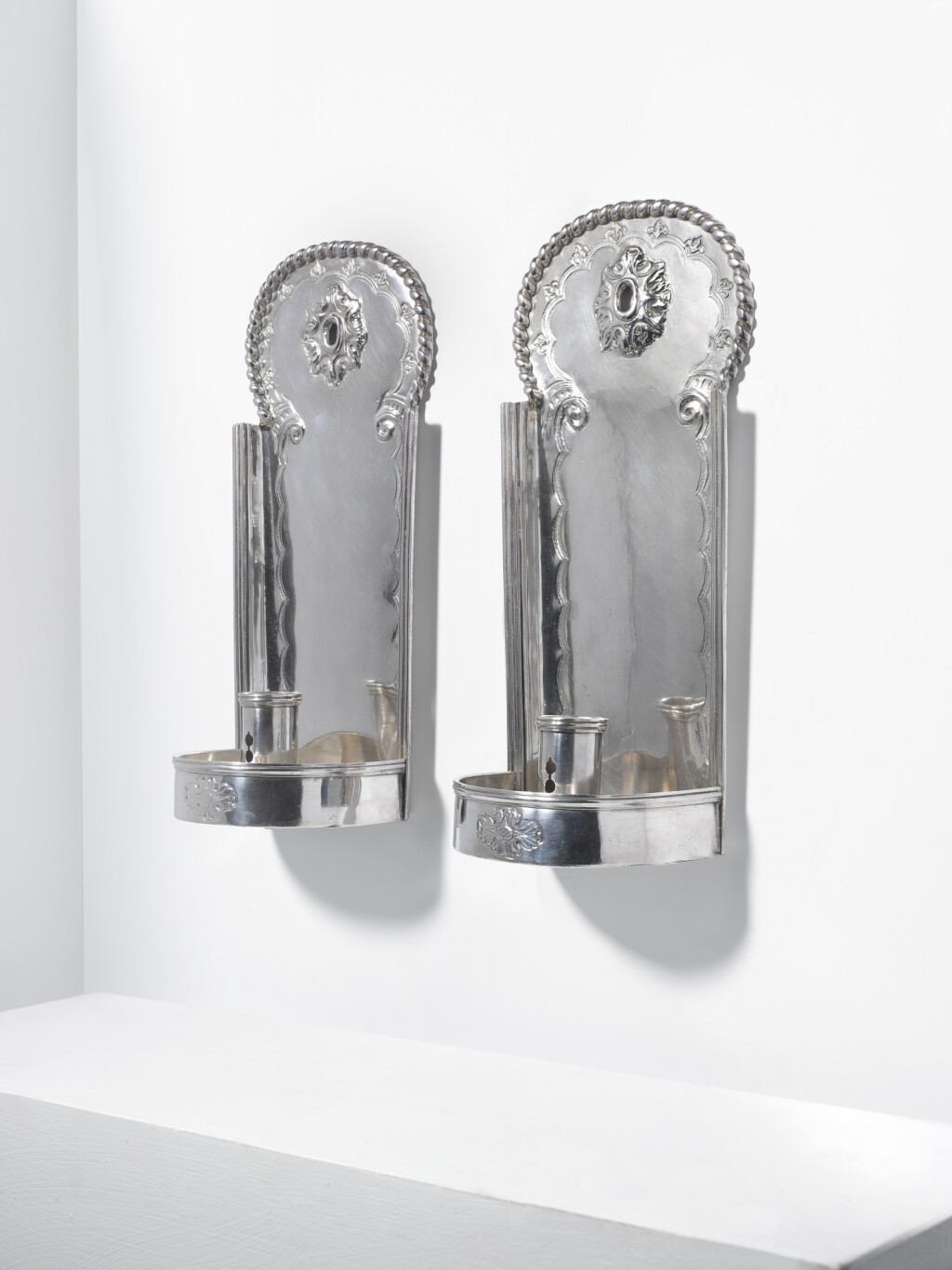
A pair of Louis XIV silver wall-lights, probably by R. Trabut, Avignon, late 17th- early 18th century
Auction Closed
December 11, 05:00 PM GMT
Estimate
50,000 - 70,000 EUR
Lot Details
Description
with a rounded base adorned with a flower, with a pierced nozzle, the backplate with a reeded border below a fluted gadrooned border, engraved with fleur-de-lys and a flower, marks underneath: jurande and maker's mark twice
(2)
Height. 13 in ; Haut. 33 cm
Weight. 1523 gr. (48.95 oz)
C.G Cassan, Les orfèvres d'Avignon et du comtat Venaissin, Paris, 1984, illus. cover and p. 52.
The art of lighting
Girandoles, candlesticks, chambersticks, chandeliers, sconces - the vocabulary of lighting in the decorative arts is wide and varied. Indeed, lighting is a very important notion, and its use varies according to social status. European courts use white wax candles, which are the most expensive to produce, and thus must be implemented to make the most of them. Artists created new shapes to illuminate interiors. For example, girandoles with several arms are mounted on high pedestals, and wall-lights are made from noble materials such as gilt-bronze or silver to best reflect the candle flame. Our pair of wall-lights dates from the late 17th - early 18th century. They are of a very simple design with a plain backplate which allows for greater reflection and luminosity. Few other examples are known, but they include a silver wall light with a simple, plain backplate, like ours, dated circa 1730, illustrated in J. Bourne and V Brett, L’art du Luminaire, Paris, 1991, p.39, fig.102. Other models from the late 17th century are shaped, embossed and sometimes engraved with coats-of-arms, suggesting the patron’s wealth and origin, but not always allowing the best reflection of the flame. In 1689, Louis XIV commissioned a major melting of royal and court silverware to finance the wars with Spain. In particular, he ordered the melting of all the furniture, the larger pieces of which also comprised of wall-lights. This is why very few French examples have survived.
Goldsmiths in Avignon, one of France’s finest Guild-masterships
The city of Avignon, like other cities such as Strasbourg, Lille, and the towns of Lorraine, had a special status in French silversmithing. As a former papal city, Avignon remained under the authority of the Holy Father and was not subject to the same tax rules as other French cities. As a result, many foreign goldsmiths, notably Italian silversmiths, moved there making Avignon’s production a distinctive blend of French and Italian styles. The city’s hallmark is a crowned A, but unlike other cities, its mark does not allow perfect dating as it appears that each silversmith was in possession of this hallmark. Our pair of wall-lights also bears the maker's mark but it is struck twice. This peculiarity is explained by the custom to hallmark twice when a higher standard of silver is used. This pair of wall-lights is a rare example of late 17th - early 18th century provincial silverware, both simple and luxurious, thanks to the use of silver and hammering to enhance light reflection.