
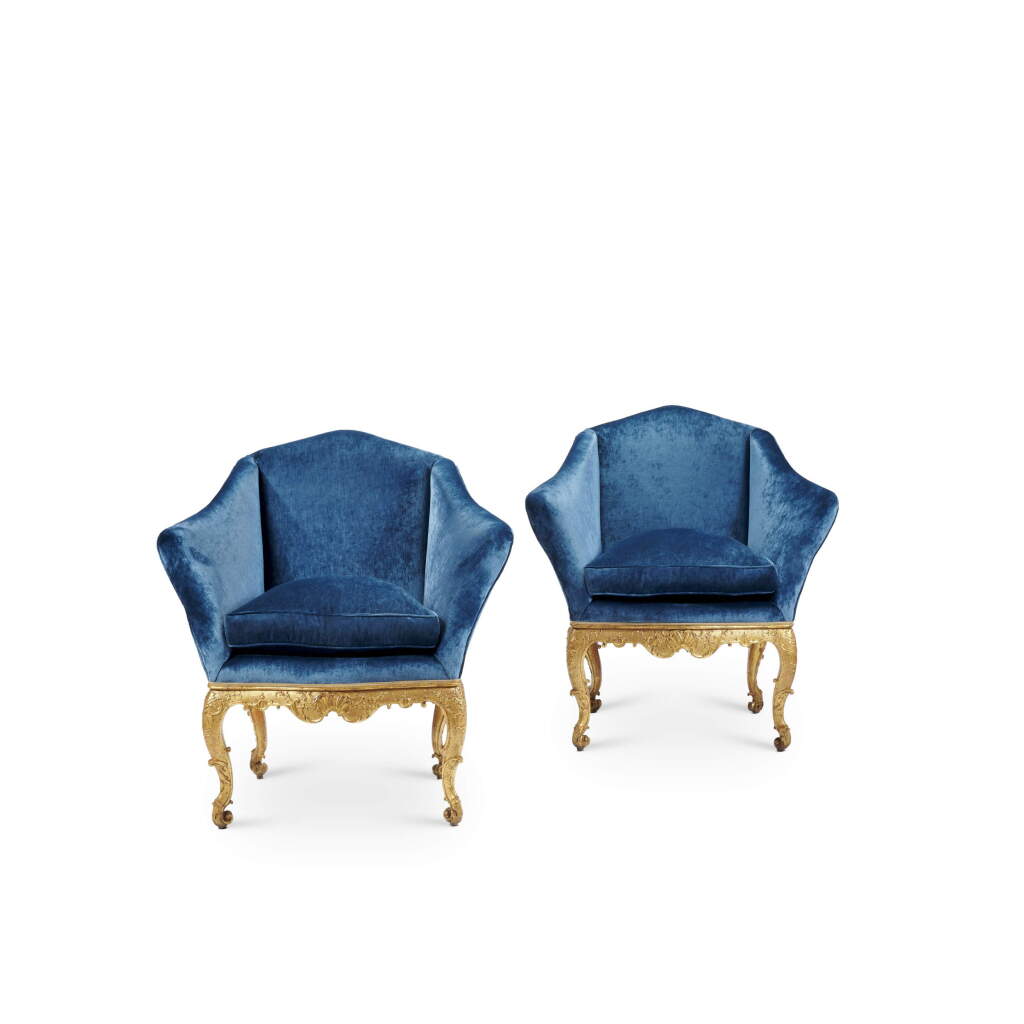
A pair of Italian giltwood armchairs 'a pozzetto', Venice, circa 1750
Auction Closed
November 27, 04:27 PM GMT
Estimate
20,000 - 30,000 EUR
Lot Details
Description
decorated with shells and floral scrolls, on scrolled feet, with blue velvet upholstery
(2)
Height. 37 1/2 in, width. 35 1/2 in, depth. 22 ½ in ; Haut. 95 cm, larg. 90 cm, prof. 57 cm
RELATED LITERATURE
S. Levy, Il mobile veneziano del Settecento, Milan, 1964, pl. 45, in which is reproduced a similar lacquered armchair from the Giuseppe Rossi collection.
The form of these chairs is documented, yet it is generally one of the less common shapes used in the mid-eighteenth century. In Italian, this is known as ‘a pozzetto’ – while ‘pozzetto’ has several meanings in modern Italian, the most logical etymology for this usage would be as the diminutive of ‘pozzo’, a well for drawing water, since the high upholstered arms enclose the sitter in a small well-like enclosure. Contemporary Venetian armchairs ‘a pozzetto’ of the same form can be seen in S. Levy, Il Mobile Veneziano del Settecento, Milan, 1964, pl. 45 and the set from the sold from the Rossi collection at Sotheby’s London, 10 March 1999, lot 158 (sold £144,500). Both of those examples are rare for their lacquer surface, as they are more commonly found in walnut, as in the examples recently sold at Sotheby’s New York, 19 April 2021, lot 92.
Surprisingly, the giltwood surface of these bergères employs a technique generally only seen in England, that of intricate gilt gesso with a punched background. Punchwork was not a new technique, since it had long been used in medieval icons to differentiate texture within large gilt areas, but it became popular in English gilt furniture at the end of the seventeenth century until around the 1720s. The elegance of gilt-gesso carving, as practised by makers such as Jean Pelletier, James Moore and Benjamin Goodison, relied on the contrast between raised details that were burnished to a high shine and the sense of depth created by rougher backgrounds – punching was an essential way to amplify this effect. It is curious, then, to see this technique, and the associated low-relief strapwork decoration, on an Italian chair: while English styles had a pronounced influence on eighteenth-century Italian furniture design, this was far less pronounced in terms of surface decoration. Notably, the punching is not in perfect circles, as was typical of English work, but has a rippled, star-like outline.


