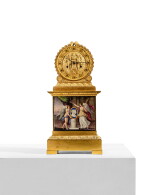
A micromosaic by Cesare Aguatti (active late 18th century), Rome, dated 1774, in a gilt-bronze frame by Paolo Spagna (1736-1788) with the coat-of-arms of pope Pio VI
Auction Closed
November 26, 04:58 PM GMT
Estimate
250,000 - 500,000 EUR
Lot Details
Description
representing the Temple of Vesta at Tivoli, the micromosaic dated and signed «Cesare Aguatti Romano 1774», the frame dated 1776
Micromosaic: 18 ½ x 26 in; the frame: 30 ¾ x 31 1/2 in ; Micromosaïque : 47 x 66 cm ; le cadre : 78 x 80 cm
A. González-Palacios, Antologia di belle arti Il Settecento, 1977;
D. Petochi, Mosaici Minuti Romani del 700 e dell’ 800, Roma, 1991, p. 166, fig.2;
A. González-Palacios, Mosaici e Pietre Dure: Mosaici a piccole tessere – Pietre dure a Parigi e a Napoli, I quaderni dell'antiquariato ,Milan, 1991, n°16, ill.;
A. González-Palacios, Arredi e Ornamenti Alla Corte di Roma 1560-1795, Milano, 2004, p.231, fig.6.
As a Papal diplomatic gift, this exquisite micromosaic panel is one of the earliest existing examples of the micromosaic technique, or mosaici minuti, executed by Cesare Aguatti, who, alongside Giacomo Raffaelli, was considered the leading mosaicist of his generation. Complementing the exquisite splendour of this panel is the superb gilt bronze frame by the silversmith Paolo Spagna, which is surmounted by the coat of arms of Pope Pius VI (1717-1799) and is documented in the Vatican archives as having been acquired in 1775 during the very first months of his papacy.
Cesare Aguatti was active in the Studio Vaticano del Mosaico, where he possibly received his training, and developed the technique of smalti filati or spun enamel threads cut into miniature tesserae that allowed the production of extremely small mosaic panels. This led to the establishment of the micromosaic technique, which would go on to achieve tremendous success in Rome with collectors, amateurs and tourists.
He is known to have worked for the Borghese family, as in 1779, Aguatti produced a micromosaic column decorated with grotesques for the Sala degli Imperatori in the Villa Borghese. He also worked for the Papal administration – as this panel proves – and was involved in the restoration of the floors in the Baths of Otricoli and the Rotonda in the Museo Pio-Clementino.
The present lot was first studied by Alvar Gonzalez-Palácios who discovered the documentation referring to the micromosaic acquisition in the Vatican archives, as well as to the commission of its frame:
“Il Comp[utista] specifica mandato a favore di Cesare Aguatti mosaicista di scudi trecentottanta moneta… d’un quadro in musaico alto palmi 2 longo palmni 2 ¾ per traverso rapresentante la Sibilla Tiburtina ed a noi consegnato per Servizio di Sua Santitá
Di Palazzo i 7 Giu.o 1775”
(Archivio Segreto Vaticano, Sacri Palazziu Apostolici, Computisteria, fascio 343, carta 132) apud González-Palacios,2004, p.240)
Aguatti's earliest micromosaics are dated to around 1773, notably the View of the Colosseum (current whereabouts unknown), sold at Christie’s, 8-10 June 1857, lot 261. The most pertinent comparisons for the present rare micromosaic are the pair of vedute by Aguatti which are preserved at Burghley House, Lincolnshire. Also signed and dated 1774, they depict a View of the Colosseum (inv. EWA08660), and a View of the Temple of Vesta (inv. EWA08660) which is closely comparable to the present lot. These were acquired by the 9th Earl of Exeter on his Grand Tour through the intermediation of Thomas Jenkins, who wrote to Lord Exeter on 11th March 1775: “enclosed… the receipt from Cesare Aguatti…the Person that makes …an excellent mosaick… of the Sibill Temple at Tivoli…wonderfully fine… he is certainly the best workman that ever was in Mosaick” (Roberto Valeriani, “Rieffenstein, Piranesi e I fornitori romani del Conte di Exeter”, in Antologia di Belle Arti, 1998, nrs.55-58, pp.150, 153).
Temple of Sybil, also known as the Temple of Vesta, was located in Tivoli in the Roman campagna and was one of the most frequently depicted Roman ruins, with its dramatic location at the top of a hill overlooking a waterfall and creating a picturesque tableau of nature and history that made it a main attraction to visitors of the region. It was therefore an ideal subject for mosaicists, who were probably working from existing prints, although unidentified in this case.
This exquisite panel, with its meticulous and painstakingly novel technique, was considered worthy of a frame that had a correspondingly rich level of ornament. The Papal administration chose Paolo Spagna, who had only officially become a silversmith in 1772, meaning that this frame would have been one of his first commissions from the Papal court. The quality of the chasing and precision of casting underlines his training as a silversmith and the bill for his work also reveals that Spagna created the wax model for it, proving that he had designed the piece:
“Conto de Lavori fatti p il Sago Palazzo Apostolico ad uso di argentiere…
Per aver fatta una Cornice quadra di Modello di Salvator Rosa larga palmi 4 scarsi ed alta p.mi 3 circa con arma isolate al disopra con festoni et altro, con ornati di foglie intorno che girano, riporti nella ognature, con altri riporti al guscio traforati di ornati, con sue fusarole al cordone di dentro, fascina girata e fittuccia ed altro lavoro d’ornato al cordone grande ed altri ornati alla detta cornice, e con spesa di metallo p detta cornice s 120
Spesi alla piastra grande d’ottone messa al di dietro della cornice compresovi fattura, brunitura e fermata com sustinenti s 8
Spesi p. l’armatura di ferro e doratura dell’occhietto s3
Oro andato p. dorare l’anzi detta cornice, cioè riporti, arme e festoni isolati, zecchini N.o 262 S 54:32
Per fattura delli Doratori compresovi argento vivo, acqua forte, grattabuscie, carbone et altre spese s 26:50
Per saldatura di arg.to andato p. saldare tutti li raporti della sudetta cornice s 5
Per aver fatto il disegno con il modello di cera per fare la sud.a s 12
Oro ricev.o dal Sag.o Palazzo per dorare la sud.a cornice che importa s 85:41
Il presente conto tarato a suoi doverosi prezzi importa netto scudi
Pietro Camporese Archo Magg.e
…Io …Paolo Spagna…
11 marzo 1776
(Archivio Segreto Vaticano, Sacri Palazzi Apostolici, Computisteria, fascio 347, carta 49, apud González-Palacios,2004, p.237)
The arms surmounting the crest are those of Pope Pius VI, Giovanni Angelo Braschi (1717-1799, who was Pope from 1775) and used only very briefly in the first period of his papacy. Widely criticized for being too complex and for carrying symbols of other European powers, the design for this crest was quickly simplified. The first version of the arms can be seen in drawings of frames which came from the collection of the Valadier workshop, although some are known to have belonged to Pietro and Giuseppe Spagna, and designed by Paolo. The Spagna’s acquired the Valadier workshop with its contents in 1832.
The present framed panel was one of the very first commissions by Pius VI as diplomatic gifts to royal visitors to Rome, and although it is not yet known who the recipient was, other gifts of framed mosaics are known in international institutions such as the Residenz in Ansbach, Pavlovsk Palace, Royal Palace, Stockholm, the Kunstindustrimuseet in Copenhagen and the Kunshistorisches Museum in Vienna.