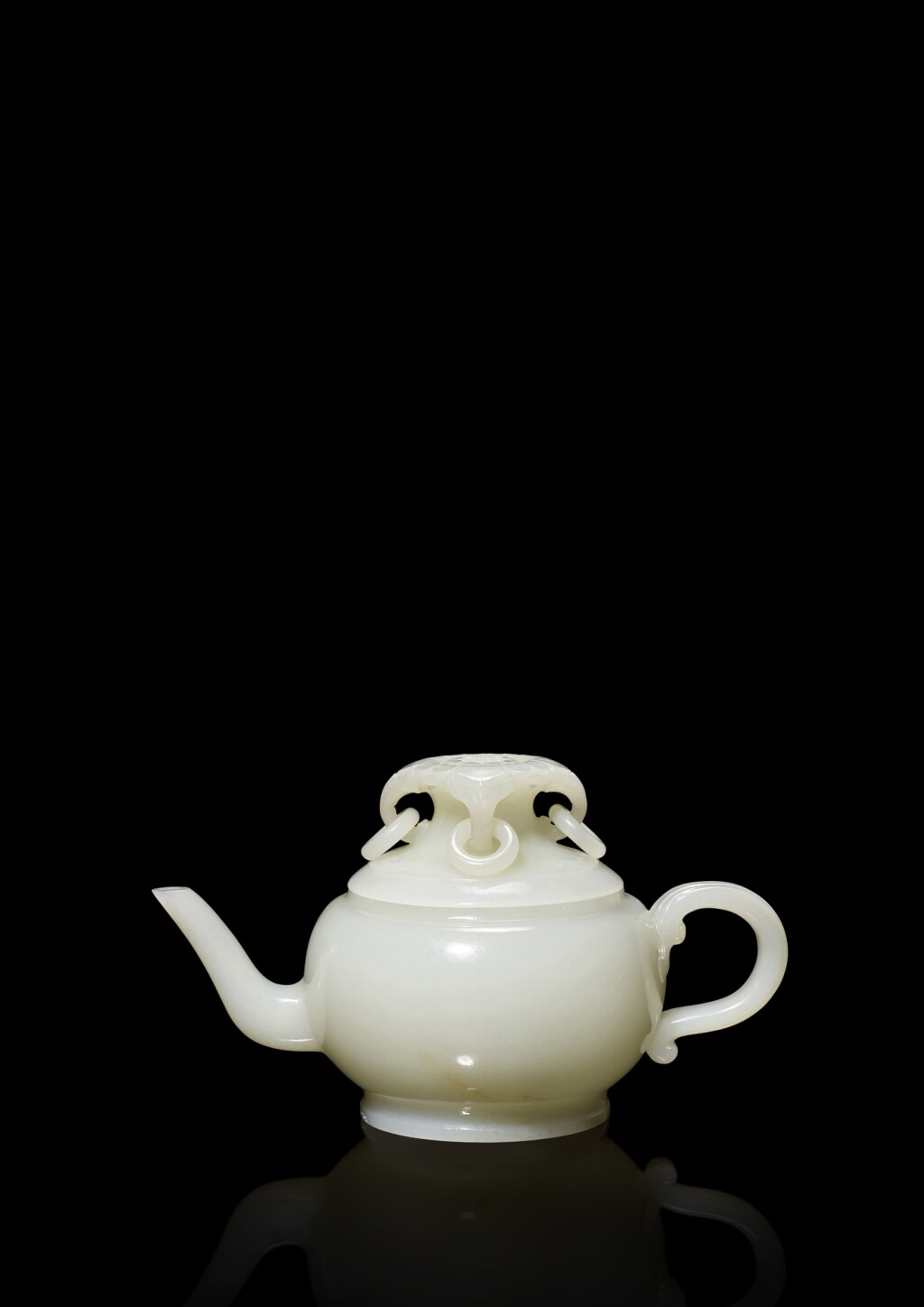
Property from the De An Tang Collection | 德安堂藏玉
An exceptional and finely carved white jade 'floral' teapot and cover, Qing dynasty, Qianlong period | 清乾隆 白玉花鈕夔柄四活環蓋壺
Auction Closed
April 9, 12:02 PM GMT
Estimate
3,000,000 - 5,000,000 HKD
Lot Details
Description
Property from the De An Tang Collection
An exceptional and finely carved white jade 'floral' teapot and cover,
Qing dynasty, Qianlong period
德安堂藏玉
清乾隆 白玉花鈕夔柄四活環蓋壺
wood stand
w. 18.5 cm
A Romance with Jade: From the De An Tang Collection, Yongshougong, Palace Museum, Beijing, 2004, cat. no. 102.
《玉緣:德安堂藏玉》,永壽宮,故宮博物院,北京,2004年,編號102
Superbly articulated from lustrous Khotan white jade of the most superlative quality, with elegant, rounded form and exquisite polish, the present teapot and cover is arguably one of the most flawless examples, with only less than a handful of surviving teapots or ewers of comparable quality in private hands.
Jade teapots and covers are rare, but the use of white jade of such high purity and quality makes it even more precious. If the stone comes with natural defects, the Qing Imperial Palace workshop would proceed with russet enhancement, or intentionally carve intricate motifs, to cover the natural flaws in the stone. On the present teapot and cover, the imperial jade lapidary artist chose to avoid excessive ornamentation and display the fine translucent quality of the jade stone as the principal element. The streamline of the body is further amplified by the ingeniously worked finial on the cover in the form of a flower with well-proportioned petals gracefully surrounding the delicately carved bud-form finial, with four petals subtly curving down each suspending a loose ring. Impeccably worked with utmost precision, the cover rests atop the vessel almost seamlessly, coming as one. The sensual circular body worked with steep rounded sides springing from a splayed foot to a high angled shoulder, one side set with a C-shaped handle, which sensitively articulated with echoing scrolling tips at the beginning and end, another side with an elegant curved spout, further adding to the overall rhythmicity.
By the Qing dynasty, the development of jade art reached an unprecedented peak during the Qianlong period under the rule of the jade enthusiast the Qianlong Emperor, who provided immense support to the specialists that later became more experienced and skilful in mining and caving, producing an abundance of jade masterpieces, particularly those intended for the use in the imperial court. Both practical and decorative for interior spaces, incense burners, vases, boxes, ewers, bowls, washers, and parfumiers predominated jade vessels of the period, whereas jade ewers remained limited due to the high degree of sophistication required for craftsmanship and the shortage of high-quality raw jade. The Palace Museum, Beijing, for instance, contains a vast collection of fine jade vessels, yet only comprises about a hundred ewers with spouts, roughly divided equally between Ming and Qing periods, according to Xu Lin.
As per the records of the workshops of the Qing imperial court, jade ewers were already produced in the first year of the Yongzheng reign (1723), mostly limited to restoring ewers remaining from previous reigns, still, fewer than thirty jade ewers were made or restored during the entire period, according to Xu Lin. As documented, the production of jade ewers saw an evident rise during the Qianlong reign, including those with handles attached. Their features were, however, described too vaguely to find a match with the surviving vessels. A closely related white jade ‘lotus’ teapot, presented by the Viceroy of Min-Zhe Yang Tingzhang, is recorded to have been produced in the 29th year of the Qianlong reign (1764). Another similar white jade ‘lotus’ wine ewer is mentioned in the 35th year of Qianlong reign (1770) archive. Despite checking carefully in the Qing court inventory, the number of jade ewers was extremely limited, corroborating the difficulty in conjuring a fine jade ewer. Among the rare recorded examples are one green jade ‘lotus’ covered ewer (with chips and fissures) preserved in the Western Warmth Chamber, and a celadon jade ‘melon’ covered ewer in the Hall of Mental Cultivation.
The precision of the carving, texture of the polish and other key features including the related petal-form of the finial on the current teapot can be seen on three famous white jade ewers likely created in the same period, all melon-shaped in form with a ram-head spout. One is in the Palace Museum, Beijing, from the Qing court collection, illustrated in The Complete Collection of Treasures of the Palace Museum, Jadeware (III), Hong Kong, 1995, pl. 216. another from the collection of Sir John Woolf is illustrated in The Woolf Collection of Chinese Jades, Sotheby’s, London, 2013, cat. no. 59; and a third, originally in the collection of Millicent Rogers (1902-1953), the American socialite and close friend of Madame Soong Mei-ling, was sold at Christie’s Hong Kong on 28 April 1996, lot 2, and again in these rooms on 3 October 2017, lot 3613. Unlike the current teapot, these ewers are all characterised by russet enhancements to the surface, deliberately created in the Imperial Palace Workshops to cover deficiencies in the stone.
See another closely related in form and quality to the current example, which was sold in these rooms, 31st October 2004, lot 233, which shares the same precision of form and quality of the finish but with a less of a curve to the spout and a single tiered chrysanthemum finial. See also another jade teapot and cover but of more angular form, sold in these rooms on 16 November 1989, lot 612.
壺白玉質,玉白如脂。矮圓形壺體,通體光素無紋,夔式柄,細流,圈足。壺蓋上雕一花瓣式壺鈕,四片花瓣向下翻卷,其葉莖與蓋壁向聯,上套活環,設計精巧,與光素壺身交相呼應,如天造地設,圓潤柔美,饒富雅趣。此件玉蓋壺,玉質晶瑩,細膩無瑕,稱目前可見私人收藏玉壺品質最高之一絕不為過。
玉質執壺本已罕見,而以如此溫潤潔白玉料製作者更稀。清宮造辦處玉作製玉,常因材施藝,石質欠佳者,多加以烤皮染色,或加以巧雕,用繁紋縟飾掩瑕避綹。此件蓋壺玉質潔白無瑕,匠人刻意不在壺身做雕刻裝飾,大片留白以展示玉石之瑩潤,使其更加圓潤柔美。觀玉壺蓋紐,以圓雕及浮雕工藝精雕,呈花瓣式,中間花兒含苞待放,四周花瓣圍繞,其中四片較大花瓣漸漸向下翻卷,花瓣下各套一活環,設計新穎,極具巧思。壺身形態豐盈、素面無紋,搭配以雙夔並成的壺柄以及纖細多姿壺流,盡顯文房雅緻,而覆都式鈕又以精雕工藝搭配花瓣式壺鈕,素雅中又凸顯幾份莊重華麗,遠觀柔美,近撫絲滑,陳設既適,實用兼宜,誠為清宮御製玉器臻絕一例。
清代以來,尤其乾隆年間,玉雕工藝發展達到高峰,除玉料開採外,雕刻技藝亦精益求精,玉匠經驗更加豐富,加之乾隆皇帝本人的大力推動,促使玉雕藝術問鼎巔峰。此時期所製玉器樣式極多,特別是宮廷陳設用玉,然而緃觀各式宮廷陳設玉器,雖多見爐、瓶、盒、洗等,美觀且實用,但相比而言,由於玉執壺製作工藝複雜,掏膛工藝比一般器皿難度大許多,其存世數量仍然較少。以北京故宮博物院明清藏品為例,據徐琳統計,附流的玉執壺僅只百餘件,明清兩朝各約佔半。
據《清宮內務府造辦處活計檔案》,雍正元年(1723年)已有玉壺製作,惟多乃收拾前朝遺留舊壺,據徐琳研究,整朝總共收拾前代及當朝所製玉壺不足三十。到了乾隆時期,據檔玉壺製作數量較前顯著增多,當中也有帶柄執壺的記載,相關記錄有如乾隆二十九年(1764年),閩浙總督楊廷璋進貢「白玉蓮花壺一件」。乾隆三十五年(1770年),又有製「白玉蓮花酒壺一件」,但大部分記錄特徵模糊,難與實物對應。細查清宮陳設檔案,雖有錄玉執壺,數量並不多,佐證其製作之艱。如光緒年間檔案載西暖閣貯「青玉蓮花式有蓋壺壹件(有缺有綹)」,養心殿又存「青白玉瓜瓞有蓋執壺一件」。
清宮舊藏的玉執壺中有三例清乾隆白玉壺,其選料、雕刻及打磨均能與本壺相媲美,大多或為乾隆年間同時期雕製,但為瓜稜式壺身及羊首流。其一現藏北京故宮博物院,載於《故宮博物院藏文物珍品全集.玉器》,香港,1995年,圖版216;另一件為約翰.伍夫爵士(Sir John Woolf)舊藏,錄於《伍夫收藏中國玉器》,蘇富比,倫敦,2013年,編號59;第三例為美國名媛米莉森.羅傑斯( Millicent Rogers)收藏,羅氏為宋美齡摯友,售於香港佳士得1996年4月28日,編號2,及香港蘇富比2017年10月3日,編號3613。然此三例壺身均見烤色,屬造辦處玉匠用以掩瑕避綹所為。
另見器形、玉質相近一例白玉執壺,2004年10月31日售於香港蘇富比,編號233。其扁圓壺身造型與本壺相似,惟本壺流成二彎式,曲線更加柔美,壺柄設計亦有所不同,壺鈕為單層菊瓣。拍賣會所見他例,如香港蘇富比1989年11月16日,編號612,造形更見稜角方正。
You May Also Like