
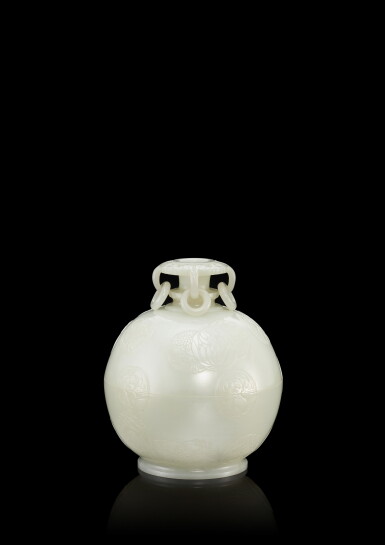
Property from the De An Tang Collection | 德安堂藏玉
A very rare white jade globular incense burner and cover, Qing dynasty, Qianlong period | 清乾隆 白玉團花紋活環鈕球式蓋奩
Auction Closed
April 9, 12:02 PM GMT
Estimate
800,000 - 1,200,000 HKD
Lot Details
Description
Property from the De An Tang Collection
A very rare white jade globular incense burner and cover,
Qing dynasty, Qianlong period
德安堂藏玉
清乾隆 白玉團花紋活環鈕球式蓋奩
13.6 cm
Sotheby's Hong Kong, 7th April 2010, lot 1870.
香港蘇富比2010年4月7日,編號1870
This piece embodies the brilliant creativity of the Qing craftsmen, which is seen in the combination of a contemporary decorative motif with the ingenious transformation of the archaic bronze dou into a loquat by carving the knop into the leaves of the fruit. The high-quality of the stone is evident in the carver's treatment of the decoration, which combines elegant medallions of fruit, flowers and bats in low-relief with broad areas of undecorated, highly-polished surfaces.
A related example, but with additional ringed side handles, in the Alan and Simone Hartman collection, is illustrated in Robert Kleiner, Chinese Jades from the Collection of Alan and Simone Hartman, Hong Kong, 1996, pl. 80; another, but with five bats elaborately carved above the petal-shape knop and five ringed loops, in the Tianjin City Art Museum, is included in Tianjin shi yishu bowuguan cang yu, Hong Kong, 1993, pl. 207; and a third slightly larger vessel, but lacking the rings on the knop and decorated with floral and shou medallions, in the Qing Court collection and still in Beijing, is published in The Complete Collection of Treasures of the Palace Museum. Jadeware (III), Hong Kong, 1995, pl. 196. Compare also a vessel of this spherical form, with ringed ruyi loops on the knop, two ringed dragon handles and decorated with kui dragons and xi (double-happiness) characters, in the De An Tang collection, included in the exhibition A Romance with Jade from the De An Tang Collection, Palace Museum, Beijing, cat. no. 103, where it is written that this type of casket was used during wedding ceremonies to store personal jewellery or other such accessories (see p. 166).
The harmonious spherical form of the censer is emphasised in the circular motifs that appear to drift over the surface. These roundels containing various specimens of flowers and fruit are also known on cinnabar lacquer; see a rectangular case similarly carved with drifting and overlapping roundels, in the Qing Court collection and still in Beijing, illustrated in The Complete Collection of Treasures of the Palace Museum. Lacquer Wares of the Qing Dynasty, Hong Kong, 2006, pl. 52; and adorning the sides of two circular boxes, with Qianlong reign mark and of the period, published ibid., pls 5 and 6.
The loquat is considered auspicious because it embodies the spirit of the four seasons: it buds in autumn, blossoms in winter, sets fruit in spring, and ripens in summer. Thus, the symbolic meaning of the loquat is accentuated through the extensive use of auspicious symbols to decorate this piece to convey the wish of eternal good luck.
You May Also Like


