Property from an Important Collection | 顯赫收藏
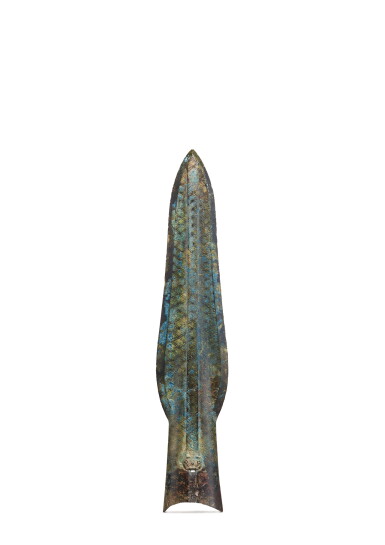
A rare bronze spearhead with metallic lozenge pattern, Eastern Zhou dynasty, Warring States period | 東周戰國 青銅菱紋矛
Auction Closed
April 9, 12:02 PM GMT
Estimate
700,000 - 900,000 HKD
Lot Details
Description
Property from an Important Collection
A rare bronze spearhead with metallic lozenge pattern,
Eastern Zhou dynasty, Warring States period
顯赫收藏
東周戰國 青銅菱紋矛
27.2 cm
Collection of David David-Weill (1871-1952), Paris, coll. no. D.W. 34/25.
Sotheby's Paris, 16th December 2015, lot 44.
大維威爾(1871-1952年)收藏,巴黎,收藏編號 D.W. 34/25
巴黎蘇富比2015年12月16日,編號44
Georges Salles, Bronzes Chinois des Dynasties Tcheou, T'sin et Han, Musée de l'Orangerie, Paris, 1934, cat. no. 80 (not illustrated).
International Exhibition of Chinese Art, Royal Academy of Arts, London, 1935-6, cat. no. 175.
Georges Salles,《中國周秦漢三朝青銅器》,橘園美術館,巴黎,1934年,編號80(沒載圖)
《參加倫敦中國藝術國際展覽會出品圖說》,英國皇家藝術學院,倫敦,1935-6年,編號175
Olov Janse, 'Le style du Houai et ses affinités. Notes à propos de quelques objets de la collection David-Weill', Revue des Arts Asiatiques. Annales du Musée Guimet, vol. VIII, no. 3, 1934, pl. LIII:2.
Max Loehr, Chinese Bronze Age Weapons. The Werner Jannings Collections in the Chinese Palace Museum, Peking, Ann Arbor, 1956, fig. 41E (drawing).
Olov Janse,〈Le style du Houai et ses affinités. Notes à propos de quelques objets de la collection David-Weill〉,《亞洲藝術雜誌.吉美博物館年鑑》,卷8,期3,1934年,圖版 LIII:2
羅樾,《中國銅器時代古兵.北京故宮博物院楊寧史舊藏三代青銅兵器圖錄》,安娜堡,1956年,圖版41E(線圖)
Distinctive for its pattern of intersecting double lines and lozenge motif in a darker-coloured metal on the surface, which is among the rarest patterns found on weapons from the Eastern Zhou dynasty, this spearhead was one of the twelve remarkable artefacts lent by David David-Weill to the landmark 1935-36 International Exhibition of Chinese Art in London.
Recorded by Olov Janse, the spearhead was reportedly discovered in Shouzhou, Anhui province, which was once an on-and-off capital of Chu and a prominent hub for the production of late Zhou bronzes.
This pattern is only found on a small number of extant weapons; among these, inscriptions are scarce, with the majority belonging to the Kings of Wu and Yue, such as the legendary Sword of King Goujian of Yue and the Spearhead of King Fuchai of Wu. See also an uninscribed sword and spearhead with this rare lozenge pattern in the collection of Taipei Palace Museum (accession nos Goutong-181 and 192), exhibited in Rituals Cast in Brilliance: Chinese Bronzes Through the Ages, Palace Museum, Taipei, 2015, p. 139, with the sword currently on view in the exhibition Sacrifice and Warfare: Guide to Ancient Weapons.
The metallurgical process used to create this pattern has yet to be completely understood; however, it has been suggested that the pattern may have been made through resist-etching or surface deposition of tin, ferric chloride, or ferric sulfate; see a similar spearhead attributed to the 6th-4th century BC, Spring and Autumn period, now housed in the Metropolitan Museum of Art (accession no.: 1985.214.27), and its entry in Maxwell K. Hearn, Ancient Chinese Art: The Ernest Erickson Collection in The Metropolitan Museum of Art, New York, 1987, cat. no. 31.
Another nearly identical spearhead was formerly in the collections of Jean-Pierre Dubosc and Dr Franco Vannotti, later dealt through the hands of Eskenazi (see Chinese and Korean Art from the Collections of Dr Franco Vannotti, Hans Popper and others, Eskenazi Ltd, London, 1989, cat. no. 14), where analysis suggests the decorative metal to be silver. It appears that silver strips were heated and adhered to the bronze surface, perhaps with the help of chemical means (see William Watson, 'Technique in Bronze and Precious Metal', ibid., pp. 10-11). Both the Vanotti spearhead and the present spearhead were mentioned in Orvar Karlbeck, 'Selected Objects from Ancient Shou-chou', BMFEA, vol. 27, 1955, p. 50.
此矛兩面滿工,矛身飾雙線菱格紋,實為珍罕。據 Olov Janse 於1934年的圖錄記載,此矛傳出自安徽壽州。壽州曾為楚國舊都,亦為青銅生產重地。紋飾相類者偶帶銘文,而銘文例多屬吳越兩王之器,如越王勾踐劍與吳王夫差矛。台北故宮博物院曾展覽一相關菱格紋劍及矛,館藏編號:購銅181及192,展覽於《吉金耀采—院藏銅器精華展》,故宮博物院,台北。2015年,頁139;其菱形紋銅劍現展覽於《祀與戎:古代兵器攻略》。
作雙線菱格紋所用冶煉工藝既非鑲嵌,又非鑿刻,至今仍有待探索,有推論稱該紋飾乃蝕刻或由錫、氯化鐵、硫酸鐵等沉積而成,見紐約大都會藝術博物館藏一矛,館藏編號1985.214.27,且錄何慕文,《Ancient Chinese Art: The Ernest Erickson Collection in The Metropolitan Museum of Art》,紐約,1987年,編號31。
另可參考一矛,如出一轍,杜伯秋及 Franco Vannotti 遞藏,後經埃斯卡納齊易手,並錄於《Chinese and Korean Art from the Collections of Dr Franco Vannotti, Hans Popper and others》,埃斯卡納齊,倫敦,1989年,編號14。研究該例,分析紋飾所用金屬為銀,銀線加熱後附於銅之表面,加以化合處理,終成紋飾,見 William Watson,〈Technique in Bronze and Precious Metal〉,前述出處,頁10-11。該例與此矛同被卡爾貝克(Orvar Karlbeck)提及,見〈Selected Objects from Ancient Shou-chou〉,《遠東文物博物館館刊》,卷27,1955,頁50。
You May Also Like