Property from the De An Tang Collection | 德安堂藏玉
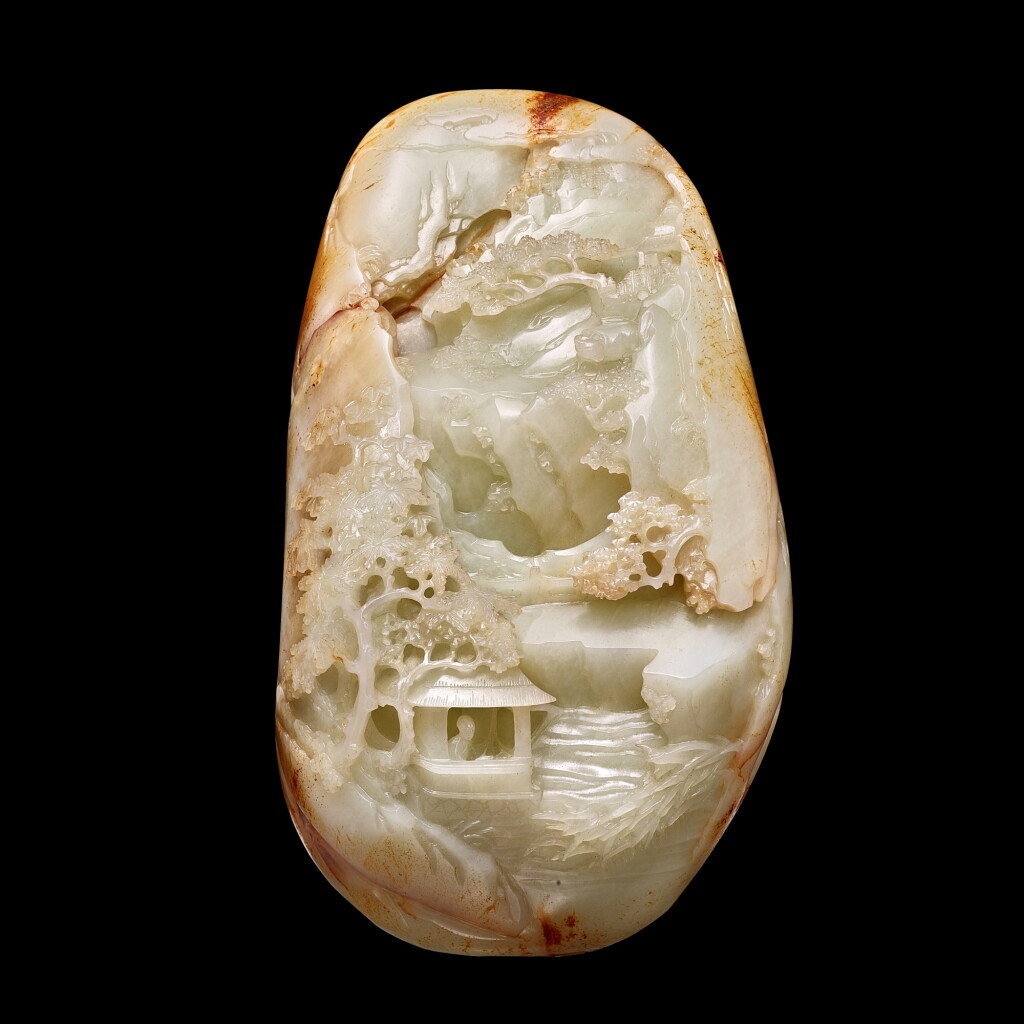
A finely carved white and russet jade 'Gengzhi tu' boulder, Qing dynasty, Qianlong period | 清乾隆 白玉耕織圖山子
Auction Closed
April 9, 12:02 PM GMT
Estimate
700,000 - 1,000,000 HKD
Lot Details
Description
Property from the De An Tang Collection
A finely carved white and russet jade 'Gengzhi tu' boulder,
Qing dynasty, Qianlong period
德安堂藏玉
清乾隆 白玉耕織圖山子
18.1 cm
Bluett & Sons, London.
Sotheby's London, 7th June 2000, lot 58.
Bluett & Sons,倫敦
倫敦蘇富比2000年6月7日,編號58
A Romance with Jade: From the De An Tang Collection, Yongshougong, Palace Museum, Beijing, 2004, cat. no. 32.
《玉緣:德安堂藏玉》,永壽宮,故宮博物院,北京,2004年,編號32
This impressive jade boulder is remarkable for not only the meticulously executed carving, but also the vivid depiction of an agricultural scene, the likes of which are relatively rarely seen on jade mountains, but were popular at the Qing (1644-1911) court.
Originally compiled by the Southern Song (1127-1279) official Lou Shou in 1145, the Gengzhi tu / Pictures of Tilling and Weaving is an illustration of the different stages of agriculture and sericulture, used as reference material to farming. It was also conceived as a metaphor for a prosperous, ordered society under a magnanimous and benevolent ruler. In the Qing dynasty, this was further developed into an important subject to glorify the golden age under the justified governance of the Manchus. The Kangxi Emperor (1662-1722) commissioned a painted version that became very famous and served as the blueprint for most later illustrations of the theme, Yuzhi gengzhi tu of 1696, preserved in the Palace Museum, Beijing. The Qianlong Emperor (1736-95) commissioned another version of this series of illustrations accompanied by his own poems, and in 1769 also the carving of the scenes on forty-eight stone slabs. These steles were then erected in the Yuanmingyuan summer palace; many of which are now destroyed, but two scrolls with ink rubbings of the scenes are known.
The more typical motifs for jade boulders are scholars appreciating waterfalls and immortals appearing in fanciful landscapes. Although jade examples of this design are rare, there is a celadon jade boulder of similar size to the present piece but sculpted horizontally, carved with a boy riding on a water buffalo approaching a thatched hut in which a lady is working at a loom, all against a backdrop of rocks with a stream rushing beneath a bridge in the foreground, sold at Sotheby’s London, 8th December 1992, lot 83, and again at Christie’s Hong Kong, 23rd March 1993, lot 960.
Compare also scenes of Gengzhi tu produced during the Qianlong period but in a different medium: a porcelain version of the album preserved in the Palace Museum, Beijing, illustrated in Kangxi, Yongzheng, Qianlong: Qing Porcelain from the Palace Museum Collection, Hong Kong, 1989, p. 418, pl. 100; a doucai moon flask in the Tianjin Municipal Museum, illustrated in Porcelain from the Tianjin Municipal Museum, Hong Kong, 1993, pl. 176; and a blue-and-white moon flask in the Walters Art Museum, Baltimore (accession no. 49.2015), included in the Museum’s exhibition Masterpieces of Chinese Porcelain, Baltimore, 1980-1.
You May Also Like