Property from a Distinguished Spanish Private Collection (lots 5, 7, 8, 11, 12, 13, 14, 17, 20, 122 and 129) | Provenant d'une prestigieuse collection particulière espagnole (lots 5, 7, 8, 11, 12, 13, 14, 17, 20, 122 et 129)
Master of the Female Half-Lengths | Maître des demi-figures féminines
Virgin with Child | Vierge à l'Enfant
Auction Closed
June 19, 03:36 PM GMT
Estimate
60,000 - 80,000 EUR
Lot Details
Description
Property from a Distinguished Spanish Private Collection
Master of the Female Half-Lengths
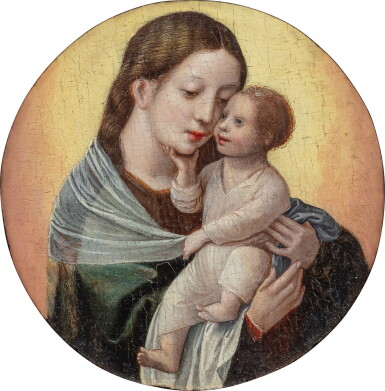
Virgin with Child
Oil on panel, circular, inserted in another panel
D. 9,7 cm ; 3⅞ in.
____________________________________________
Provenant d'une prestigieuse collection particulière espagnole
Maître des demi-figures féminines
Vierge à l'Enfant
Huile sur panneau, circulaire, enchâssé dans un autre panneau
D. 9,7 cm ; 3⅞ in.
Anonymous sale, Sotheby’s, Amsterdam, 10 May 2011, lot 1 (as Circle of Gerard David).
____________________________________________
Vente anonyme, Sotheby’s, Amsterdam, 10 mai 2011, lot 1 (comme Entourage de Gerard David).
The Virgin and Child, simply portrayed in a natural and intimate pose, is a recurrent theme in early Flemish works of the fifteenth and sixteenth centuries. Recently attributed to the Master of the Female Half-Lengths by Suzanne Laemers (see RKD n° 253953), the Virgin appears to represent the feminine type that is characteristic of the painter: a straight, narrow nose, thin eyebrows, hair parted in the middle and lowered eyes. Awarded his notname by Max Friedländer, the Master of the Female Half-Lengths was one of the most respected and fashionable artists in Antwerp in the second quarter of the sixteenth century. He often revisited compositions that were popular at the time, notably with variants of his Virgin and Child paintings, as Ellen Konowitz clearly demonstrated in her 1999 article devoted to the artist, The Master of the Female Half-Lengths Group, Eclecticism and Novelty (Oud Holland, 1999, 113, 1/2, pp. 1–12). Friedländer and Koch had already seen the influence of Bernard van Orley in these figures. According to Konowitz, the artist seems to have been inspired by Jan Gossaert as well as by Ambrosius Benson and Adriaen Ysenbrant, while retaining his own distinctive qualities.
However, in the view of Till Holgert Borchert, this charming tondo is more likely to be by a follower of Gerard David.
It is also worth noting the Virgin and Child by Ysenbrant in the Museu Nacional de Machado de Castro in Coimbra, Portugal (inv. no. 3351), where the figures are very close to those in our panel. The present representation of the Virgin and Child against a glowing background was undoubtedly much sought-after in the first half of the sixteenth century and was surely produced to meet the demands of the market. Its size and its subtlety reinforce the intimate aspect of this object of private devotion, as does its precious quality. The consistency of artistic representations and the coherent taste of these painters and their patrons provides useful information not only about the evolution of these artists’ style and about the many exchanges between Antwerp, Bruges and Brussels, but also about the spiritual priorities of their contemporaries.
____________________________________________
La Vierge à l’Enfant représentée sans artifice dans une attitude naturelle et intime est un thème récurrent dans les œuvres primitives flamandes des XVe et XVIe siècles. Récemment attribué au Maître des demi-figures par Suzanne Laemers (voir RKD n° 253953), la Vierge semble avoir le type féminin caractéristique du peintre, le nez droit et fin, les sourcils minces, ses cheveux sont séparés au milieu et ses yeux sont baissés. Ainsi nommé par Max Friedländer, le Maître des demi-figures féminines est l'un des artistes les plus réputés et en vogue à Anvers dans le deuxième quart du XVIe siècle. Il reprenait souvent les compositions populaires de son époque avec des variantes notamment pour ses Vierge à l’Enfant comme l’a très bien montré Ellen Konowitz en 1999 dans son article consacré à l’artiste, The Master of the Female Half-Lenghts Group, Eclectism and Novelty (Oud Holland, 1999, 113, 1/2, p. 1-12). Friedländer et Koch voyaient déjà une influence de Bernard van Orley dans ces figures. Selon Konowitz, il semble s’être inspiré de Jan Gossaert mais aussi d’Ambrosius Benson et d’Adriaen Ysenbrant tout en conservant sa singularité.
Ce charmant tondo est selon Till Holgert Borchert plutôt de la main d’un suiveur de Gerard David.
On notera également une Vierge à l’Enfant d’Ysenbrant conservée au Museu Nacional de Machado de Castro à Coimbra au Portugal (inv. 3351) dont le motif est très proche de notre panneau. Cette représentation de la Vierge et de l'Enfant sur un fond lumineux était sans doute très recherchée dans la première moitié du XVIe siècle et a sûrement été produite pour répondre à la demande du marché. Son format et sa subtilité renforcent l’aspect intime de cet objet de dévotion particulière ainsi que sa préciosité. Le syncrétisme des motifs artistiques et la cohérence du goût des artistes et de leurs commanditaires nous renseignent utilement sur l’évolution du style de ces artistes et les échanges nombreux entre Anvers, Bruges et Bruxelles ainsi que sur la spiritualité de leurs contemporains.
You May Also Like