
Joseph Werner
Saul and the Witch of Endor | Saul devant la sorcière d'Endor
Auction Closed
June 19, 03:36 PM GMT
Estimate
10,000 - 15,000 EUR
Lot Details
Description
Joseph Werner the Younger
Bern 1637 - 1710
Saul and the Witch of Endor
Oil on canvas
82,8 x 70,5 cm ; 32⅝ by 27¾ in.
____________________________________________
Joseph Werner le Jeune
Berne 1637 - 1710
Saul devant la sorcière d'Endor
Huile sur toile
82,8 x 70,5 cm ; 32⅝ by 27¾ in.
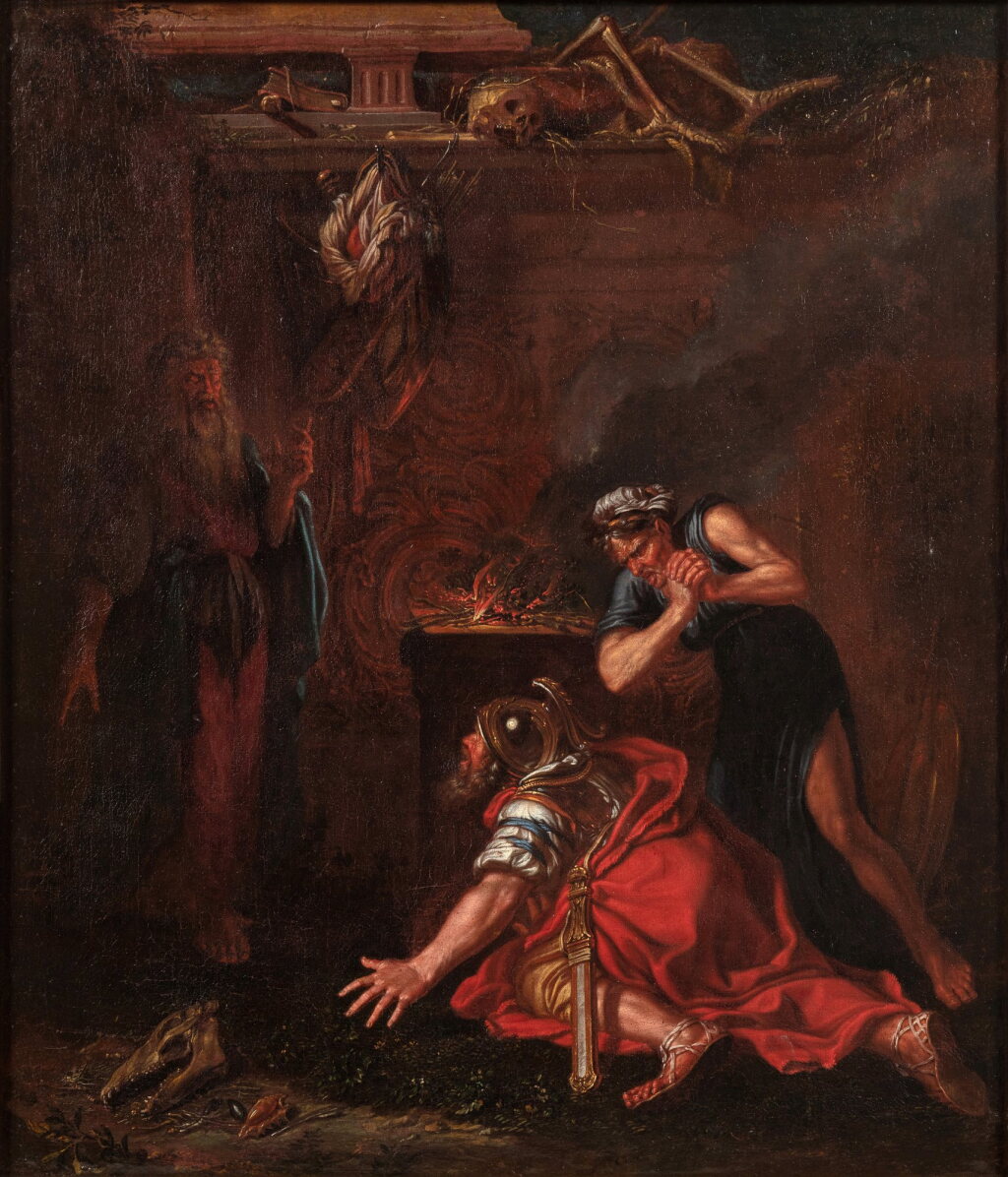
The scene of Samuel’s shade appearing to Saul before the Witch of Endor comes from the Old Testament, specifically the first Book of Samuel (1 Samuel, 28: 3–25). Saul is fearful, seeing his enemies the Philistines mobilizing around Israel; unable to consult Yahweh, he turns to a witch at Endor and asks her to summon Samuel. According to the Old Testament, when the spectre appears, ‘she cried out at the top of her voice’. Unable to see the prophet, Saul asks her to describe her vision. ‘Then Saul knew it was Samuel, and he bowed down and prostrated himself with his face to the ground’ (1S 28:12, 14). Biblical texts do not reveal where this event took place, but Werner chooses to locate the scene in front of an altar, which suggests a sacred funerary monument – perhaps Samuel’s burial place.
The composition was engraved by Georg Andres Wolfgang (1631–1716), enabling us to situate the work within the artist’s career (ill. 1). Wolfgang worked in Augsburg, where Werner was married in 1667: it thus seems probable that the two artists met at this time. Originally Swiss, Werner left his homeland to travel in Italy, France and Bavaria: French and Flemish influences consequently supplemented the classicism of his compositions. This is evident in the prominent folds of drapery and the blue and red colours which stand out from the chiaroscuro background, as well as in the dynamic composition and the figures’ dramatic gestures.
____________________________________________
La scène de l’ombre de Samuel apparaissant à Saül devant la pythonisse d’Endor, est tirée de l’Ancien Testament, et plus précisément du Premier livre de Samuel (1S, 28, 3-25). Saül, voyant ses adversaires les Philistins regroupés autour d’Israël, prend peur ; ne parvenant pas à consulter Yahvé, il s’adresse à une pythonisse à Endor, et lui demande d’évoquer Samuel. L’Ancien Testament raconte alors que, voyant apparaître le spectre, « la femme poussa un grand cri » ; Saül ne pouvant voir le prophète, il demande à la sorcière de lui décrire sa vision ; « Saül sut que c’était Samuel et, s’inclinant la face contre terre, il se prosterna » (1S, 28 :12, 14). Les textes bibliques ne décrivant pas le lieu où se déroule l’invocation, Werner choisit de la situer devant un autel, rappelant un monument funéraire sacré – peut-être celui où repose Samuel.
La composition a fait l’objet d’une gravure par Georg Andres Wolfang (1631-1716), permettant de situer notre œuvre dans la carrière de l’artiste (ill. 1). Wolfgang travaille à Augsbourg, ville dans laquelle Werner se marie en 1667 : il semble donc probable que les deux artistes s’y soient rencontrés à cette période. D’origine suisse, Werner a quitté son pays natal pour voyager en Italie, en France et Bavière : au classicisme de ses compositions, s’ajoutent alors des influences françaises et flamandes. Les plis accentués des drapés, les coloris bleus et rouges se détachant du clair-obscur de l’arrière-plan, mais aussi le dynamisme de notre composition et la gestuelle dramatique des figures en témoignent.
You May Also Like


