
Property from a European Distinguished Private Collection | Provenant d'une prestigieuse collection particulière européenne
Follower of Quentin Massys | Suiveur de Quentin Massys
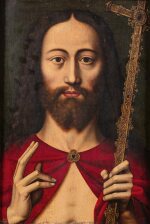
Salvator Mundi
Auction Closed
June 19, 03:36 PM GMT
Estimate
15,000 - 20,000 EUR
Lot Details
Description
Property from a European Distinguished Private Collection
Follower of Quentin Massys
Salvator Mundi
Oil on panel
51,5 x 34 cm ; 20¼ by 13⅜ in.
____________________________________________
Provenant d'une prestigieuse collection particulière européenne
Suiveur de Quentin Massys
Salvator Mundi
Huile sur panneau
51,5 x 34 cm ; 20¼ by 13⅜ in.
The iconography of Christ as Salvator Mundi, holding the globe in his left hand – sometimes simply suggested by a cross – while raising his right hand in a sign of benediction, became a popular image in Italy in the fifteenth century before spreading to northern Europe. The prototype of the present version can be found in Antwerp: the painting produced by Quentin Matsys in 1505, now in the Royal Museum of Fine Arts in Antwerp (inv. no. 241), accompanied by a Praying Virgin (inv. no. 242). Our painting may also have had a pendent, and the pair would have been intended for private devotions.
The present composition echoes the particularly restricted framing of Christ in the Matsys painting: it does not even allow the globe surmounting the cross to be seen. It is equally probable that the panel has been cut down at the top and on the left.
The stylistic treatment of our Salvator Mundi combines two influences: the Flemish influence of the prototype, from which our Christ derives his strongly drawn features, his finely described hair and a certain stiffness in the drawing; while the emphatic chiaroscuro, the very clear black outlines of his fingers and the richness of the cross’s decoration suggest a Spanish source.
____________________________________________
L’iconographie du Christ en Salvator Mundi, portant l’orbe de sa main gauche – parfois simplement suggérée par une croix - tandis qu’il lève sa main droite en un signe de bénédiction, est appréciée dès le XVe siècle en Italie, avant de se propager dans le nord de l’Europe. Le prototype de notre version est à chercher à Anvers : il s’agit du tableau réalisé par Quentin Massys en 1505, aujourd’hui conservé au musée royal des Beaux-Arts d’Anvers (inv. 241). Accompagné d’une Vierge en prière (inv. 242), notre tableau pourrait lui aussi avoir eu un pendant, dédiés à la dévotion privée.
Notre composition reprend le cadrage particulièrement resserré sur le Christ, ne laissant pas même apparaître l’orbe à l’extrémité de la croix. Il est également probable que le panneau ait été coupé, dans ses parties supérieure et gauche.
Le traitement stylistique du Salvator Mundi mêle ici deux influences : celle de son modèle, flamand, dont notre Christ emprunte le visage aux traits fortement dessinés, les cheveux finement décrits et une certaine raideur dans le dessin. En revanche, l’important clair-obscur, les cernes noirs très marqués de ses doigts, mais aussi la richesse du décor de la croix évoquent plutôt une source espagnole.