Jean Delville
Prometheus | Prométhée
No reserve
Auction Closed
June 19, 03:36 PM GMT
Estimate
3,000 - 5,000 EUR
Lot Details
Description
Jean Delville
Leuven 1867 - 1953 Brussels
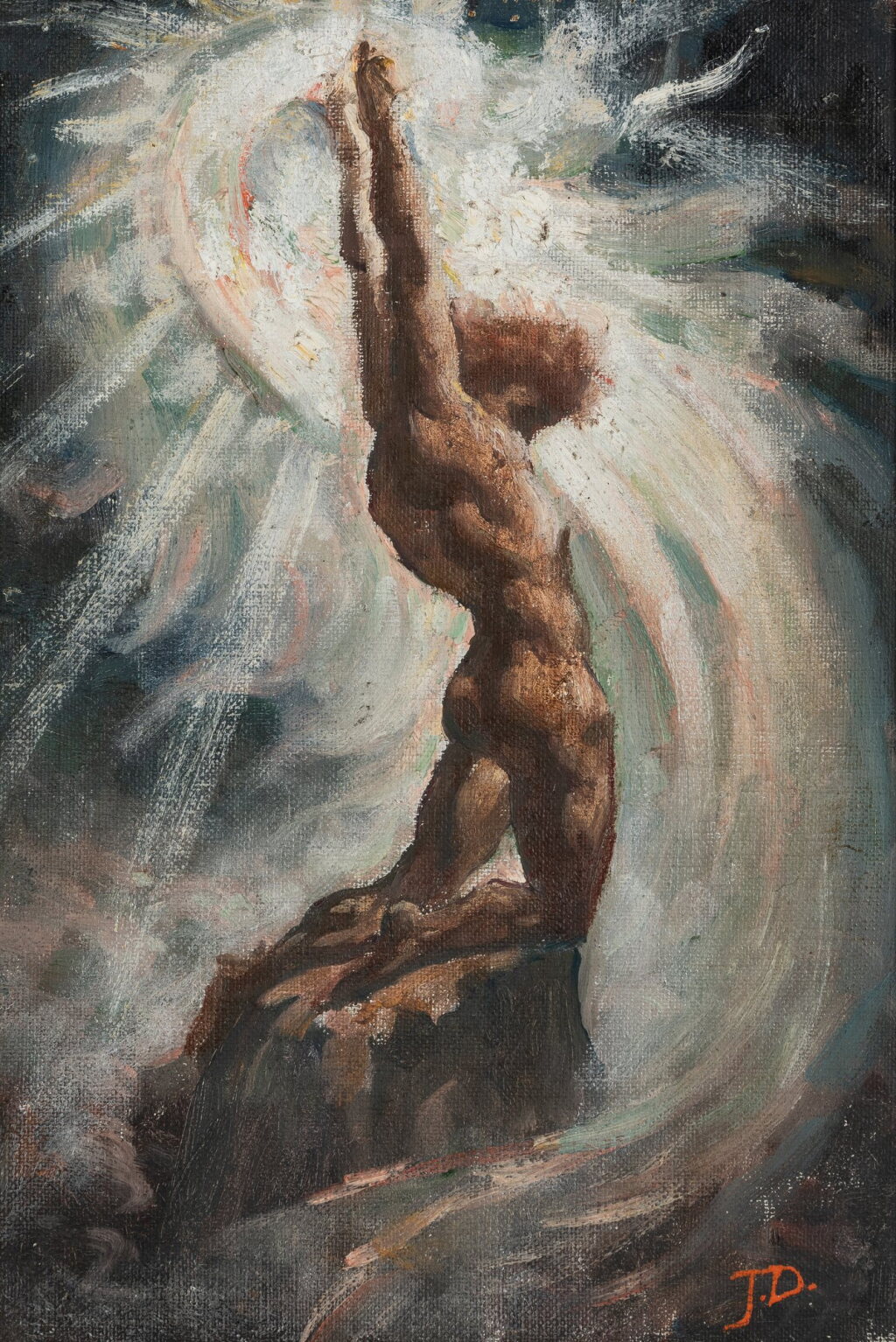
Prometheus
Oil on canvas
Signed with monogram lower right J.D. ; inscribed and signed on the reverse Première étude pour Prométhé [sic] par J. Delville
30,3 x 20,4 cm ; 11⅞ by 8 in.
____________________________________________
Jean Delville
Louvain 1867 - 1953 Bruxelles
Prométhée
Huile sur toile
Signé des initiales en bas à droite J.D. ; annoté au dos Première étude pour Prométhé [sic] par J. Delville
30,3 x 20,4 cm ; 11⅞ by 8 in.
We are grateful to Mrs Miriam Delville for having confirmed the authenticity of the work after first-hand inspection.
Jean Delville (1867–1953), the Belgian Symbolist artist, had a ‘monumental’ vision of the art of painting. This can be seen in Prométhée (1904–07, 500 x 250 cm, Université Libre de Bruxelles), a canvas described in the catalogue of the 1907 triennial exhibition in Brussels as a ‘decorative painting which could ornament a temple of science, a university or an institute’. This chimed with the artist’s determination, at the turn of the twentieth century, that idealistic works should be sited in public places.
Referencing the precepts advocated by Joséphin Péladan (1858–1918), Jean Delville saw the artist as an artist-mystic, playing a spiritual role as a guide to the sacred, and this determined the gigantic size of his works. It was also in 1907 that he proposed in his article ‘Le principe social de l’art’ (in La Belgique artistique et littéraire) that art is a ‘civilizing force’ and as such should find a place in modern society. It was through his conceptual vision of social art that he sought to make humans feel the essential immateriality of things.
The present work, which is a new discovery, is the ‘first study’ for Prométhée, showing the prophet as a bearer of light, a visualization of the spiritual elevation of human beings, thanks to the intervention of an initiate, a superman.
____________________________________________
Nous remercions Madame Miriam Delville d'avoir confirmé l'authenticité de cette œuvre, après un examen de visu.
Jean Delville (1867–1953), artiste symboliste belge, avait une vision « monumentale » de l’art de peindre. C’est le cas de Prométhée (1904-07, 500 x 250 cm, Université Libre de Bruxelles), toile qui est décrite dans le catalogue de l’exposition triennale de 1907 de Bruxelles comme une « peinture décorative pouvant orner un temple de la science, une université, un institut », ce qui rejoint la lutte de l’artiste, au tournant du XXe siècle, pour la présence des œuvres idéalistes au sein des lieux publics.
Faisant référence aux préceptes prônés par Joséphin Péladan (1858-1918), Jean Delville considère comme artiste, l’artiste-mystique, celui qui joue un rôle spirituel de passeur vers le sacré, ce qui conditionnera le gigantisme des formats de ses œuvres. C’est en 1907 aussi qu’il prônera dans l’article Le principe social de l’art (in La Belgique artistique et littéraire) que l’art est une « force civilisante » et, qu’en tant que telle, elle doit trouver une place dans la société actuelle. C’est à travers sa vision idéiste de l’art social qu’il veut faire sentir à l’homme l’immatérialité essentielle des choses.
L’œuvre que nous présentons, et qui est une découverte, est ainsi la « première étude » de Prométhée, représentation du prophète porteur de lumière, une mise en image de l’élévation spirituelle des êtres humains, grâce à l’intervention d’un initié, d’un surhomme.
You May Also Like