An Important Symbolist Collection: lots 78 to 123
Georges de Feure
Marguerite
Lot Closed
November 13, 02:15 PM GMT
Estimate
12,000 - 18,000 EUR
We may charge or debit your saved payment method subject to the terms set out in our Conditions of Business for Buyers.
Read more.Lot Details
Description
Georges de Feure
Paris 1868 - 1943
Marguerite
Oil on canvas
Signed lower left De Feure
82 x 65,2 cm ; 32¼ by 25⅝ in.
Pierre-Michel Bardou-Job;
By inheritance to Mlle J., niece-by-law of the above;
By inheritance to the present owner.
Tokyo, Odakyu Grand Gallery and Osaka, Daimaru Museum, Umeda, Georges de Feure, July-September 1990, no. 22.
H. Frantz, 'Georges de Feure', in Le Figaro illustré, no. 119, February 1900, p. 37;
I. Millman, Georges De Feure, Maître du Symbolisme et de l’Art Nouveau, Courbevoie 1992, pp. 112-113.
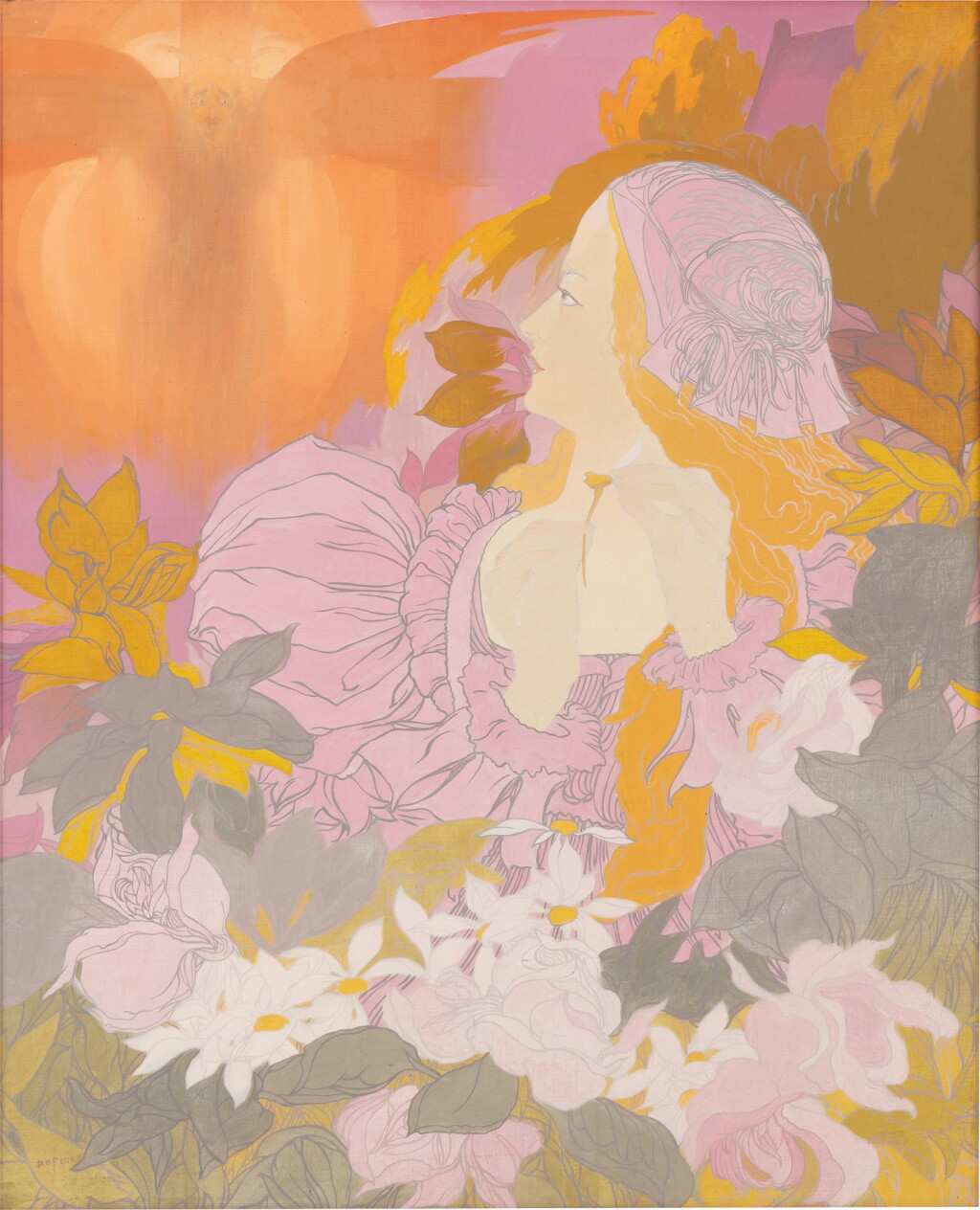
Marguerite belongs to the series of Fémini-flores that De Feure produced during the 1890s. Once again, the artist has turned to the motif of the femme fatale. Here, the woman is both beautiful and evil, deploying her magic through flowers, in a similar way to other compositions by De Feure, although this time it is explicit. Surrounded by lush vegetation which includes daisies (marguerites in French), the woman observes the man in limbo in the background before pulling off the last petal of the daisy she holds. The game whose outcome will affect him seems much more cruel than the innocent plucking of the flower’s petals, which traditionally quantifies a suitor’s love. It is easy to imagine the fate that will befall the lover when the last petal is torn off.
The man in the background is like those in fin-de-siècle narratives, in which femmes fatales exploit their powers to bring misery to their victims, who are fascinated by their charm and beauty. He stares with passive apprehension at the daisy that will seal his fate.
It is impossible not to make a connection between this painting and the artist’s wife, Marguerite Guibert. Although she does not seem to have been the model for this composition, the artist must surely be affirming his personal belief in the truth of the themes concerning the femme fatale that he was exploring and of the ambivalent feelings, both sublime and tragic, provoked by female beauty and love.
Here again, we see the distinctive style De Feure developed in the 1890s, more graphic than pictorial. This allows the artist to stylize the motifs and the composition, creating the overall appearance of an Art Nouveau decorative motif. In his article about the artist, written in 1900 for Le Figaro illustré, Henri Frantz picks out Marguerite and Tubéreuse from all the Fémini-flores, taking the view that they ‘demonstrate M. de Feure’s fine qualities of colour and drawing. His painting does not use the impasto technique, it has the delicacy and lightness of the surface that can be admired among the artists of the Italian Renaissance.’
You May Also Like