Édouard De Bièfve
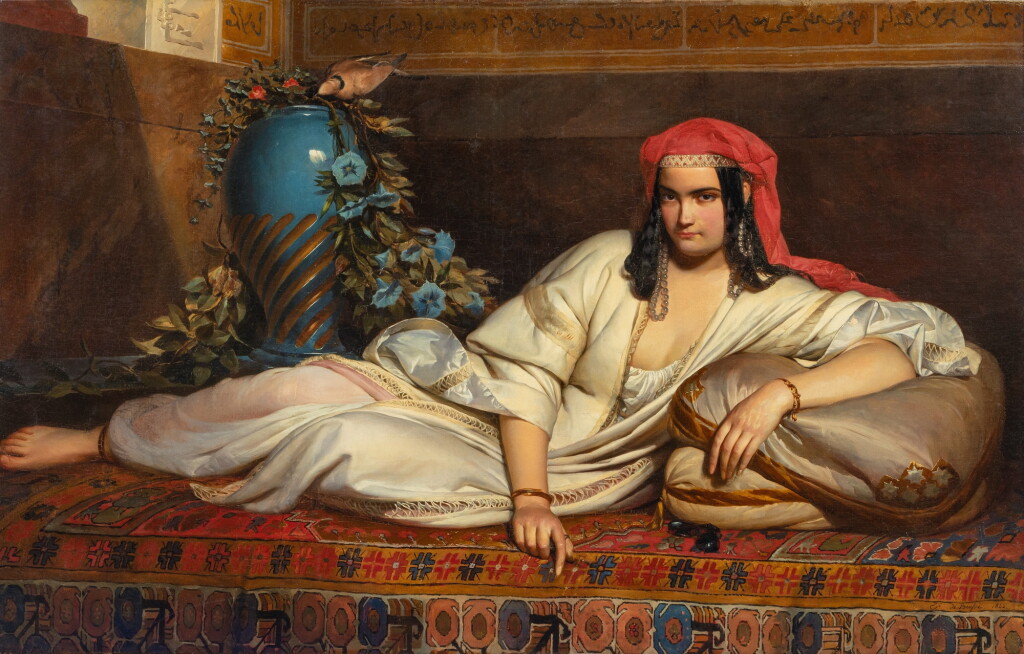
Odalisque (The Almeh)
Lot Closed
November 13, 01:57 PM GMT
Estimate
20,000 - 30,000 EUR
We may charge or debit your saved payment method subject to the terms set out in our Conditions of Business for Buyers.
Read more.Lot Details
Description
Édouard de Bièfve
Brussels 1808- 1882
Odalisque (The Almeh)
Oil on canvas
Signed and dated lower right ED. de Biefve. 1842.
119,7 x 186,2 cm ; 47⅛ by 73¼ in.
Anonymous sale, London, 1978;
Private collection, Coronado, California;
Private collection, Los Angeles, California, acquired from the above;
Anonymous sale, Heritage Auctions, Dallas, 7 December 2023, lot 69023;
Where acquired by the present owner.
Brussels Salon, 1842.
J. Matus, Unstable Bodies: Victorian Representations of Sexuality and Maternity, Manchester 1995, pp. 135-137.
This spectacular painting is undoubtedly the most famous by Édouard de Bièfve. The artist displayed it, with the title L'Almeh, at the 1842 Brussels Salon, where it had a sensational reception and was praised as much as it was criticized. The painting’s fame increased when a lithograph was produced with the title The Sultan's Favourite Songstress in 1878 and it was published in Georg Ebers’s book, Egypt: Descriptive, Historical, and Picturesque, (I, New York, 1878, p. 285).
Édouard de Bièfve, born into an aristocratic family in Brussels, is renowned for his portraits and vast history paintings. He was honoured in his lifetime and benefitted from royal and aristocratic patronage in Belgium, France and throughout the German-speaking world. After training at the Académie des Beaux-Arts in Brussels with a pupil of Jacques-Louis David, then in Paris in the studio of the sculptor David d'Angers, he travelled in Europe. Later, he exhibited regularly at the Salons in Paris, Antwerp, Ghent and Brussels. He was also a member of the academies of Berlin, Munich, Dresden and Vienna. He settled permanently in Brussels in 1841, where he became interested in Orientalism.
The present painting met with a tumultuous reception in 1842 largely because of its title. The Arab term Almeh designates a class of educated women who sang and recited poems from behind a screen or from another room during parties or private entertainments. However, the term’s meaning became distorted and for many at that time it was associated with exhibitionist dancers whose suggestive dances had a sexual connotation. L'Almeh by Bièfve is deliberately provocative: languorously reclining on a couch, the woman looks directly at the viewer and points a finger at the mattress. It is hardly surprising that the painting met with such reactions.
The quality of the drawing, the mastery of form and the attention paid to the various fabrics all attest to the artist’s talent. It is easy to understand why his career was so successful, particularly in relation to the present painting.