A Duan inkstone, Late Ming - early Qing dynasty | 晚明清初 蟲蛀四平硯
Auction Closed
October 29, 08:30 AM GMT
Estimate
300,000 - 600,000 HKD
Lot Details
Description
A Duan inkstone,
Late Ming - early Qing dynasty
晚明清初 蟲蛀四平硯
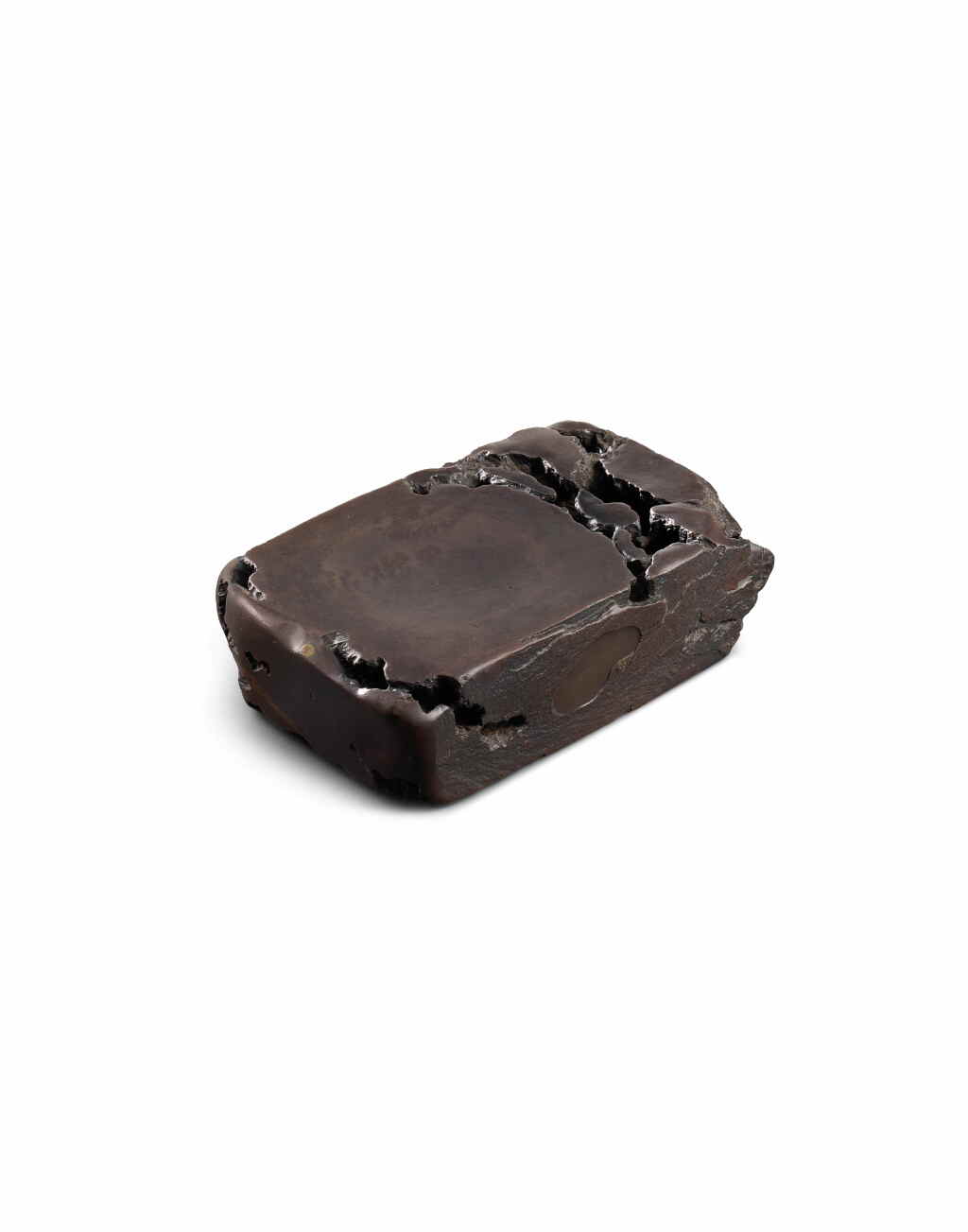
of rectangular form, the thick slab of stone minimally carved to preserve the form and skin of the stone, one side with a smoothed area forming the ink pool, surrounded by extensive 'worm-eaten' pitting forming the water pool, 18th-century wood stand
18.2 cm
Made of the most coveted Duan Brook stone, the current inkstone belongs to a form of inkstone of which production gained popularity in the late Ming to early Qing dynasties. Bearing tightly packed granules and a smooth surface, the stone was employed as much as possible by the artisan, who was able to retain the stone's skin in the production of the inkstone. The slab of stone is marked with irregular 'worm-eaten' pitting and calls to mind the textured appearance of infested wood or crevices in a weathered cave. The deeper 'worm-hole' hollows act as the water pool, while the levelled area serves as a smooth ink pool. Aside from the ink pool, which was smoothed flat by the artisan, the natural state of the stone has been retained on all other parts of the piece, including the back, masterfully combining the material with the carving technique. The flat planes on four sides of the inkstone give it its rectangular shape and Chinese name (siping).
This inkstone is made of the best Duan Brook stone, which has a fine texture and a natural, austere beauty much appreciated by collectors. Duan inkstones were produced in Zhaoqing, Guangdong, which was called Duanzhou in ancient times and gave the inkstone type its name. Inkstones made in this area were beloved by the ancient literati for aiding in the smooth movement of the ink stick, as well as the quick release and fine slip of the ink, which in turn enabled smooth writing and prevented brush wear. The Tang emperors designated Duan inkstones as tribute items, and the phrase “Duan inkstone” (Duan yan) first appeared in a poem by Tang poet Li He (790-816): “Stone-masons of Duan-zhou, subtle as spirits, / Trod the sky, hewed purple clouds with polished knives.”[1] Duan inkstones are named first among the four major types of inkstones, and they are prized among scholarly works of art. Tang poet Liu Yuxi (772-842) wrote, “Inkstones made of Duanzhou stone are valued among the people.”[2] Song poet Zhang Jiucheng (1092-1159) wrote, “Antique inkstones from Duan Brook are miracles of nature, / The purple midnight [colour] sends out a faint rainbow. / They stand apart from other types of fashionable stone, / which try to compete with the sun and moon for glory.”[3] Renowned for their substantial yet smooth and fine nature, Duan inkstones continue to be admired today as beautiful elements of a scholarly studio.
[1] Li He, “Singing of Yang’s Purple Inkstone with a Green Pattern,” in The Collected Poems of Li He, trans. J. D. Frodsham, Hong Kong, 2016, p. 186.
[2] Original Chinese: Gao Sisun, Yanjian (Notes on Inkstones), in Wenlange qinding siku quanshu (Complete Books of the Four Storehouses Commissioned for the Wenlan Hall), Vol. 861, eds., Song Weiping and Xu Hairong, Hangzhou, 2015, p. 740.
[3] Original Chinese: Zhang Jiucheng, Hengpuji, in Jingyin Wenyuange siku quanshu (Complete Books of the Four Storehouses Printed for the Wenlan Hall), Vol. 140, Taipei, 1986, p. 301.
「晚明清初 蟲蛀四平硯」,此硯取端溪璞石製成,是晚明清初開始盛行的樣式。石質細膩溫潤,藝匠因材施藝,隨形順勢略琢成硯,硯邊天然石皮均予保留,硯身滿佈蟲蛀石理,參差嵌空,呈現樹木被蟲蛀過的破碎質感,亦如自然風化的巖窟洞穴。以硯面深窪蟲蛀借為硯池,略平整處取作硯堂,平坦開闊。全器除此受墨處,以節制的人工予以磨平外,其它連硯背,皆保存原天然石材原貌,選材與造法之高妙,尤堪稱絕。因硯身四面皆有平整處,得名四平硯。
此硯取材端溪佳石,質地細潤,有古樸天成之美,賞藏皆佳。「端硯」產自於廣東省肇慶市,肇慶古稱「端州」,因而得名。此地所產硯臺以「研墨不滯,發墨快,研出墨汁細滑,書寫流暢不損毫」等優點,備受歷代文人雅士喜愛。端硯於唐代被欽點為貢品,「端硯」一詞則始見於唐代詩人李賀(790〜816)詩:「端洲硯工巧如神,踏天磨刀割紫雲。」[1] 端硯名列四大名硯之首,在硯史上獲得極高評價,唐代詩人劉禹錫(772〜842)稱「端州石硯人間重」[2]。宋代詩人張九成(1092〜1159)詩云:「端溪古硯天下奇,紫花夜半吐虹霓。不同凡石追時好,要與日月爭光輝」[3] 端硯以石質堅實、細膩、溫潤等特質馳名於世,時至今日,仍載譽天下,奉為文房名品。
[1] (宋)高似孫撰,《硯箋》,收入(清)紀昀等奉敕編;宋衛平,徐海榮主編,《文瀾閣欽定四庫全書》(杭州:杭州出版社出版,2015),子部,第861冊,頁739。
[2] (宋)高似孫撰,前引書,頁740。
[3] (宋)張九成撰,《橫浦集》,收入《景印文淵閣四庫全書》(台北:台灣商務印書館據故宫博物院藏本影印,1986),集部,第140冊,頁301。
You May Also Like