
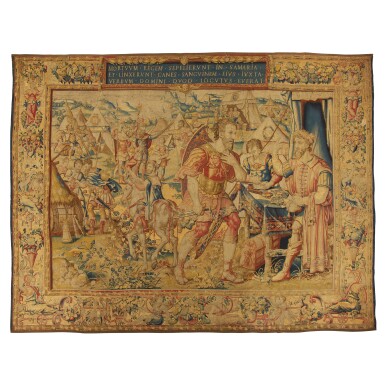
An Important Northern Renaissance Tapestry
‘King Ahab preparing for battle’, A Flemish Old Testament Biblical Tapestry, from the series ‘The Life of Ahab and the Kings of Israel’, Brussels, circa 1550, workshop of Cornelis de Ronde
Lot Closed
January 17, 02:44 PM GMT
Estimate
40,000 - 60,000 GBP
Lot Details
Description
Woven in wool and silk, with various figures in a landscape setting, with the large foreground figure of King Ahab in his active encampment preparing for battle, within a wide four-sided border with allegorical standing figures and each lower corner with a further seated figure on car pulled by two camels and two putti respectively, with swags and vases of flowers and further figures, with narrow inner and outer borders the top border centred with a blue ground entablature with the Latin inscription: Mortuum . Regem . Sepelierunt . in . Samaria. Et . linxerunt . canes sanguinem . eius. iuxta. Verbum . domini . quod . locutus . everat (fuerat): They buried the dead king in Samaria and the dogs licked his blood according to the word of the Lord which had been spoken (I Kings 22:37-38), with weaver’s mark
Approximately 357cm high, 464cm wide; 11ft. 7in, 15ft. 2in.
This lot will be on view in our New Bond Street galleries on 9th, 10th, 11th, 12th, 15th, 16th and 17th January 2024.
Probably acquired by Catherine of Austria, Queen of Portugal, in Antwerp in 1551 (as part of a set of nine tapestries)
Monsieur Leon Somzee Collection, Brussels, late 19th century, auctioned 1901
Charles Mather Ffoulke Collection, Washington D.C., 1901 (Three tapestries from the series)
French & Co, New York, 1926
Nieves Urgell, Barcelona who sold it in 1957 to a Spanish Noble Family.
Through French & Co, at the Wandsworth Atheneum, Connecticut, 1932.
Ffouke, Charles Mather, The Ffouke Collection of Tapestries, New York: Privately Printed by Frederic Fairchild Sherman, 1913, pp. 73-78.
Gschwend, Annemarie Jordan, “The Manufacture and Marketing of Flemish Tapestries in Mid-Sixteenth Century Brussels. Two Habsburg Patrons and Collectors: Mary of Hungary and Catherine of Austria”, Ao Modo de Flandres. Disponibilidade, Inovação e Mercado de Arte na Época dos Descobrimentos (1415-1580). Actas do Congresso Internacional celebrado em a Reitoria da Universidade de Lisboa, 11-13 de abril de 2005, eds. Bernardo García García, and Fernando Grilo, Lisbon: Lisboa Universidade de Lisboa/Madrid Fundación Carlos de Amberes, 2005, pp. 91-113.
This important Renaissance tapestry by Cornelis was most likely part of the series acquired by Catherine of Austria from Cornelis de Ronde through her agent Francisco Carneiro in Antwerp in 1551, and subsequently displayed at the Royal palace in Lisbon. This tapestry, together with two other companions known to be in 1913 in the Ffoulke Collection are the only known surviving pieces from the series The Life of Ahab and Kings of Israel by de Ronde and, as of today, Catherine’s series the only one documented.
For a discussion on Queen Catherine’s tapestry purchases and collecting see the essay by Annemarie Jordan Gschwend, Metaphors of Princely Rule- Magnificent Flemish Tapestries at the Lisbon Court, after this catalogue note.
Charles Mather Ffoulke (d.1909), was a wool merchant and major tapestry collector in Philadelphia and later Washington. He travelled extensively and on a trip to Europe in 1889 he met Princess Barberini and bought her entire tapestry collection, which consisted of 135 tapestries. His fascination and acquisition of tapestries continued all his life. The Ffoulke Collection of Tapestries, was published in 1913 and illustrates many pieces from his collection, including the offered tapestry of ‘Ahab preparing for battle’ (11ft 7in by 15ft 2in: 357 by 464cm), in which the Brussels town mark is visible, the panel of ‘Ahab and Jehoshaphat receiving the prophets’ (11ft 8in by 17ft 5in; 360 by 534cm), and the panel of ‘The Death of Ahab’ (11ft 8in by 15ft 2in; 360 by 464cm), all of which have the same border design.
The narrative of the tapestry is from the story of the battle of King Ahab, King of the Israelites, in alliance with King Jehoshaphat of Judah, against Ben-Hadad and Syria. From the misjudged acts of Ahab and his false prophet, in selfishly making a treaty, God warns that if you do not fear him, you may not discern his word. In the Bible fearing God is defined as hating that which is evil. As Ahab was disobedient to God, he dies on the battlefield, as Micaiah the prophet foretold. Ahab was criticised for causing moral decline and his sins reflect those of people at large and were to be learnt from and instructive.
Tapestries of the 16th century are particularly distinguished in their subject matter, which is moralising and allegorical, their design being especially awe inspiring and stately, and in their incredible virtuosity of technical dyeing and weaving skills. Flemish tapestries of this epoch were highly sought after by the courts of Europe.
Cornelis de Ronde (d.1568/early 1569), was a Brussels weaver, recorded in 1551 when he supplied a set of nine tapestries of Ahab and the Kings of Israel, to Catherine of Austria, Queen of Portugal. There is little recorded of his life. He was dean of The Cornflower chamber of Rhetoricians in 1560. He is known to have supplied tapestries with gold thread to the Marshal De Saint-Andre before 1565. His weaving cypher incorporated his initials, and in accordance with the ordinance of 1528 by the Brussels city magistrates, all tapestries larger than three ells had to include his cypher (or that of whoever had commissioned it) and the town mark, which by May 1544 was an Imperial edict for towns of production to have their town marks on tapestries, which was implemented in Brussels by 1546. His cypher was used in eight tapestry series. The present tapestry has the weaver’s cypher, but the lower later selvedge does not include the Brussels town mark of B(Brussels) B(Brabant) centred by a red shield, which was present on the original blue selvedge of the lower border, and removed during conservation in the early 20th century.
Many of de Ronde’s series were influenced the style of the Italian High Renaissance, in their depictions of ancient historical costume design and classical architecture and larger than life mannerist style figures and advanced concepts of space and form. Italian artists such as Raphael (1483-1520) and Perino del Vaga (1501-1547) had a huge influence on the artists of the north and one of the greatest protagonists was the tapestry designer and ‘Renaissance Man’, Pieter Coecke van Aelst (1502-1550) who had travelled extensively within Europe and Ottoman Empire, had many connections and therefore influence on his fellow Flemish weavers. He combined the styles of Italy with those of the great tradition of Netherlandish artists, such as Rogier van der Weyden, Jan van Eyck, Hans Memling and Pieter Bruegel. It resulted in Coecke being held in great esteem by his contemporaries and for two hundred years after his death. Flemish weaving workshops were inevitably inspired by the success of his tapestry designs. Cornelis de Ronde was one of those designers. The border designs were very striking in enclosing the narrative of the tapestries in entablatures, with distinctive classical, elegant compartmentalised designs which incorporated architectural detailing and allegorical figures along with fantastical and imaginary groupings, such as seated figures in cars pulled by small children or animals, such as camels.
The Northern Renaissance style resulted in De Ronde working with designs after the important Italian Renaissance artist, Perino del Vaga, for example on ‘The Story of Aeneas’, circa 1540, and with Jan van der Vyst, on the series ‘Grotesque Months’, circa 1565, who had worked closely with Pieter Coecke van Aelst. The van der Vyst border designs with various small putti, on the van Aelst tapestries of The Life of Saint Paul, circa 1529 or 1535, (Boston, Museum of Fine Arts), are comparable with elements in the present border. The putti were taken from the Grotesque Tapestry designs inspired by the excavation in 1480 of the ancient Roman house, Domus Aurea (Golden House), which influenced French and Flemish art, as well as Italian. Cornelis de Ronde was inspired further stylistically for border elements by the exotic ‘grotesque’ border designs of Cornelis Bos (c.1515-1555), for example ‘Flemish Grotesque with a fantastic cart pulled by satyrs’, which incorporates strapwork elements, Antwerp, 1550, engraving, Metropolitan Museum of Art, New York (Acc.No.49.95.369). In addition, Cornelis Floris de Vriendt (1514-1575), was influential with his fantastical designs, an example being ‘Design for circular border with grotesque ornament and mythical sea creatures’, which shows figure seated on a car pulled by a large insect, 1542, drawing, Victoria and Albert Museum, London (Inv.No.E.185-1918).
A tapestry by Cornelis de Ronde ‘Perseus receiving Medusa's troops before the battle’, historically in the collections of the Dukes of Infantado, sold in Madrid, Alcalá 30-31 March 2022, lot 660, for €85,000. The proportions of the figures in the main narrative are similar to those of the present tapestry, and the border type is comparable, with variations in the standing allegorical figures and animals and birds used to pull the seated figures in the cars in each lower corner.
_________________________________________________
METAPHORS OF PRINCELY RULE
MAGNIFICENT FLEMISH TAPESTRIES AT THE LISBON COURT
Annemarie Jordan Gschwend
Senior Research Scholar, Centro de Humanidades (CHAM), Zurich, Switzerland & Lisbon, Portugal
Catherine of Austria, Queen of Portugal (r. 1525-1578) owned an impressive collection of Flemish tapestries. Her connoisseurship and appreciation of tapestries had been cultivated since childhood at her mother’s court, Juana I, in Tordesillas. Flemish tapestries belong to the tradition of Habsburg collecting in the Renaissance. Family members (male and female) were discerning connoisseurs, investing large sums of money in acquiring or commissioning significant allegorical, biblical, mythological, and classical history cycles to enhance their collections and furbish their residences and palaces - Catherine’s tastes aligned with family tradition.
For Habsburg collectors, tapestries functioned as princely decoration; the medium dazzled owners because of the extensive use of silk, silver and gold thread. Sumptuous tapestry cycles with targeted narratives mirrored Habsburg dynastic claims and political aspirations. At the height of tapestry production in Brussels, Habsburg patrons purchased the most significant sets (over seventeen series) ever woven in the sixteenth century. For Catherine, her brother Emperor Charles V, and their families, tapestries were the ideal platform to glorify Habsburg power.
The Portuguese queen recruited the help of her elder sister, Queen Mary of Hungary, Regent of the Netherlands, a great patron of tapestries, to help her acquire outstanding tapestry cycles from leading weavers in Flanders. The artistic relationship between the two sisters, especially Flemish tapestries, has come to light in a rare document in the Torre do Tombo archive in Lisbon. This report, 34 folios in length, itemises the purchases made on her behalf in the Netherlands.1 In 1551, the Portuguese queen sent her page, Francisco Carneiro, to Mary’s court to supervise her acquisitions, with the extraordinary sum of 5,000 cruzados budgeted for his shopping. Nine panels of the biblical history of Queen Esther were bought in Antwerp from the Nuremberg merchant banker Lazarus Tucher. In Brussels, Carneiro purchased nine panels of the Story of King Ahab and the Israelite Kings and eleven of the History of Solomon from Cornelis de Ronde’s workshop.2
The Portuguese queen appears to have been best informed by her sister Mary of the stock for sale in de Ronde’s workshop. Catherine was particularly keen on acquiring a set of seven panels, he wove after the editio princeps executed for Andrea Doria, depicting the History of Aeneas, based on earlier designs made by Perino del Vaga before 1536. However, as Carneiro informed the queen, Mary had bought the cycle before he arrived in Brussels. The Ahab cycle was purchased by Carneiro instead of Aeneas.3
Catherine’s tapestries were destined for the Lisbon royal palace, the Paço da Ribeira, and displayed in her private quarters and public rooms, particularly the queen's hall, the Sala da Rainha. This space reserved for fêtes and state events reflected Catherine’s political objectives, as she linked her rule, through representative tapestries, to her brother’s reign of empire-building. Two courtiers from the Farnese court in Parma attended a wedding celebrated in Lisbon in 1565, which the Portuguese queen staged in these same rooms.
Angelo Carissimo described Catherine’s tapestries in the queen’s sala as “rich, fine panels with diverse ancient and modern stories hung along the walls from top to bottom so that not one bit of the wall could be seen”. Francesco di Marchi, Carissimo’s companion, dined in Catherine’s apartments “richly decorated with tapestries woven with gold, silver and silk”.
Little information exists about de Ronde’s early training or career as a tapestry dealer. Documents confirm that he was a successful weaver, active in Brussels between 1545 and his death in 1569. His CR monogram appears on eight tapestry cycles, identifying his high- quality production. Among them, the twelve panels of the Allegories of the Months in Vienna (Kunsthistorisches Museum), one set of the Story of Aeneas purchased by Mary of Hungary instead of Catherine of Austria in 1551 (Patrimonio Nacional, Madrid), and the Life of Hannibal, divided between the Uffizi in Florence (three tapestries) and the Bavarian National Museum in Munich (six tapestries).
The later history of Catherine’s nine panels of the Life of Ahab is not documented. In 1901, Charles Mather Ffoulke, a prominent American tapestry collector in Washington, D.C., acquired three tapestries of the Life of Ahab woven by Cornelis de Ronde from the 1901 sale of Jean de Somzée in Brussels, including this present panel, which may be related to Catherine’s cycle purchased in 1551 and once in the Lisbon royal palace. After the Portuguese queen died in 1578, her rich tapestry collection was dispersed, with some sets taken by her nephew Philip II of Spain after he took over the Portuguese throne and the royal collections in 1580. The Spheres tapestries, once the pride of the Portuguese court in the sixteenth century, are now in the Patrimonio Nacional in Madrid.4
Annemarie Jordan Gschwend is a senior research scholar and curator associated with the Centro de Humanidades (CHAM) in Lisbon and Zurich since 2010. She obtained her PhD in 1994 from Brown University (Providence, R.I.), with a dissertation on the court, household, and collection of Catherine of Austria, Habsburg princess and queen of Portugal. She is the author of numerous publications – books, articles, and exhibition catalogues. In 2017, she published a biography of Catherine of Austria entitled Catarina de Áustria. A rainha colecionadora. She co-curated the 2018 Schloss Ambras exhibition in Innsbruck, Women. The Art of Power. Three Women from the House of Habsburg, in which Catherine was highlighted as patron and collector.
1 Published in Annemarie Jordan Gschwend, “The Manufacture and Marketing of Flemish Tapestries in Mid- Sixteenth Century Brussels. Two Habsburg Patrons and Collectors: Mary of Hungary and Catherine of Austria”, Ao Modo de Flandres. Disponibilidade, Inovação e Mercado de Arte na Época dos Descobrimentos (1415- 1580). Actas do Congresso Internacional celebrado em a Reitoria da Universidade de Lisboa, 11-13 de abril de 2005, eds. Bernardo García García, and Fernando Grilo (Lisbon: Lisboa Universidade de Lisboa/Madrid Fundación Carlos de Amberes, 2005), pp. 91-113, especially pp. 103-111 (Doc. 1).
2 Carneiro paid de Ronde a total of 447,000 reais for both sets. Cf. Jordan Gschwend, 2015, p. 106: “Se comprou de Corneles do Romde [Cornelis de Ronde] hua camara de tapeçaria da estorea del Rey Acab em que ha nove panos e hua porta […]”; “Se comprou outra camara de tapeçaria da estoria de Salamão em que ha nove panos […]”.
3 Jordan Gschwend, 2015, p. 107: […] “he em lugar da de Eneas que era vemdida leva outra da estorea del Rey Acab nas ditas tres camaras de tapeçaria […]”.
4 Consult online: https://www.habsburgwomen.com/post/the-spheres-tapestries-portugal-s-global-history--woven-in-silk-silver-and-gold%2C-and-https%3A/www.patrimonionacional.es/colecciones-reales/textiles-y--tapiceria/hercules-sostiene-la-esfera-celeste (accessed 5 December 2023).
Related Literature
Iain Buchanan, Habsburg Tapestries (Studies in Western Tapestry, 4) (Turnhout: Brepols, 2016).
Elizabeth Cleland, ed. Grand Design: Pieter Coecke van Aelst and Renaissance Tapestry
(New York: The Metropolitan Museum of Art, 2014), p. 130 and p. 357, n. 47.
Guy Delmarcel, Flemish Tapestry from the 15th to the 18th Century (Tielt: Lannoo Publishers, 1999), p. 138 and p. 369.
Guy Delmarcel and Claire Dumortier, “Cornelis de Ronde, wandtapijtwever te Brussel (†1569)”, Revue belge d’archéologie et d’histoire de l’art/Belgisch tijdschrift voor oudheidkunde en kunstgeschiedenis, 55 (1986), pp. 41-67.
Julia Farmer, Imperial Tapestries: Narrative Form and the Question of Spanish Habsburg Power, 1530-1647 (Lewisburg: Bucknell University Press, 2016).
Annemarie Jordan, Portuguese Royal Collections (1505-1580): A Bibliographic and Documentary Survey, MA Thesis (George Washington University: Washington, D.C., 1985).
Annemarie Jordan, The Development of Catherine of Austria’s Collection in the Queen’s Household: Its Character and Cost, PhD thesis (Brown University, Providence, R.I., 1994).
Annemarie Jordan Gschwend, “‘Verdadero Padre y Señor’: Catherine of Austria, Queen of Portugal”, Los Inventarios de Carlos V y la familia imperial/The Inventories of Charles
V and the Imperial Family edited by Fernando Checa (Madrid: Fernando Villaverde Ediciones, 2010), p. 3023.
Lucia Meoni, “L’arazzo con la Spoliazione dei corpi dopo la battaglia di Canne della serie dedicata alle imprese di Annibale nella seconda guerra punica”, La Galleria degli arazzi. Fragilita della bellezza, (Florence: Galleria degli Uffizi, 2014), pp. 29-47.
Elisabeth Scheicher, “Die Groteskenmonaten. Eine Tapisserienserie des Kunsthistorischen Museums in Wien”, Jahrbuch der kunsthistorischen Sammlungen in Wien, LXIX, 1993, pp. 55-84.