From a European Noble family
Mellerio dits Meller
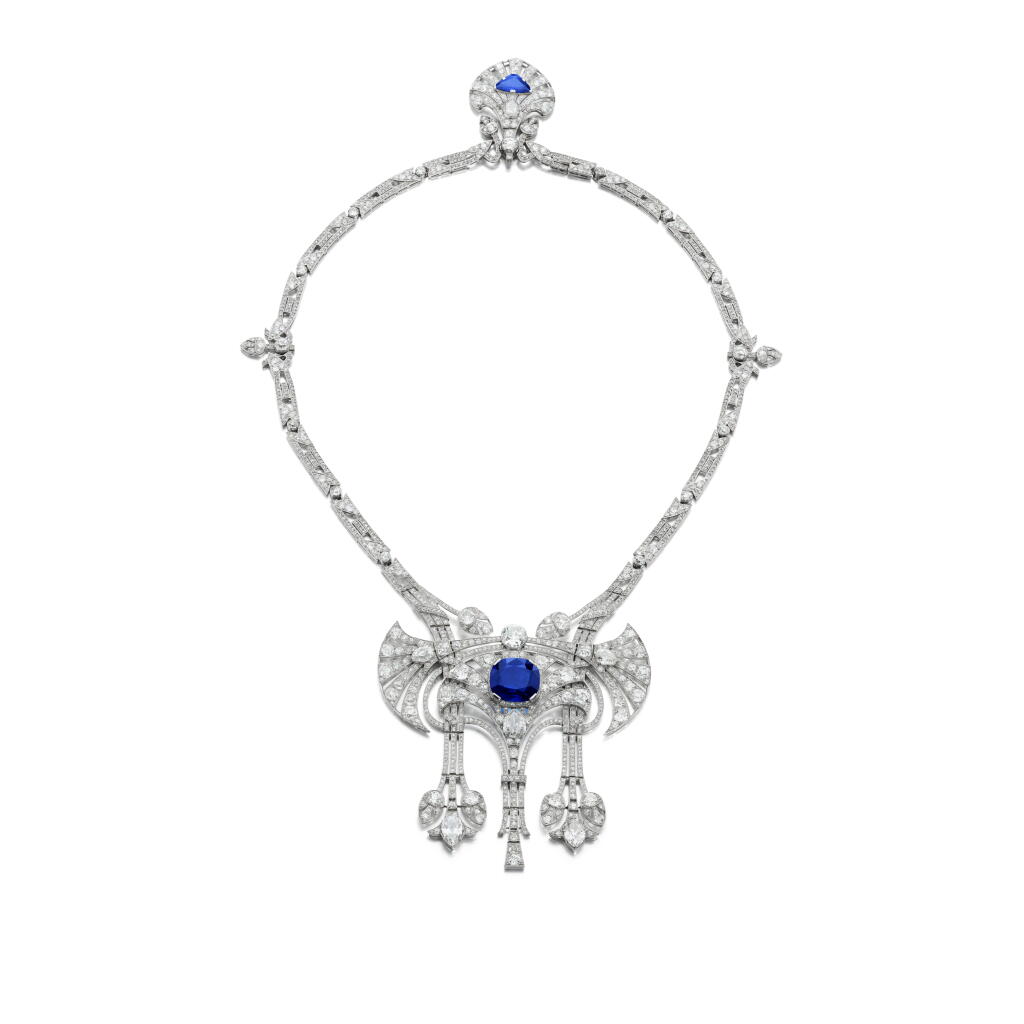
Highly important sapphire and diamond necklace, early 20th century with alterations in the 1920s and 30s
Auction Closed
November 13, 06:32 PM GMT
Estimate
170,000 - 340,000 CHF
Lot Details
Description
Of Egyptian revival design, the front designed as intertwined papyrus reeds centering a cushion-shaped sapphire weighing 18.08 carats, set throughout with circular- and single-cut, old cushion-shaped and rose diamonds, accented by pear-shaped diamonds, the clasp featuring stylised lotus flowers set with a triangular sapphire, length approximately 520mm, signed Mellerio and Mellerio dits Meller, maker’s mark for Mellerio, French assay mark for gold.
Accompanied by SSEF report no. 140343, dated 10 September 2024, stating that the sapphire is of Ceylon origin, with no indications of heating; together with a copy of a Mellerio fiche object particulier.
The Splendour of Diamond: 400 years of Diamond Jewellery in Europe, Tokyo National Museum and Osaka Municipal Museum, Tokyo and Osaka, 7 October 2004 - 29 February 2005.
Jewellery from the Renaissance to Art Deco 1540-1940, Tokyo Metropolitan Teien Art Museum, Tokyo, 7 October 2003 - 27 February 2004.
Cf.: Vincent Meylan, Mellerio dits Meller - Joaillier des Reines, Paris, 2013, p. 370-371.
Egypt and Mellerio
By Vincent Meylan
Egypt has been an inspiration for French design for more than two centuries. In 1798, General Bonaparte decided to invade the land of the Pharaohs in order to fight his English enemies on the south side of the Mediterranean. When he came back to France one year later, Egyptian style became so fashionable, especially in furniture, that it was given a name: ‘Retour d’Egypte’. Sphinxes, lotus flowers and goddesses were very popular motives and remained so during the 19th century and the first half of the 20th century.
The most striking example of the relationship between the two countries is the obélisque which stands on the Place de la Concorde in Paris. It comes from the world-famous temples of Luxor and was given to France in 1830 by the Vice-Roi Mehemet Ali. In 1857, Said Pacha, Mehemet Ali’s younger son, appointed Auguste Mariette, a French archeologist, as conservateur du service des antiquités égyptiennes. Two years later, the same Said Pacha, gave permission to Ferdinand de Lesseps to start working on the project of the Suez Canal which was inaugurated in 1869 by Empress Eugénie.
Literature was also involved. In 1857, the famous French writer Theophile Gauthier published a novel ‘Le roman de la momie’ which was an absolute best-seller of the time. In 1862, it became the subject matter of a ballet created in St. Petersburg by Marius Petipa, ‘La Fille du Pharaon’ or ‘The Pharaoh’s Daughter’. In 1911, the novel was finally adapted in a movie by Albert Capellani and Henri Desfontaine.
No wonder that Egypt also found its way into jewellery. One of the finest examples of the influence of ancient Egypt on French jewellers is a necklace-devant de corsage dated circa 1850 made of gold, amethyst and turquoise-blue ceramic pendants which was exhibited recently at the Musée d’Orsay during the ‘Spectaculaire Second Empire’ exhibition. This jewel is signed by Mellerio, the oldest French jewellery house. The Mellerio family originates from the Craveggia valley in Piedmont, Northern Italy. Their first arrival in France is dated around 1515 and during many centuries they were travelling salesmen between Italy and France, selling very small articles of jewellery. During the 18th century, some members of the family settled in Paris on a more permanent basis. The oldest archives kept today by the firm are dated around 1755 and their first ledgers start in 1776.
The 19th century was a very busy time for Mellerio. They were one of the many jewellers of Empress Joséphine. Then, they became jewellers to Queen Marie Amélie and finally to Emperor Napoléon III and Empress Eugénie. Today, Mellerio continues to thrive as a family business, the only jeweller on rue de la Paix to remain so. Laure Isabelle Mellerio leads the company as its CEO and artistic director.
Egyptomania
In the 1920s, the vocabulary of luxurious jewellery was thematically influenced to a great degree by various ancient cultures. Vogue magazine published a number of features in 1921 on fashions in ancient Egypt, Greece and the Near East.
The discovery of King Tutankhamen’s tomb in 1922 inflamed a fascination with the land of the Pharaohs that spread across the globe, and jewellers turned to symbols from ancient Egyptian art as a source of inspiration for their creations of glittering statement pieces. It is a period when trends in fashion and jewellery were inextricably linked. Bias cuts and tunic shapes proliferated. Couturiers such as Doucet, Lanvin and Vionnet created evening dresses which perfectly complemented the latest fashions in jewels such as elongated pendant earrings and panel bracelets.
This highly important sapphire and diamond necklace is an exceptionally early example of Egyptian revival jewellery, announcing the trend some ten years earlier than its peak in the early 1920s. In fact, the necklace was originally created by Mellerio in 1909 with three emeralds set in the centre. Subsequently the necklace was altered in 1922. Four years later in 1926, the emeralds were exchanged for the current cushion-shaped sapphire. In 1931 and 1933, the necklace was altered again to its present form. The triangular sapphire was added to the clasp in 1931. It is a fascinating jewel that cannot be captured by just one style or period.
You May Also Like