The Leshantang Collection 樂山堂收藏
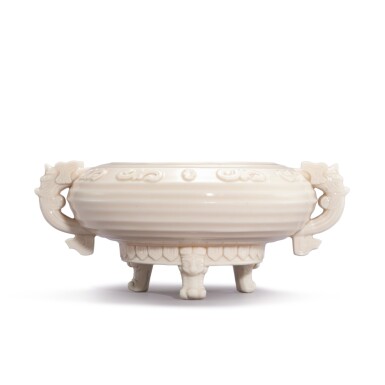
A blanc-de-Chine archaistic 'mask' incense burner, 17th century | 十七世紀 德化白瓷仿古貼卷草紋雙龍耳簋式爐
Lot Closed
December 4, 03:55 AM GMT
Estimate
100,000 - 150,000 HKD
We may charge or debit your saved payment method subject to the terms set out in our Conditions of Business for Buyers.
Read more.Lot Details
Description
A blanc-de-Chine archaistic 'mask' incense burner
17th century
十七世紀 德化白瓷仿古貼卷草紋雙龍耳簋式爐
well potted after the archaistic Zhou dynasty bronze gui form, the compressed circular body with ribbed sides resting on three short feet modelled as paws and applied with bovine masks, the sides flanked by a pair of loop handles issuing from animal masks, the base encircled by moulded pendant lappets and the rim with zoomorphic motifs, covered overall with an even ivory-tinged glaze
w. 20.7 cm
Collection of Edward T. Chow.
Sotheby's Hong Kong, 19th May 1981, lot 467.
Offered at Sotheby's Hong Kong, 11th April 2008, lot 2504.
來源:
仇焱之收藏
香港蘇富比1981年5月19日,編號467
上拍於香港蘇富比2008年4月11日,編號2504
Chūgoku meitō ten: Chūgoku tōji 2000-nen no seika [Exhibition of important Chinese ceramics: Essence of two thousand years of Chinese ceramics], Nihonbashi Takashimaya, Tokyo, and six other locations in Japan, 1992, cat. no. 103.
展覽:
《中国名陶展:中国陶磁2000年の精華》,日本橋高島屋,東京,以及其他六個日本縣市,1992年,編號103
The Leshantang Collection of Chinese Porcelain, Taipei, 2005, pl. 17.
Zhongguo mingtao Riben xunhui zhan. Gangtai mingjia shoucang taoci jingpin [Exhibition of famous Chinese ceramics touring Japan. Fine ceramics from private Hong Kong and Taiwanese Collections], Museum of History, Taipei, 1992, p. 154.
出版:
《樂山堂藏瓷》,台北,2005年,圖版17
《中國名陶日本巡迴展—港台名家收藏陶瓷精品》,歷史博物館,台北,1992年,頁154
Fine Dehua wares are appreciated for their beauty, pure white pearl-like glaze and for the particularly smooth texture of the glaze. It was a ware highly favoured by the literati class who felt that the white glaze reflected and emulated their pure taste. Dehua kilns produced objects for the scholar's desk and the house altars.
Censers in the form of archaic bronzes after late Western Zhou dynasty tripod gui catered to the scholar's antiquarian tastes. Robert H. Blumenfield in Blanc de Chine. The Great Porcelain of Dehua, Berkeley, 2002, p. 21, notes that 'Dehua-made incense burners were used in temples, by families at household altars, or by scholars who sometimes used them to hold scholars' rocks or pebbles (for contemplating nature) or who savoured the smell of incense while they worked.'
A closely related censer from the Palace Museum, Beijing, is illustrated in The Complete Collection of Treasures of the Palace Collection. Monochrome Porcelain, Hong Kong, 1999, pl. 109; and another similar example, from the Carl Kempe collection in the Museum of Art and Far Eastern Antiquities, Ulricehamn, Sweden, is published in Chinese Ceramic Treasures. A Selection from the Ulricehamn East Asian Museum, Including the Carl Kempe Collection, Ulricehamn, 2002, cat. no. 810.
Compare a related gui decorated with a band of stylised flowers and raised on a high foot sold in our London rooms, 12th December 1989, lot 387; and another sold in these rooms, 17th May 1988, lot 41. For examples of archaic bronze-inspired Dehua censers of other forms see a ding illustrated in P. J. Donnelly, Blanc de Chine, London, 1969, pl. 13D; and a fangding included in Robert H. Blumenfield, op. cit., p. 23, fig. D.
For the inspiration of this piece see a Western Zhou dynasty archaic bronze gui illustrated by Jessica Rawson, Western Zhou Ritual Bronzes from the Arthur M. Sackler Collections, vol. II B, Arthur M. Sackler Foundation, Washington DC, 1990, no. 56.
這三足爐的器形深受西周青銅器簋所影響、但用途已由原來的盛放飲食或禮器變為焚香之用。而其象牙白色的釉色、温潤細膩、配合簡素但富層次感的貼花紋飾、一派穩重雅儒、因此德化白瓷極得明、清文人雅士之垂菁。