Jan Lievens
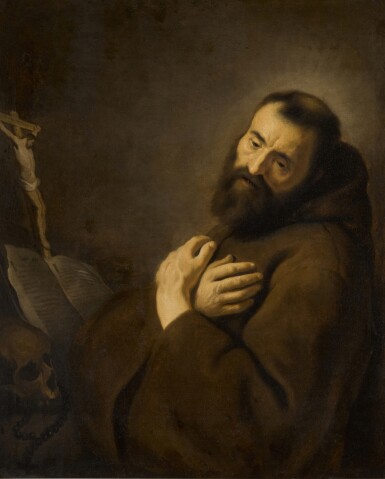
Saint Francis in Ecstasy
Lot Closed
July 4, 09:43 AM GMT
Estimate
30,000 - 50,000 GBP
Lot Details
Description
Jan Lievens
Leiden 1607–1674 Amsterdam
Saint Francis in Ecstasy
oil on canvas
unframed: 96.1 x 79.6 cm.; 37⅞ x 31⅜ in.
framed: 130.3 x 114.3 cm.; 51¼ x 45 in.
Ida Israelsson (1874–1962) and August Herbert Israelsson (1876–1968), Örebro, from 1925;
Thence by descent to their son, Martin Israelsson Hagenfeldt (1899–1974), Örebro;
Decoen collection, Belgium, by 1932.
Leiden, Museum De Lakenhal, on loan in 1931.
H. Schneider, Jan Lievens. Sein Leben und seine Werke, Haarlem 1932, pp. 35 and 107, no. 65, reproduced fig. 4 (as Jan Lievens);
K. Bauch, Die Kunst des jungen Rembrandt, Heidelberg 1933, p. 220 (as Jan Lievens);
H. Schneider and R.E.O. Ekkart, Jan Lievens. Sein Leben und seine Werke, Amsterdam 1973, pp. 107 and 324, no. 65, reproduced fig. 4 (as Jan Lievens);
J. Knipping, Iconography of the Counter Reformation in the Netherlands, Utrecht 1974, p. 150, n. 219 (as Jan Lievens);
W. Sumowski, Gemälde der Rembrandt-Schüler, Landau in der Pfalz 1986, vol. III, p. 1795, under no. 1239 (as Jan Lievens);
B. Schnackenburg, Jan Lievens: Friend and Rival of the Young Rembrandt, with a catalogue raisonné of his early Leiden work 1623-1632, Petersburg 2017, pp. 31, 106 and 325, no. 144, reproduced (as Jan Lievens).
Hailing from Leiden, Jan Lievens' artistic journey was deeply intertwined with that of his friend and rival, Rembrandt van Rijn, during the late 1620s and early 1630s. This period witnessed a fertile collaboration between the two artists, characterized by shared models (and probably studio spaces) and a mutual exchange of techniques, culminating in works imbued with profound psychological depth and dynamic chiaroscuro effects, as evidenced in the present canvas. Here, the artist depicts the founder of the Franciscan order, Saint Francis of Assisi in ecstasy before a crucifix. The muted color palette, restricted to a predominance of beiges and browns, contributes to the sobriety and asceticism of the scene, conforming to the spirit of the Catholic Counter-Reformation.
This work relates to a painting, horizontal in format, depicting the same subject, in the Palais des Beaux-Arts, Lille.1 The precise nature of the relationship between the two is still not entirely clear. Werner Sumowski described the Lille picture as an extended copy the present work.2 More recently however, Bernard Schnackenburg published both works as autograph, deeming the present work to be an autograph reduced replica of the Lille painting.3
We are grateful to Dr Lloyd De Witt for endorsing the attribution to Jan Lievens upon firsthand inspection of the work in 2023. He dates the picture to circa 1629–30 and compares it stylistically to the artist’s Samson and Delilah in the Rijksmuseum, Amsterdam.4 Like Sumowski, he considers the picture in Lille to be a copy after the present work.
1 Inv. no. P 1930; oil on canvas; 94.2 x 104.5 cm.; https://www.pop.culture.gouv.fr/notice/joconde/000PE017705?base=%5B%22Collections%20des%20mus%C3%A9es%20de%20France%20%28Joconde%29%22%5D&mainSearch=%22jan%20lievens%22&last_view=%22list%22&idQuery=%220327a6a-b27d-fb3d-7188-71cad7a6e30%22
2 Sumowski 1986, p. 1795.
3 Schnackenburg 2017, p. 325.
4 Inv. no. SK-A-1627; oil on canvas; 131 x 111 cm.; https://www.rijksmuseum.nl/en/collection/SK-A-1627
You May Also Like