
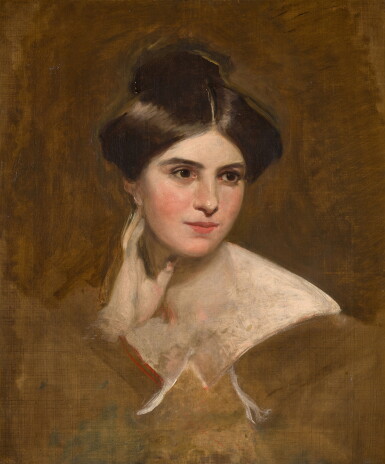
Property from a Private Collection
Henry William Pickersgill, R.A.
Portrait of Frances Ann Kemble (1809–1893)
Lot Closed
July 4, 11:05 AM GMT
Estimate
12,000 - 18,000 GBP
Lot Details
Description
Property from a Private Collection
Henry William Pickersgill, R.A.
London 1782–1875
Portrait of Frances Ann Kemble (1809–1893)
oil on canvas, unlined
unframed: 60.9 x 50.8 cm.; 24 x 20 in.
framed: 79.9 x 69.7 cm.; 31½ x 27½ in.
In the possession of the artist upon his death in 1875;
Sold at his posthumous estate sale ('The Remaining Works of H.W. Pickersgill, R.A.'), London, Christie's, 16 July 1875, lot 157 (as The Lady Georgiana West, &c.);
Anonymous sale, London, Roseberys, 28 June 2017, lot 1183 (as Circle of Sir Thomas Lawrence, P.R.A.);
Where acquired by the present owner.
Probably F.A. Kemble, Records of a Girlhood, New York 1883, p. 367.
This rediscovered portrait of Frances Ann Kemble constitutes an exciting addition to Henry William Pickersgill's œuvre. The sitter is identifiable on account of the similarities in her appearance across this picture and other documented portraits, the most famous of which must be the drawing by Sir Thomas Lawrence (1769–1830), which is today lost and therefore known only through copies.1 The present painting is in fact likely recorded in a letter written by the sitter, in March 1831: she describes sitting for Pickersgill, 'a very eminent portrait painter', but explains that their encounter was broken off abruptly as a result of a disagreement between one of Kemble's friends, who accompanied her, and the artist, leaving the portrait unfinished.2
Born in London, Kemble was an abolitionist, poet, and writer, raised in a family of prominent stage actors. She began her acting career and earned acclaim for her 1829 turn as Juliet in Romeo and Juliet, performed at the Covent Garden Theatre, which was owned by her father, Charles Kemble (1775–1854). After a tour of the United States, she married Pierce Mease Butler (d. 1867): one of the largest slaveholders in the nation. The narrative of her four-month stay at a Butler plantation, Journal of a Residence on a Georgian Plantation in 1838–1839 (1863), offers an eyewitness account of the horrors of slavery. Kemble waited more than 20 years to publish the volume, compiled from letters she wrote to Elizabeth Sedgwick during her stay, out of fear of antagonizing Butler, who maintained custody of their two children following the couple’s divorce in 1848. Kemble later returned to the stage, giving dramatic readings of Shakespeare, and lived in Lenox, Massachusetts, for much of her later life, before returning to London in 1877. During an 1873 visit to Rome, she began a lasting friendship with novelist Henry James (1843–1916).
1 One such copy is in the National Portrait Gallery, London: inv. no. NPG D5156; hand-coloured lithograph, 175 mm x 133 mm.; https://www.npg.org.uk/collections/search/portrait/mw39503/Fanny-Kemble.
2 F.A. Kemble, Records of a Girlhood, New York 1883, pp. 366–67.