Sir Peter Paul Rubens
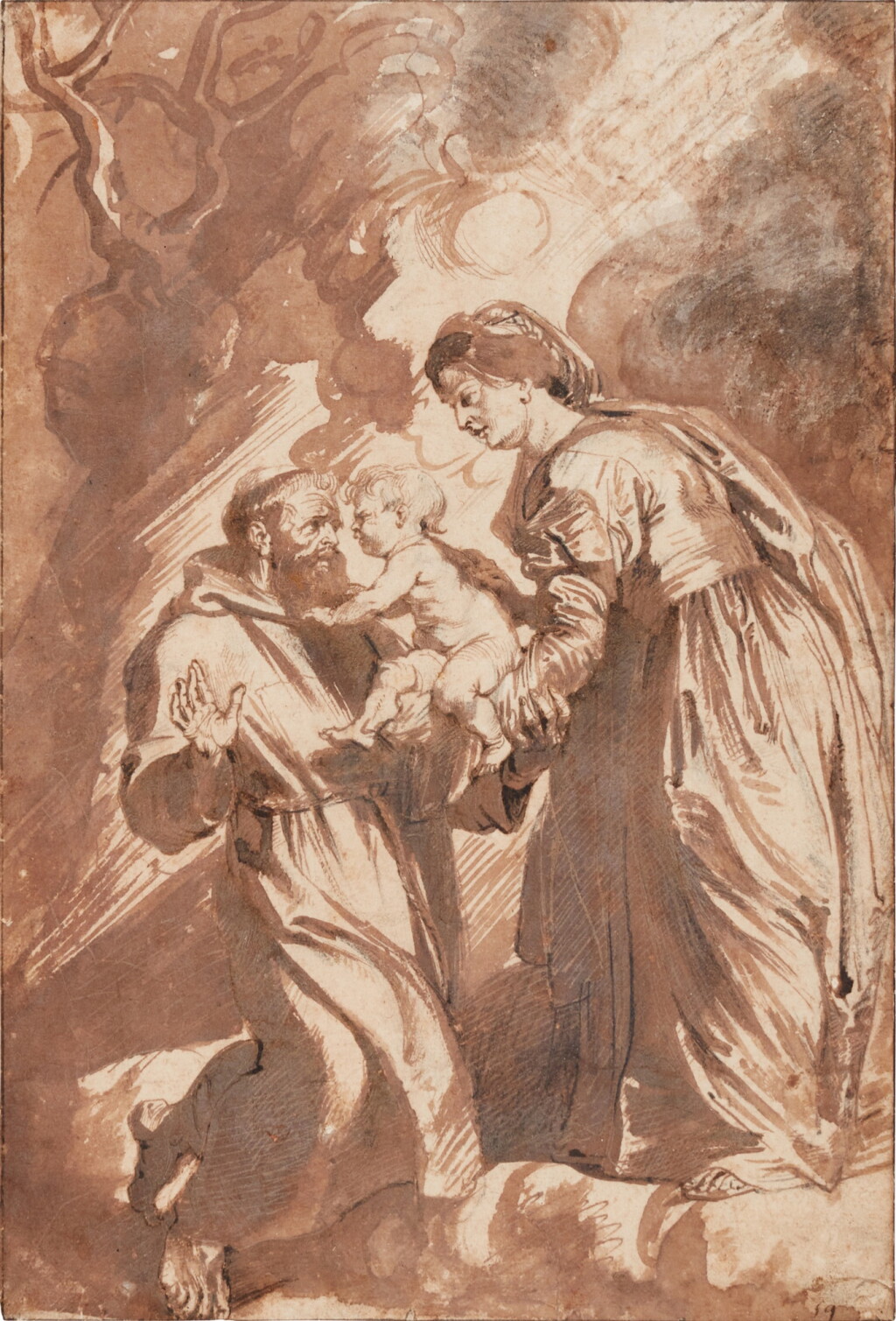
St. Francis of Assisi receiving the Infant Christ
Lot Closed
February 2, 06:03 PM GMT
Estimate
15,000 - 20,000 USD
Lot Details
Description
Sir Peter Paul Rubens
1577 - 1640
St. Francis of Assisi receiving the Infant Christ
Pen and brown ink and wash over black chalk, indented for transfer;
Bears numbering in brown ink, lower right: 59
303 by 204 mm
Possibly Pierre Crozat (1665-1740), Paris (the pen numbering lower right is very similar to his: L.3621)
Bernardus de Bosch, Amsterdam, sale, 10 March 1817;
Sir Thomas Lawrence (1769-1830), London;
Charles Sackville Bale (1791-1880), London (L.640), his sale, London, Christie’s, 9-14 June 1881, lot 2447;
Jacques Mathey, Paris
London, The Woodburn Gallery, The Lawrence Gallery. First Exhibition. A catalogue of one hundred original drawings by Sir P.P. Rubens Collected by Sir Thomas Lawrence, 1835, p. 21, no. 87
M. Rooses, L’Oeuvre de P.P. Rubens, Antwerp 1888, vol. 2, p. 253 (as Rubens);
J. Müller Hofstede, 'Beiträge zum zeichnerischen Werk von Rubens', Wallraf-Richartz Jahrbuch, XXVII, 1965, pp. 335-38, reproduced, fig. 237 (as Rubens);
H. Vlieghe, Corpus Rubenianum, Ludwig Burchard: Saints, VIII, London 1972-1973, vol. I, pp. 148-49, no. 95a, reproduced, fig. 168 (as Rubens)
The drawing is, however, even more closely related to a print, executed in 1617-18 by the relatively little known engraver Michel Lasne (circa 1590/4-1667), which, intriguingly, adapts the composition of Rubens's Lille painting only a little, but transforms the subject into a representation of a different saint, St. Francis of Paola (fig. 2). A particularly significant indicator of the change of subject is the removal of the stigmata in the Saint's hands, visible in the painting but not in either drawing or print, so the process of changing the subject had already been initiated when the present drawing was executed.
Until now, the drawing has always been published (most recently in Hans Vlieghe's 1972-3 Corpus Rubenianum volume) as an autograph work by Rubens, and even though the fact that it is extensively indented for transfer to the engraver's plate has not previously been noted, it has rightly been considered the study from which Lasne made his print (which is in reverse to the drawing). The only significant compositional differences between drawing and print are in the very broadly drawn background, in which the washes largely obscure the faintly drawn figures of the two putti, who are to be found in the upper left corner of the print. Interestingly, while the central figures in the drawing are fairly extensively indented for transfer, those two (now rather invisible) putti seem not to be.
The question, though, of who actually executed this drawing remains open, as more recent scholars do not find the handling of pen or brush to be characteristic of Rubens himself. The most straightforward explanation would be for it to be by the engraver Lasne, but it seems surprising that someone with only a rather tangential connection with Rubens would have taken the liberty of adopting and adapting one of the master's composition, changing its very subject, right under his nose, especially when the resultant image of St. Francis of Paola seems iconographically questionable, given that that saint is not recorded as having had a vision of the Virgin and Christ Child. Furthermore there are no known drawings that can be securely attributed to Lasne.1
1. A red chalk drawing with the same composition as the print discussed here, and in the same direction, is preserved as a drawing by Lasne in the Print Room at the Museum Plantin-Moretus, Antwerp (inv. PK.OT.00268), but would seem to be a copy after the print.
You May Also Like